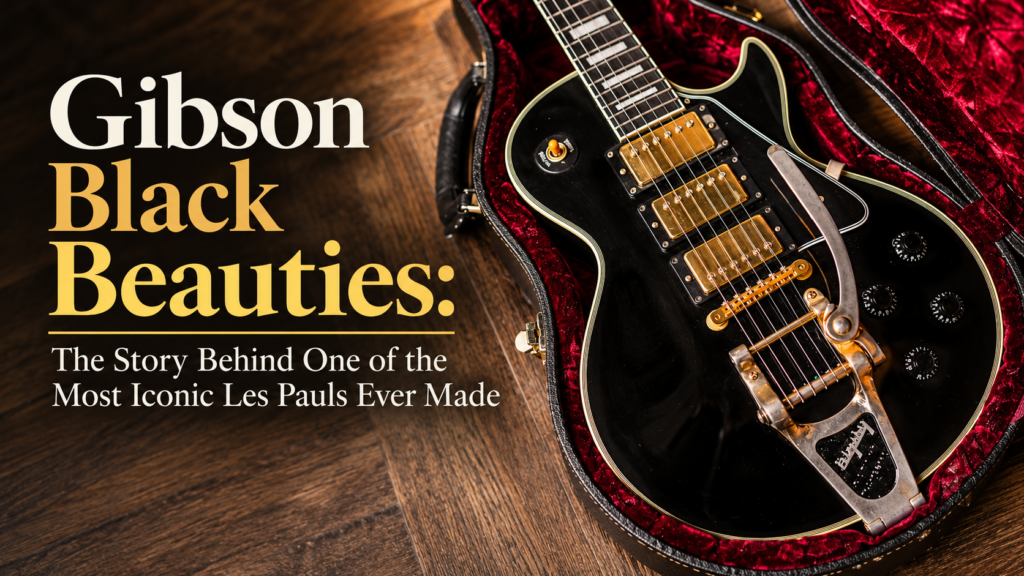
When it comes to electric guitars, few instruments make quite the same impression as a Gibson Les Paul Black Beauty. With its unmistakable black finish, elegant gold hardware and beautifully detailed binding, it’s a guitar that manages to look every bit as impressive as it sounds.
First introduced in the 1950s, the Les Paul Custom quickly established itself as one of Gibson’s most prestigious instruments. Often referred to as the ‘Black Beauty’, it became a favourite among professional musicians, collectors and guitar enthusiasts alike.
But there’s considerably more to this guitar than its striking appearance. From its unusual beginnings to its place in rock history, the Black Beauty has an interesting story worth exploring.
So, what makes the Gibson Black Beauty so special, and why does it continue to attract so much attention nearly 70 years after its introduction?
Let’s take a closer look.
The Origins of the Gibson Black Beauty
The story of the Black Beauty begins in 1954, when Gibson introduced the Les Paul Custom as a more luxurious alternative to the original Les Paul Goldtop.
While the Goldtop had already established itself as a hugely popular solid-body electric guitar, Gibson wanted something that would sit at the very top of its range.
The result was an instrument with a distinctly more sophisticated appearance.
Designed with input from Les Paul himself, the new Custom featured an all-black finish intended to resemble a formal tuxedo. The idea was simple but effective: a guitar that looked elegant under stage lighting while allowing the player’s hands to stand out against its dark finish.
The original models featured several premium appointments, including:
- A solid mahogany body and carved mahogany top
- An ebony fingerboard with mother-of-pearl block inlays
- Gold-plated hardware
- Multi-ply body binding
- A split-diamond headstock inlay
- An Alnico V staple pickup in the neck position and a P-90 in the bridge
The result was a guitar that looked considerably more expensive than its already impressive stablemates.
It also introduced the nickname that would stick for generations: the Black Beauty.
From P-90s to Humbuckers: The 1957 Evolution
One of the most important developments in the Black Beauty’s history came in 1957.
This was the year Gibson began fitting its Les Paul models with the newly developed PAF humbucking pickups, designed by Seth Lover.
The introduction of humbuckers represented a major step forward in electric guitar design. Compared with traditional single-coil pickups, they offered significantly reduced electrical interference and a thicker, fuller sound.
For the Les Paul Custom, this created an entirely new tonal character.
The original two-pickup configuration was available with humbuckers, while Gibson also offered the increasingly distinctive three-pickup version.
The three-pickup Black Beauty became particularly recognisable, with its additional middle pickup giving the guitar an unmistakable appearance.
These early examples are now among the most desirable vintage Les Pauls on the collector market.
The 1961 Disappearance and 1968 Return
Like many classic Gibson models, the Les Paul Custom underwent some significant changes during the 1960s.
In 1961, Gibson replaced the traditional single-cutaway Les Paul design with a much thinner, double-cutaway body. This eventually became the guitar we now know as the SG.
Although the Les Paul Custom name continued on the new design, the original single-cutaway Black Beauty was temporarily gone.
Fortunately for fans of the original shape, it didn’t stay away forever.
In 1968, Gibson brought back the single-cutaway Les Paul Custom, restoring the familiar silhouette that had made the guitar so popular.
There were, however, some important differences.
The reintroduced model featured a maple top over a mahogany body, rather than the all-mahogany construction of the earliest examples. It also featured two humbucking pickups as standard, although various configurations have appeared throughout the years.
This late-1960s design helped establish the foundation for many of the Les Paul Customs that followed.
What Makes a Black Beauty So Special?
There’s no shortage of beautiful electric guitars, but the Gibson Black Beauty has a combination of features that makes it particularly distinctive.
The Finish
The glossy black finish is arguably the most recognisable feature.
While other Les Paul Custom finishes have appeared over the years, including Alpine White, Wine Red and Silverburst, the traditional black version remains the definitive look.
There’s something particularly striking about the contrast between the deep black body, cream binding and gold hardware.
The Gold Hardware
Gold-plated hardware has always played an important role in the Black Beauty’s identity.
From the Tune-O-Matic bridge and stopbar tailpiece to the pickup covers and tuning machines, the gold appointments give the instrument a luxurious appearance.
It’s a relatively simple design choice, but one that has helped distinguish the Custom from other Les Paul models for decades.
The Ebony Fingerboard
Traditional Les Paul Customs are particularly well known for their ebony fingerboards.
Ebony is a dense, hard-wearing wood with a naturally dark appearance and a smooth playing surface. Combined with the familiar block inlays and bound edges, it gives the Custom a particularly refined feel.
Some modern examples use alternative fingerboard materials, depending on the model and production period, but ebony remains closely associated with the instrument.
The Pickups and Tone
Depending on the year and specification, Black Beauties can offer a surprisingly broad range of tones.
Early P-90 and staple pickup models have their own distinctive character, while later humbucker-equipped versions deliver the thick, powerful sound that many guitarists associate with the Les Paul.
Whether you’re playing blues, classic rock, hard rock or heavier styles, a well-set-up Les Paul Custom is capable of covering a considerable amount of ground.
Famous Guitarists Who’ve Played Black Beauties
The Black Beauty’s reputation has been helped considerably by the musicians who’ve taken them onto stages and into recording studios.
Some of the most notable players associated with the Les Paul Custom include:
Peter Frampton
Peter Frampton is closely associated with his famous 1954 three-pickup Les Paul Custom, affectionately named ‘Phenix’.
The guitar was believed to have been lost in a plane crash in 1980, only to be rediscovered decades later. Its remarkable story has made it one of the most recognisable individual Les Paul Customs in existence.
Jimmy Page
Best known for his legendary Les Paul Standards, Jimmy Page also owned and played a 1960 three-pickup Les Paul Custom.
The guitar became an important part of his early musical career, adding another interesting chapter to the history of the Black Beauty.
Randy Rhoads
Although often associated with his distinctive white Les Paul Custom, Randy Rhoads helped demonstrate just how versatile the Custom design could be.
His playing combined classical influences with the emerging heavy metal sound of the early 1980s, making him one of the most influential guitarists of his generation.
Zakk Wylde
Zakk Wylde is perhaps one of the most recognisable modern Les Paul Custom players.
His famous bullseye-finished Customs, often fitted with active EMG pickups, have become synonymous with his powerful playing style and distinctive stage presence.
Vintage vs Modern Gibson Black Beauties
For anyone considering owning a Black Beauty, one of the biggest questions is whether to go vintage or modern.
Both have plenty to offer, but there are some important differences.
Vintage Black Beauties
Original 1950s examples are among the most sought-after Gibson electric guitars ever produced.
Their historic significance, original construction methods and relatively limited availability make them particularly desirable to collectors.
Of course, condition, originality, provenance and year of manufacture can have a considerable influence on their value.
A genuine 1950s Black Beauty in excellent original condition is a very different proposition from a heavily modified or refinished example.
Modern Black Beauties
Modern Gibson Les Paul Customs offer the familiar appearance and playing experience while benefiting from contemporary manufacturing techniques and components.
Gibson USA and the Gibson Custom Shop have produced numerous versions over the years, including historically inspired reissues and more modern interpretations.
For players who want the classic Black Beauty look without the considerable expense and responsibility of owning a vintage instrument, these can be excellent alternatives.
Custom Shop examples are particularly interesting, with many designed to recreate specific historical specifications and finishes.
Are Gibson Black Beauties Good Investments?
It’s difficult to discuss vintage Gibson guitars without mentioning their collectability.
Original 1950s Les Paul Customs have become highly desirable instruments, with particularly rare examples attracting considerable interest from collectors around the world.
However, it’s important to remember that not every Black Beauty will necessarily increase in value.
Factors such as originality, condition, rarity, provenance and market demand all play an important role.
For collectors, an untouched vintage example with documented history can be particularly appealing.
For players, however, the real attraction might simply be owning and enjoying one of Gibson’s most iconic designs.
After all, guitars are made to be played, and there’s something special about picking up an instrument with such a rich musical history.
Final Thoughts: An Enduring Gibson Classic
Few guitars have maintained their appeal quite like the Gibson Les Paul Black Beauty.
From its introduction in 1954 to the countless variations produced over subsequent decades, the Les Paul Custom has remained a symbol of quality, craftsmanship and timeless design.
Its distinctive appearance is instantly recognisable, while its range of pickup configurations and construction styles has helped it find a home in almost every corner of popular music.
Whether you’re drawn to the rare early models, the three-pickup Customs of the late 1950s or a modern Custom Shop reissue, there’s plenty to appreciate.
And while plenty of guitars have come and gone over the years, the Black Beauty remains one of those rare instruments that never seems to go out of fashion.
Sometimes, getting the design right really is all it takes.