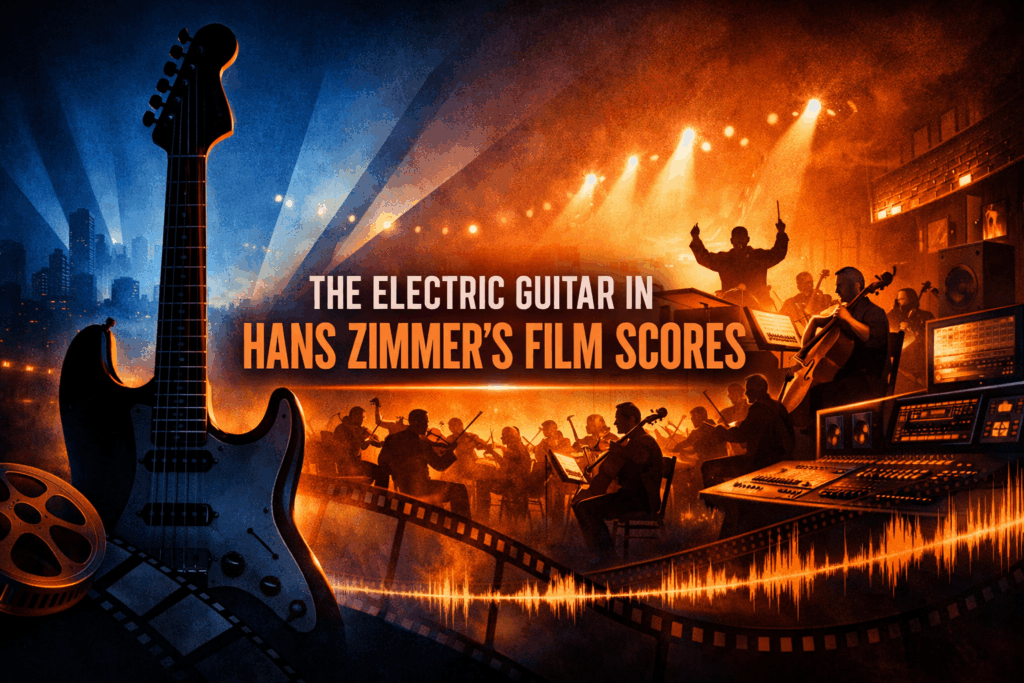
In the early days of cinema, orchestras were the undisputed backbone of film music. Sweeping strings, heroic brass, and delicate woodwinds shaped the emotional language of Hollywood for decades. Yet in the hands of composer Hans Zimmer, the film score evolved into something much broader. Zimmer didn’t abandon the orchestra — instead, he fused it with modern technology, synthesizers, and perhaps most unexpectedly, the electric guitar.
Across several iconic soundtracks, the electric guitar became one of Zimmer’s most powerful tools for adding texture, emotion, and raw intensity to cinematic storytelling.
From Orchestra to Hybrid Scores
Zimmer rose to prominence in the late 1980s and early 1990s, bringing a new “hybrid” approach to scoring — blending traditional orchestration with electronic instruments and modern production techniques. Films like Rain Man and The Lion King showcased his ability to create distinctive sonic worlds, but it was later projects that pushed his sound further into rock territory.
Zimmer has long treated the orchestra like a band, encouraging experimentation with unconventional instruments. In that context, the electric guitar naturally found its place — not as a novelty, but as a core expressive voice.
The Dark Knight Trilogy: Electric Guitar as Atmosphere
Perhaps the most famous example of Zimmer’s guitar work appears in Christopher Nolan’s The Dark Knight Trilogy.
Working alongside composer James Newton Howard, Zimmer crafted a score that captured the chaos and menace of Gotham City. Electric guitars were layered into the soundscape to create gritty tension and sonic aggression, especially in themes associated with the Joker.
Instead of traditional melodic guitar playing, Zimmer often used drones, distorted textures, and sustained feedback, transforming the guitar into something closer to a cinematic sound design tool.
The result was a score that felt modern, dangerous, and emotionally volatile — perfectly matching the darker tone of Nolan’s Batman films.
The Power of Collaboration: Johnny Marr and Modern Guitarists
Zimmer frequently collaborates with world-class guitarists to bring his sonic ideas to life. One of the most notable is Johnny Marr, whose distinctive playing appears across multiple Zimmer scores.
Marr’s guitar work can be heard in soundtracks such as:
- Inception
- The Amazing Spider-Man 2
- The Dark Knight Rises
Rather than traditional rock solos, Marr’s contributions often involve textural playing — shimmering chords, rhythmic pulses, and atmospheric lines that blend seamlessly with synthesizers and orchestral arrangements.
Zimmer’s philosophy is clear: the guitar is not just a lead instrument, but a component of the orchestral palette.
Interstellar: Guitar as Cosmic Texture
In Interstellar, Zimmer moved away from heavy guitar presence, focusing instead on church organ and minimalist orchestration. Yet subtle electric guitar textures still appear in parts of the score, helping create a sense of scale and tension.
The guitar here functions less like a rock instrument and more like a synthesizer with strings, capable of swelling ambient sounds that blur the boundary between electronic and acoustic music.
Dune and the Evolution of Cinematic Guitar
Zimmer pushed the boundaries even further with his score for Dune. While the soundtrack is famous for its experimental vocals and unusual instruments, guitars still play a role in shaping the film’s sonic identity.
Distorted tones, unusual tunings, and heavily processed guitar sounds are used to create a harsh, alien atmosphere — proving once again that Zimmer views the electric guitar not as a stylistic cliché, but as a tool for world-building.
Why the Electric Guitar Works in Film Scores
The electric guitar has unique characteristics that make it incredibly useful for film composers:
1. Emotional intensity
Distortion and sustain allow guitars to express anger, tension, and urgency.
2. Sonic flexibility
Effects pedals, amplification, and studio processing can turn the guitar into anything from a whisper to a wall of sound.
3. Cultural familiarity
Because audiences associate guitars with rock music, they immediately evoke energy, rebellion, and modernity.
Zimmer understands this deeply, using the instrument to bridge the gap between classical scoring and contemporary sound design.
A New Voice for Modern Cinema
Hans Zimmer’s work helped redefine what film music could sound like. By embracing the electric guitar alongside orchestra and electronics, he created scores that feel both epic and contemporary.
Today, many composers follow the hybrid path he pioneered — blending guitars, synths, and orchestral instruments into cinematic soundscapes.
For guitar enthusiasts, it’s a reminder that the instrument’s influence stretches far beyond rock stages and recording studios. In the right hands, an electric guitar can shape entire worlds — even galaxies — on the silver screen.