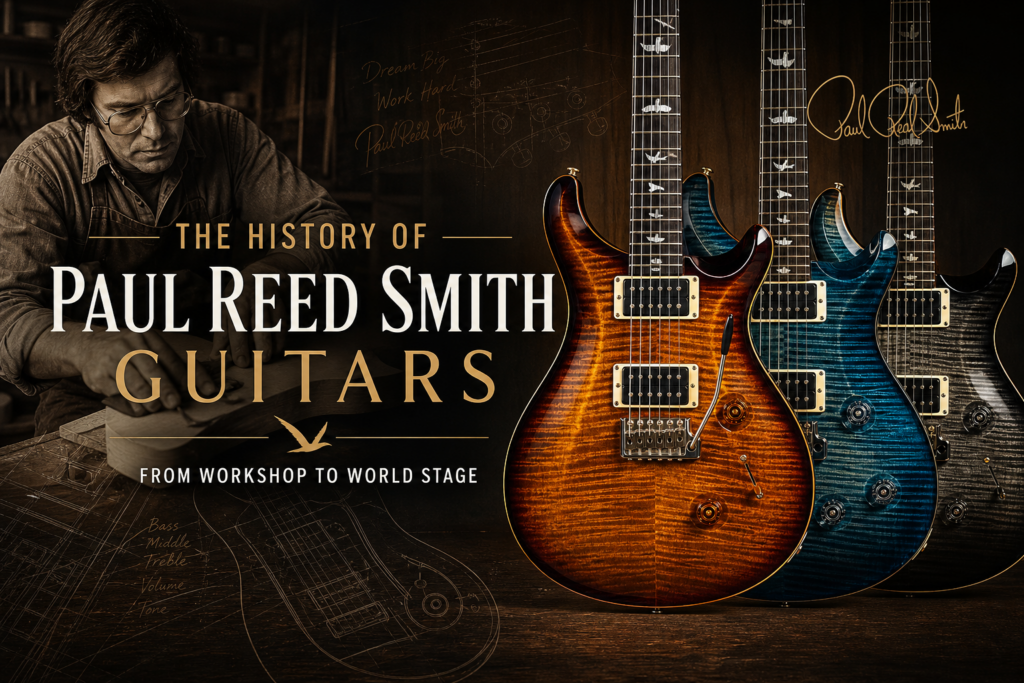
Few modern guitar brands have achieved the balance of craftsmanship, innovation, and mass appeal quite like Paul Reed Smith. Sitting comfortably between the heritage-heavy worlds of Fender and Gibson, PRS carved out its own identity—one built on precision, consistency, and a distinctly refined aesthetic.
A Vision Begins: Paul Reed Smith in the 1970s
The story begins with Paul Reed Smith himself. As a teenager in the early 1970s, Smith was already obsessed with improving the electric guitar. Dissatisfied with the inconsistencies he saw in production instruments, he began hand-building guitars while studying at St. Mary’s College in Maryland.
In a now well-known story, Smith would take his handmade guitars to gigs and approach established players, asking them to try his instruments. One of the most pivotal encounters came when he met Carlos Santana, who immediately recognised the quality and potential of Smith’s work. Santana’s support would become instrumental in PRS’s early success.
1985: The Birth of a Brand
In 1985, Paul Reed Smith officially launched PRS Guitars in Annapolis, Maryland. The debut lineup introduced what would become the brand’s flagship model: the PRS Custom 24.
The Custom 24 was a bold statement. It blended:
- The double-cutaway comfort reminiscent of a Strat-style guitar
- The set neck and sustain associated with Gibson designs
- A 25-inch scale length, sitting between Fender and Gibson standards
- High-output humbuckers with coil-splitting versatility
Add to that PRS’s now-iconic bird inlays, impeccable finishes, and carved maple tops, and the formula was instantly recognisable.
The PRS Identity: Precision Meets Artistry
Throughout the late 1980s and 1990s, PRS built its reputation on consistency and quality control—two things that were not always guaranteed by larger manufacturers during that era.
Key elements of the PRS identity included:
- Carved maple tops with dramatic figuring
- Mahogany bodies and necks for warmth and sustain
- Wide Thin and Wide Fat neck profiles for player preference
- Locking tuners and PRS tremolo systems for tuning stability
While traditionalists debated whether PRS guitars had enough “character,” working musicians embraced their reliability and versatility.
Expansion and Evolution: 1990s–2000s
As the brand grew, PRS expanded its lineup to appeal to a wider range of players:
- McCarty Series (1994) – Inspired by vintage designs and named after Ted McCarty, who mentored Smith
- CE Series – Bolt-on neck models offering snap and brightness
- Singlecut (early 2000s) – PRS’s take on the single-cutaway formula
PRS also became known for its limited editions and private stock instruments, showcasing extreme craftsmanship and exotic materials.
By this point, artists such as Mark Tremonti, Al Di Meola, and Dave Navarro had adopted PRS guitars, further cementing the brand’s reputation across genres.
SE Series: Opening the Doors
In 2001, PRS launched the SE (Student Edition) Series, manufactured overseas to offer more affordable instruments while maintaining PRS design principles.
This move dramatically expanded the brand’s reach. For many players, an SE model became their first experience of PRS—and often a gateway to the USA-made Core line.
The SE range proved that PRS could scale production without losing its core identity, something many boutique brands struggle to achieve.
Modern PRS: Innovation Without Compromise
Today, PRS stands as one of the most respected guitar manufacturers in the world. Its lineup spans:
- Core Series – USA-made flagship instruments
- S2 Series – More accessible USA-built models
- SE Series – High-quality import range
- Private Stock – Custom, ultra-premium builds
Recent collaborations, such as the PRS Silver Sky developed with John Mayer, show that PRS continues to evolve—blending vintage inspiration with modern precision.
Why PRS Matters
PRS didn’t just build guitars—it redefined expectations. At a time when consistency across major brands could be hit-or-miss, PRS offered:
- Reliable build quality
- Impeccable finishing
- A modern approach to classic design
They occupy a unique space: not bound by vintage purism, yet deeply respectful of it.
Final Thoughts
From a college workshop to a global powerhouse, Paul Reed Smith’s journey is a testament to what happens when obsessive attention to detail meets genuine innovation.
Whether you see them as the perfect hybrid or a category of their own, one thing is certain—PRS guitars have earned their place in the modern guitar canon.