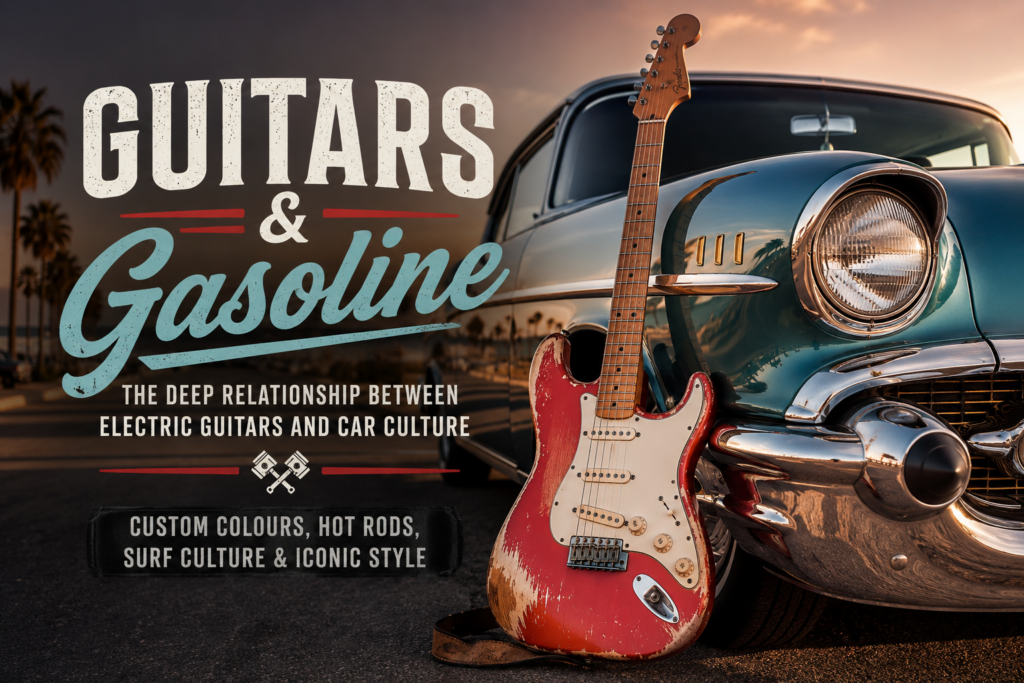
Few cultural pairings feel as natural as electric guitars and classic cars. Both represent freedom, individuality, rebellion, craftsmanship, and style. From the chrome-lined optimism of 1950s America to the candy-coloured hot rods of California and the muscle-car era of the late 1960s, the worlds of automobiles and electric guitars have long inspired one another. The connection runs far deeper than simple aesthetics too — it shaped finishes, marketing, design language, artist identity, and even the mythology surrounding the electric guitar itself.
For decades, guitar companies borrowed directly from Detroit’s colour palettes and styling trends, while musicians embraced cars as symbols of speed, youth, and escape. In many ways, the electric guitar became the musical equivalent of the American automobile: personal, expressive, loud, and endlessly customisable.
Post-War America: Chrome, Tailfins & The Birth of the Electric Guitar
To understand the relationship between guitars and car culture, it helps to look at post-war America. The late 1940s and 1950s saw massive economic growth in the United States. Car ownership exploded, suburbs expanded, highways stretched across the country, and youth culture began to emerge as a powerful commercial force.
At the same time, the electric guitar was evolving from a niche instrument into a cultural icon. Companies like Fender and Gibson were not simply building instruments — they were selling aspiration, modernity, and excitement.
Leo Fender in particular understood industrial design. The original Telecaster and Stratocaster looked radically modern compared to traditional hollow-body instruments. Their sleek contours, metallic hardware, sculpted bodies, and bold colours felt entirely in step with the automotive world emerging around them.
Southern California proved especially important. Hot rod culture, surf music, drag racing, and rock ’n’ roll all developed side by side. Fender’s factory in Fullerton sat right in the middle of this rapidly expanding car-and-youth ecosystem.
Fender Custom Colours & Detroit Inspiration
Perhaps the clearest crossover between guitar and automotive culture came through Fender’s famous custom colour finishes.
During the 1950s and early 1960s, most guitars were fairly conservative in appearance. Sunburst finishes dominated the market. But Fender embraced colour in a way that mirrored contemporary American car manufacturing.
Beginning officially in the early 1960s, Fender allowed customers to order instruments in colours borrowed directly from automobile paint catalogues — particularly those from General Motors, Ford, and Chrysler.
Some of the most iconic Fender finishes originated as automotive colours:
- Fiesta Red
- Sonic Blue
- Daphne Blue
- Surf Green
- Lake Placid Blue
- Shell Pink
- Burgundy Mist
- Candy Apple Red
- Inca Silver
- Olympic White
Many of these shades came directly from Cadillac, Lincoln, Chevrolet, and Ford automotive palettes. Candy Apple Red, for example, perfectly reflected the metallic finishes appearing on custom hot rods and show cars during the late 1950s.
These colours transformed guitars into lifestyle objects. A Stratocaster in Fiesta Red or Lake Placid Blue looked futuristic and exciting — much like the convertibles parked outside diners and drive-ins across America.
Today, these finishes remain some of the most desirable and collectible colours in vintage guitar history.
California Cool: Surf Culture, Cars & Offset Guitars
The relationship between guitars and cars became even more pronounced during the surf boom of the early 1960s.
Surf music emerged from Southern California car culture. Young musicians drove to beaches with guitars in the trunks of their cars, while hot rods and customised vehicles became central to the identity of the scene.
Fender’s offset models — particularly the Fender Jazzmaster and Fender Jaguar — perfectly captured this aesthetic. Their futuristic shapes looked almost automotive in design, with sweeping curves and chrome hardware resembling dashboard trim and tailfin-era styling.
Bands associated with surf culture often posed with cars in promotional photographs, while guitar advertisements increasingly borrowed the visual language of automotive marketing. Speed, motion, freedom, and youth became recurring themes.
Even the names of certain finishes sounded automotive:
- Ice Blue Metallic
- Shoreline Gold
- Firemist Silver
- Ocean Turquoise Metallic
These weren’t accidental choices — they were designed to evoke the same emotional response as a showroom floor full of polished American cars.
Hot Rod Culture & Guitar Modification
Customisation sits at the heart of both guitar culture and car culture.
Hot rod enthusiasts modified engines, suspensions, paintwork, and interiors to create unique machines. Guitarists did exactly the same thing with their instruments.
By the late 1960s and 1970s, players were:
- Swapping pickups
- Refinishing bodies
- Adding racing stripes
- Installing aftermarket hardware
- Modifying electronics
- Personalising instruments with stickers and graphics
Perhaps the ultimate example is Eddie Van Halen and his legendary Frankenstrat. With its striped paintwork inspired partly by racing aesthetics and hot rod graphics, the guitar looked less like a traditional instrument and more like a heavily customised muscle car.
Likewise, players such as Rick Nielsen, George Lynch, and many glam-metal musicians embraced bold graphics, flames, stripes, and neon colours that felt directly descended from custom automotive paint culture.
Muscle Cars, Rock Music & The 1970s
The 1970s cemented the visual connection between hard rock and American muscle cars.
Album covers, stage shows, and guitar finishes increasingly embraced aggressive styling. Black guitars with chrome hardware echoed blacked-out muscle cars, while gold hardware and metallic finishes mirrored luxury automotive trends.
Bands regularly referenced cars in their music:
- “Little Deuce Coupe”
- “Hot Rod Lincoln”
- “Radar Love”
- “Panama”
- “Highway Star”
The road itself became part of rock mythology. Touring bands spent endless hours in vans, buses, and cars, reinforcing the symbolic connection between driving and music.
Guitar advertising also evolved. Manufacturers increasingly sold instruments not as refined musical tools, but as expressions of identity and attitude — exactly the same approach used by car companies.
Custom Shops & Bespoke Culture
Modern guitar custom shops owe something to bespoke automotive culture too.
Companies like Fender Custom Shop and Gibson Custom Shop now offer:
- Relic finishes
- Bespoke paint colours
- Racing stripes
- Aged hardware
- Hand-built specifications
- One-off custom creations
This mirrors the world of custom garages and coach-built automobiles, where individuality and craftsmanship matter as much as performance.
Collectors often discuss guitars in remarkably similar language to classic cars:
- Original finish
- Matching numbers
- Factory colour
- Modifications
- Patina
- Restoration quality
Even the value structure feels similar. Rare colours, originality, and provenance dramatically affect desirability in both worlds.
Why The Connection Still Matters
The guitar-and-car relationship remains powerful because both objects represent more than simple utility.
Neither a vintage Stratocaster nor a classic Mustang is merely practical. They are emotional objects tied to identity, memory, aspiration, and self-expression.
Both also occupy a fascinating space between industrial manufacturing and personal artistry. They are mass-produced objects that people develop deeply personal relationships with.
That emotional connection explains why vintage custom-colour guitars command such attention today. A faded Sonic Blue Stratocaster or a Burgundy Mist Jazzmaster doesn’t simply look beautiful — it evokes an entire era of American optimism, design, and youth culture.
The Legacy of Colour & Style
Modern guitar companies continue to embrace automotive influence:
- Metallic finishes remain hugely popular
- Racing stripes still appear on signature models
- Retro pastel colours are constantly reissued
- Relic ageing mimics vintage automotive patina
- Boutique builders often reference hot rod culture directly
Even outside America, the influence spread globally. Japanese manufacturers during the 1980s embraced neon finishes and futuristic styling inspired by sports cars and performance culture, while modern boutique builders frequently draw from café racer motorcycles and vintage European automobiles.
Ultimately, the relationship between guitars and cars persists because both symbolise the same thing: individuality in motion.
Whether it’s a Fiesta Red Stratocaster under stage lights or a vintage muscle car gleaming under petrol station neon, both tap into the same enduring fascination with style, freedom, and the thrill of the open road.