Introduction
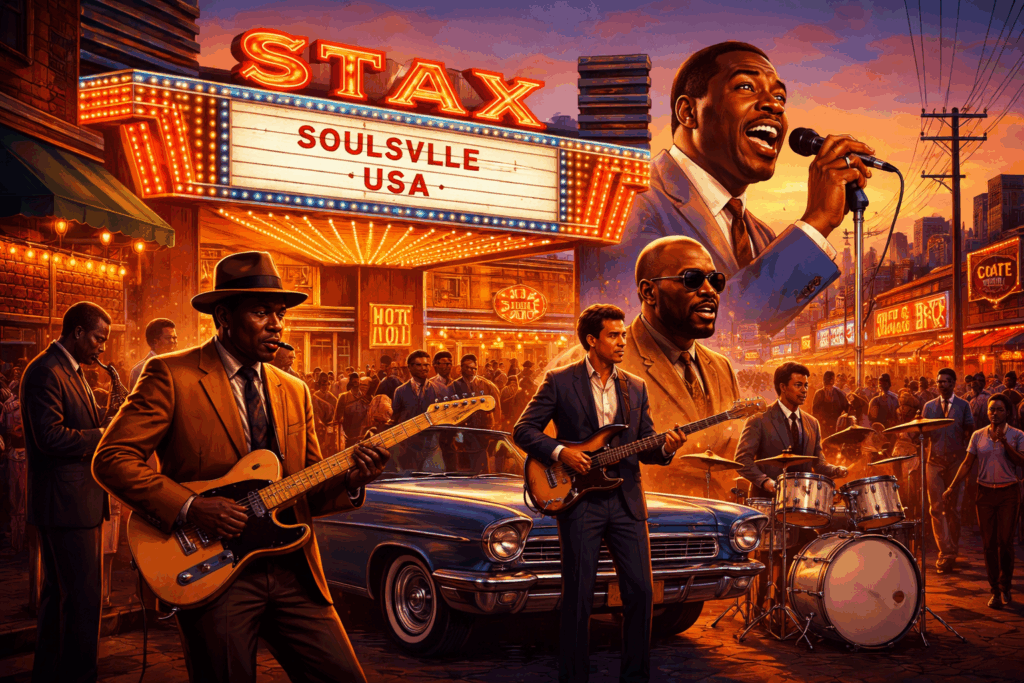
Few record labels have shaped the sound, spirit, and cultural identity of American music quite like Stax Records. Born in the heart of Memphis, Tennessee, Stax didn’t just produce records—it captured a feeling. Raw, emotional, and deeply human, the Stax sound became the backbone of Southern soul and a defining voice of the 1960s and early ’70s.
For guitar lovers, Stax is just as important as any amp or instrument brand. It’s where tone met touch, where simplicity met groove—and where feel mattered more than flash.
Humble Beginnings in Memphis
Stax Records began life in 1957 as Satellite Records, founded by siblings Jim Stewart and Estelle Axton. Initially focused on country and pop, the label struggled to find its identity.
Everything changed when they moved into a former movie theatre at 926 East McLemore Avenue in Memphis. The sloped floor of the old cinema created a naturally unique acoustic environment—one that would become part of the unmistakable Stax sound.
By 1961, Satellite became Stax Records (a blend of STewart and AXton), and the label began to lean into something new—something deeply rooted in gospel, blues, and rhythm & blues.
The Birth of the Stax Sound
At the core of Stax was its legendary house band: Booker T. & the M.G.’s. Featuring:
- Booker T. Jones – Hammond organ
- Steve Cropper – Fender Telecaster
- Donald “Duck” Dunn – Bass
- Al Jackson Jr. – Drums
This band didn’t just back artists—they defined the Stax sound.
Unlike the polished, orchestrated productions of Motown, Stax recordings were gritty, live, and immediate. You can almost hear the room in every track.
For guitarists, Steve Cropper is the standout figure. His playing was:
- Minimalist
- Rhythm-focused
- Deeply locked into the groove
No overplaying. No excess. Just perfect, tasteful phrasing—often on a simple Telecaster through a clean amp.
Icons of Soul
Stax became home to some of the most powerful voices in music history:
- Otis Redding – The emotional heart of soul music
- Sam & Dave – Explosive, gospel-driven energy
- Isaac Hayes – Orchestral soul innovator
- Wilson Pickett – Raw, electrifying performances
Songs like “Try a Little Tenderness”, “Soul Man”, and “Dock of the Bay” weren’t just hits—they were cultural milestones.
What made Stax special was its integrated environment. In a deeply segregated America, Stax stood out as a place where Black and white musicians worked side by side, united by music.
Stax vs Motown: Feel vs Precision
While Motown in Detroit focused on slick, radio-ready hits, Stax embraced imperfection and feel.
Motown:
- Tight arrangements
- Polished production
- Pop crossover appeal
Stax:
- Live-in-the-room recordings
- Raw emotion
- Groove-first philosophy
For guitar players, this difference is huge. Stax teaches restraint, timing, and feel—arguably the hardest skills to master.
Tragedy and Transformation
In 1967, tragedy struck with the death of Otis Redding in a plane crash. It was a devastating blow—not just emotionally, but creatively.
Soon after, Stax lost its distribution deal with Atlantic Records, and in the process, much of its back catalogue.
But Stax fought back.
Under new leadership, the label reinvented itself in the late ’60s and early ’70s:
- Isaac Hayes brought cinematic soul to the forefront (Shaft)
- The label expanded aggressively, releasing dozens of albums
- The Wattstax Festival (1972) became a defining cultural event
The Fall of a Giant
Despite its resurgence, financial struggles and distribution issues eventually caught up with Stax. In 1975, the label filed for bankruptcy.
But by then, its influence was already permanent.
Legacy: Why Stax Still Matters
Today, Stax Records stands as one of the most important chapters in music history.
For guitarists and musicians, its lessons are timeless:
- Feel beats flash
- Space is as important as notes
- Great music comes from chemistry, not perfection
The Stax sound continues to inspire players across genres—from soul and blues to indie and modern R&B.
And if you plug in a Telecaster, roll back the tone, and lock into a groove—you’re already speaking its language.
Conclusion
Stax Records wasn’t just a label—it was a moment in time where music broke barriers, captured raw emotion, and redefined what a recording could feel like.
It reminds us that sometimes, the most powerful tone isn’t the loudest or the most complex…
…it’s the one that feels right.