Few guitarists have shaped the sound, mystique, and visual identity of rock music quite like Jimmy Page. As the sonic architect behind Led Zeppelin, Page didn’t just play guitars—he chose them with purpose, each instrument becoming a key part of his evolving tone.
From the razor-sharp bite of a Telecaster to the thick, roaring sustain of a Les Paul, Page’s guitar journey mirrors the evolution of rock itself.
The Early Days: Telecaster Precision
Before the stadiums, before the mystique, there was a Telecaster.
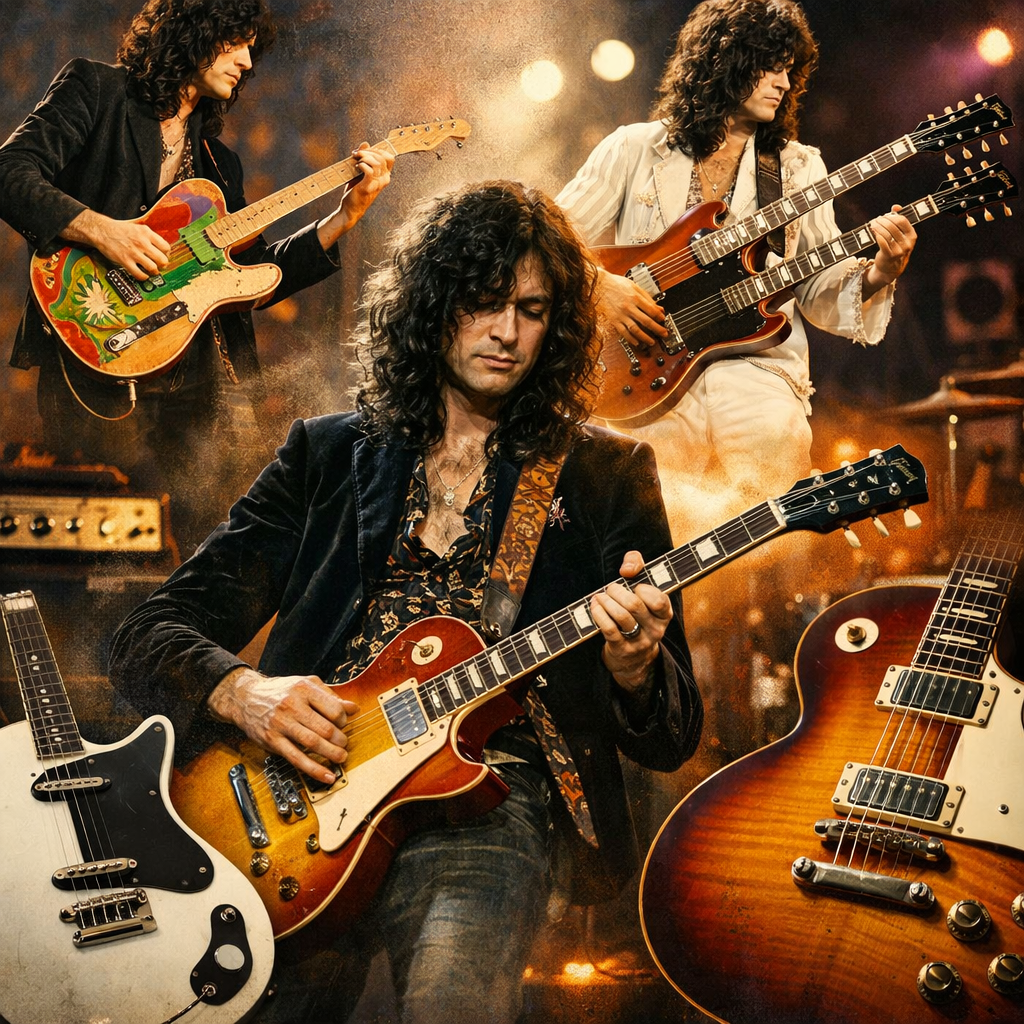
Page’s iconic “Dragon” Telecaster—a hand-painted Fender Telecaster—was originally gifted to him by Jeff Beck during their time in The Yardbirds.
This guitar became Page’s main weapon during the first Led Zeppelin album. You can hear it all over “Good Times Bad Times” and “Dazed and Confused”—bright, cutting, and incredibly articulate.
Why the Tele worked:
- Snappy attack and clarity
- Perfect for intricate riffing and studio layering
- Took pedals and studio effects exceptionally well
It’s easy to forget that one of the heaviest debut albums in rock history was largely recorded with a Telecaster.
The Shift: Enter the Les Paul
As Led Zeppelin’s sound grew heavier and more expansive, Page needed something thicker, warmer, and more powerful.
Enter the “Number One”: a 1959 Gibson Les Paul Standard.
This guitar became the Jimmy Page instrument.
What changed:
- Humbuckers delivered thicker, more saturated tones
- Greater sustain for soaring solos
- Fuller midrange for live performance power
From “Whole Lotta Love” to “Stairway to Heaven”, the Les Paul defined Page’s most recognisable tones.
Page later acquired a second Les Paul—“Number Two”—used for alternate tunings and live backup, often featuring coil splits and wiring mods that expanded tonal flexibility.
The Double-Neck Icon: Gibson EDS-1275
For live performances of “Stairway to Heaven”, Page needed to switch between 12-string and 6-string parts seamlessly.
The solution? The legendary Gibson EDS-1275.
Why it mattered:
- Eliminated the need to swap guitars mid-song
- Became one of the most iconic stage visuals in rock history
- Cemented Page’s image as both innovator and showman
Few guitars are as instantly recognisable as Page with a double-neck slung over his shoulder.
Beyond the Big Names: Danelectro & Alternate Tunings
Page wasn’t just about Gibsons and Fenders.
For songs like “Kashmir”, he turned to a Danelectro 3021.
Why the Danelectro?
- Unique, slightly hollow and jangly tone
- Ideal for droning, modal riffs
- Worked beautifully with alternate tunings
This choice highlights something crucial: Page selected guitars based on texture, not brand prestige.
Studio Sorcery: Layering and Experimentation
Beyond specific guitars, Page’s genius lay in how he used them.
- Multi-tracked guitars for orchestral depth
- Varied tunings and capo use
- Violin bow techniques for eerie textures
- Creative mic placement and production (learned during his session days)
His guitar choices were just one part of a much bigger sonic vision.
Why It Still Matters Today
Jimmy Page’s guitar journey teaches a lesson that still resonates with players and collectors alike:
The “right” guitar isn’t about hype—it’s about context.
- Telecaster = precision and bite
- Les Paul = power and sustain
- Danelectro = texture and mood
For modern players, builders, and collectors, Page’s approach is a blueprint for tonal exploration.
Final Thoughts
From the hand-painted Telecaster to the legendary Les Paul burst, Jimmy Page didn’t just play guitars—he curated sounds.
Each instrument became part of rock history, not because of what it was—but because of what he did with it.