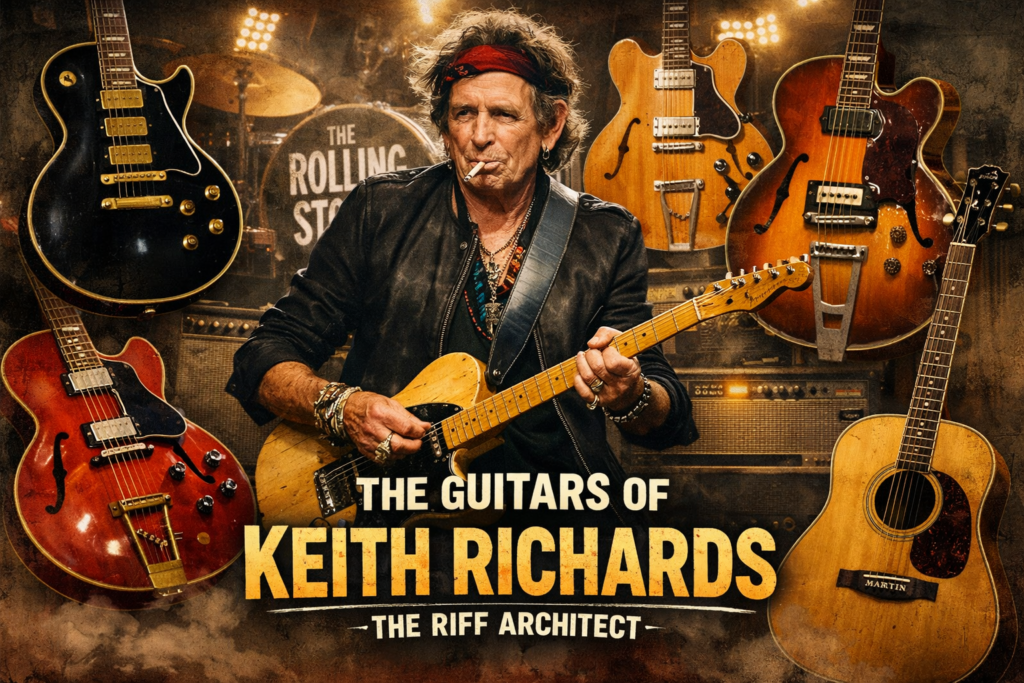
Few guitarists have defined the sound of rock ’n’ roll quite like Keith Richards. As the driving force behind The Rolling Stones’ unmistakable groove, Richards’ approach to guitar is less about virtuosity and more about feel, rhythm, and tone. Central to that identity is a collection of iconic instruments—each one tied to a specific era, tuning, or sonic evolution.
This is the story of the guitars that shaped the riffs.
The Early Years: Harmony, Epiphone & the Birth of a Sound
In the early 1960s, before stadium tours and global fame, Richards cut his teeth on modest instruments. One of his earliest notable guitars was the Harmony Meteor, a semi-hollow model that delivered a raw, woody tone perfect for the blues covers that dominated the Stones’ early sets.
He also spent time with an Epiphone Casino—a fully hollow guitar that would later become synonymous with British Invasion tones. These instruments helped shape Richards’ rhythmic style, heavily influenced by Chicago blues players and early rock ’n’ roll.
The Telecaster Era: “Micawber” and Open G Mastery
If one guitar defines Keith Richards, it’s the Fender Telecaster—specifically his legendary 1953 model known as “Micawber.”
Gifted to him by Eric Clapton, Micawber became Richards’ primary weapon from the late ’60s onward. It’s famously set up in open G tuning (D–G–D–G–B–D)—with the low E string removed—creating a punchy, percussive sound that defined classics like “Brown Sugar” and “Start Me Up.”
Richards’ Telecaster style is all about:
- Chord fragments and partial shapes
- Syncopated rhythm playing
- Interplay with a second guitarist (notably Ronnie Wood)
Other Telecasters, including his black Custom models, have rotated through his rig, but Micawber remains the cornerstone.
Gibson Les Paul Customs: The Early Rock Years
Before fully embracing the Telecaster, Richards was often seen wielding a Gibson Les Paul Custom—particularly during the late 1960s.
These “Black Beauty” Les Pauls, often with three pickups, delivered a thicker, more aggressive tone suited to the Stones’ transition from blues purists to rock innovators. This era includes landmark performances like the 1969 American tour, where Richards’ tone was heavier and more sustaining than his later Telecaster-driven sound.
Gibson ES-335 & Semi-Hollow Versatility
Richards has also leaned on the Gibson ES-335 throughout his career, particularly in studio settings.
The ES-335 offered:
- Warmth and resonance for rhythm parts
- Clarity for layered recordings
- A balance between hollow-body air and solid-body sustain
It’s a guitar that fits Richards’ role as both rhythm anchor and texture builder, especially during the Exile on Main St. era.
Acoustic Foundations: J-200, Martins & Songwriting Tools
Behind many of the Stones’ greatest songs lies an acoustic guitar. Richards frequently turned to models like the Gibson J-200 and various Martin acoustics for writing and recording.
These guitars were essential in crafting:
- The chordal foundations of songs
- Signature tunings (including open G and open D)
- The interplay between acoustic and electric layers
Richards’ songwriting often begins on acoustic, even if the final track becomes a full electric arrangement.
The Five-String Revolution: Stripping It Back
One of Richards’ most influential innovations wasn’t a guitar model—but a modification.
By removing the low E string from his Telecaster and embracing open G tuning, he created a leaner, more focused sound. This approach:
- Eliminates muddy low-end frequencies
- Encourages tighter, more rhythmic playing
- Leaves space for bass and drums
It’s a deceptively simple change that has influenced countless guitarists across rock, country, and indie music.
Amps, Pairings & the Bigger Picture
While guitars are central, Richards’ tone is also shaped by his amp choices—often pairing Fender and Ampeg amplifiers for clarity and punch. His philosophy has always prioritised feel over perfection, favouring groove and interaction over technical flash.
Legacy: The Sound of Rock Rhythm Guitar
Keith Richards’ guitar collection isn’t about excess—it’s about purpose. Each instrument serves a role in a larger musical conversation, whether it’s the chime of a Telecaster in open G or the depth of a Les Paul pushing a valve amp into saturation.
More than anything, Richards proves that great guitar playing isn’t about complexity—it’s about attitude, timing, and tone.
And sometimes, all you need is five strings and the right riff.