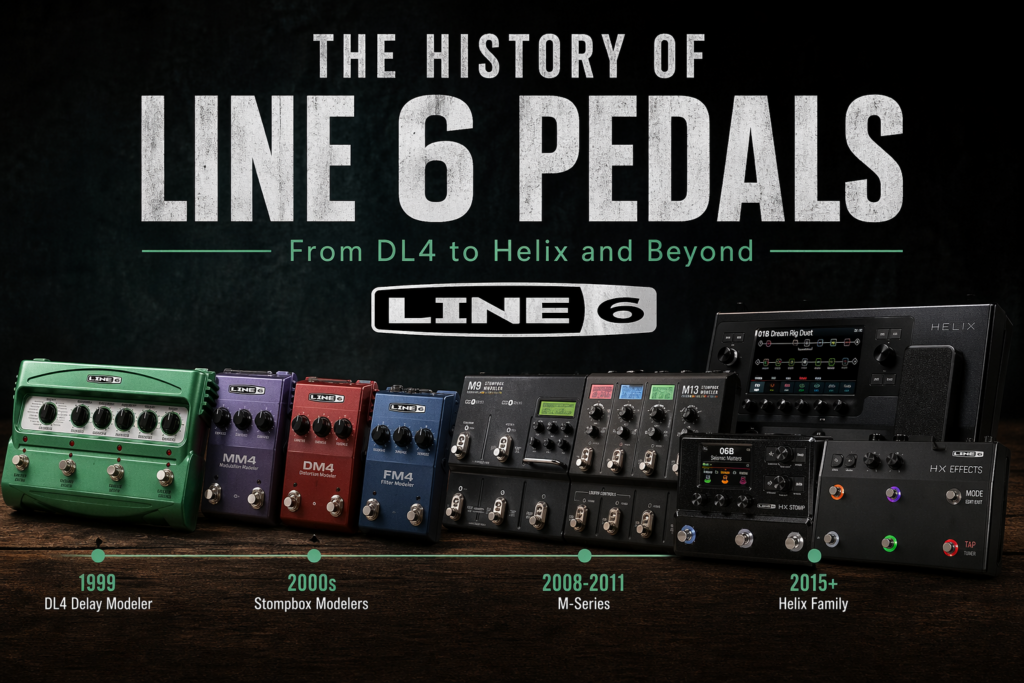
When Line 6 entered the guitar world in the late 1990s, it didn’t just release a few pedals—it fundamentally challenged how players thought about tone. At a time when analogue purism still dominated pedalboards, Line 6 leaned hard into digital modelling, offering unprecedented flexibility, affordability, and convenience. What followed was a revolution that reshaped not only effects pedals, but the entire landscape of modern guitar gear.
Origins: A New Kind of Gear Company
Line 6 was founded in 1996 by a team of engineers and musicians who saw potential in digital modelling technology. Their early success came from amp modelling—most notably the iconic Line 6 AxSys 212—but it was their move into effects pedals that truly put them on pedalboards worldwide.
Unlike traditional manufacturers, Line 6 approached gear design like a tech company. Instead of recreating one sound per unit, they asked a simple question: what if one pedal could do everything?
The DL4 and the “Stompbox Modeler” Era
In 1999, Line 6 released the now-legendary Line 6 DL4 Delay Modeler—a pedal that would become one of the most influential effects units of all time.
The DL4 wasn’t just a delay pedal. It was fifteen delay pedals in one, modelling everything from vintage tape echo to modern digital repeats. With built-in looping functionality, stereo outputs, and a robust footswitch layout, it quickly became a staple for experimental players and touring musicians alike.
Following the DL4’s success, Line 6 expanded the concept into a full range of “Modeler” pedals:
- Line 6 MM4 Modulation Modeler
- Line 6 DM4 Distortion Modeler
- Line 6 FM4 Filter Modeler
These pedals introduced guitarists to a new paradigm: one box, countless tones. While some analogue purists remained sceptical, working musicians embraced the versatility.
Tone, Flexibility, and the Rise of Digital Acceptance
By the early 2000s, Line 6 pedals were everywhere—from indie stages to arena tours. Artists such as Jonny Greenwood and Omar Rodríguez-López helped cement the DL4’s cult status, using it for everything from ambient textures to chaotic sonic experimentation.
What made Line 6 pedals so appealing wasn’t just their sound—it was their practicality. Instead of hauling multiple pedals (and worrying about power, patch cables, and reliability), players could cover huge tonal ground with a single unit.
Crucially, Line 6 helped shift the conversation. Digital effects were no longer just a compromise—they were becoming a legitimate creative tool.
The M-Series: Compact Multi-Effects for Modern Boards
Building on the success of the Modeler range, Line 6 introduced the M-Series in the late 2000s:
- Line 6 M5 Stompbox Modeler
- Line 6 M9 Stompbox Modeler
- Line 6 M13 Stompbox Modeler
These units refined the original concept, offering improved sound quality, better user interfaces, and the ability to run multiple effects simultaneously—much like a traditional pedalboard.
The M13, in particular, became a favourite for players wanting a “digital pedalboard” without diving into complex menus. It retained the immediacy of stompboxes while offering deep versatility.
Enter Helix: A New Standard in Modelling
In 2015, Line 6 raised the bar again with the launch of the Line 6 Helix platform. While Helix is best known as a full amp and effects modeller, its pedal-focused variants—such as the Line 6 HX Effects and Line 6 HX Stomp—brought studio-grade processing to pedalboards.
With advanced DSP, highly detailed modelling, and regular firmware updates, the Helix ecosystem demonstrated how far digital technology had come since the DL4 era. Effects were no longer approximations—they were increasingly indistinguishable from their analogue inspirations.
Legacy: Changing the Way We Build Pedalboards
Today, Line 6 stands as one of the most influential innovators in guitar effects history. Their pedals helped:
- Democratise access to a wide range of tones
- Normalize digital modelling in professional settings
- Inspire competitors to push digital technology further
From the green chassis of the DL4 to the sleek, modern Helix units, Line 6 has consistently challenged convention—and in doing so, expanded what’s possible for guitarists.
Final Thoughts
Love them or debate them, Line 6 pedals have earned their place in the story of the electric guitar. They didn’t just follow trends—they created them.
For players today, the idea of a compact unit delivering dozens (or hundreds) of effects is completely normal. But that expectation can be traced directly back to Line 6’s bold vision at the turn of the millennium.
And it all started with a simple idea: why settle for one sound when you can have them all?