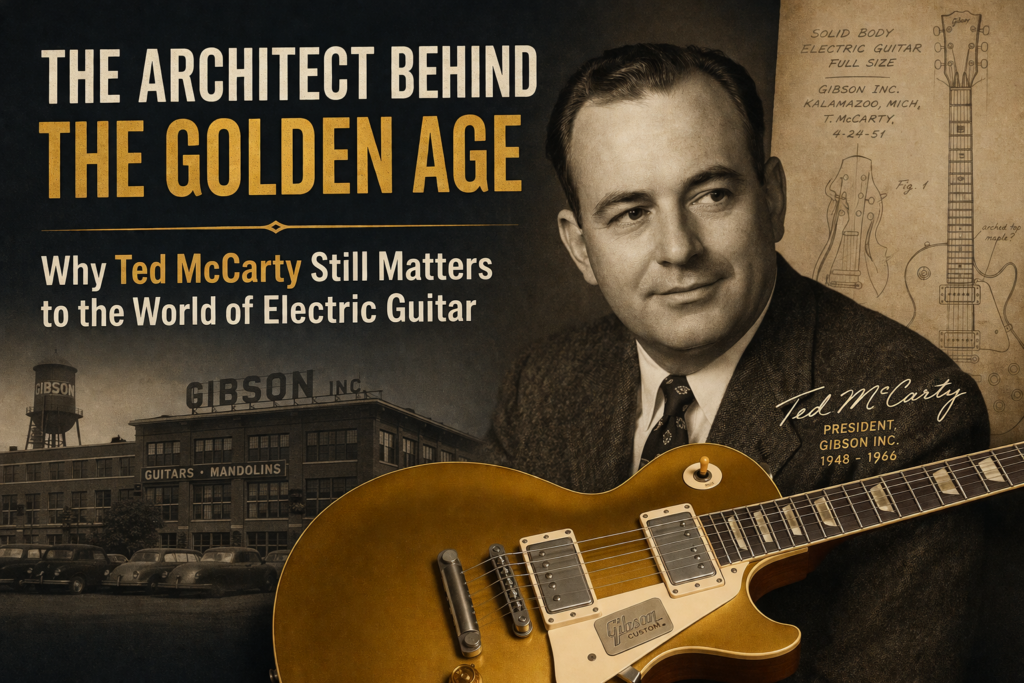
When discussing the evolution of the electric guitar, names like Les Paul, Leo Fender, and Jimi Hendrix often dominate the conversation. Yet behind many of the most iconic instruments ever created stands a less celebrated—but arguably more influential—figure: Ted McCarty.
As president of Gibson from 1948 to 1966, McCarty didn’t just oversee production—he helped define what an electric guitar could be. His impact is woven into the very DNA of the instruments players still covet, collect, and perform with today.
A Visionary in the Right Place at the Right Time
When Ted McCarty joined Gibson in the late 1940s, the electric guitar was still finding its identity. Amplification had opened new sonic possibilities, but the instrument itself hadn’t yet settled into a standard form.
McCarty approached the guitar not just as a musical tool, but as a product of design, engineering, and cultural relevance. He recognised that musicians needed instruments that could handle louder volumes, greater sustain, and evolving playing styles. Under his leadership, Gibson became a hub of innovation rather than tradition-bound craftsmanship.
The Birth of the Modern Electric Guitar
The Les Paul Model
One of McCarty’s most enduring achievements was bringing the Gibson Les Paul to market in 1952. Working alongside Les Paul himself, McCarty helped refine the concept into a production-ready instrument.
While Les Paul contributed ideas and endorsement, it was McCarty and his team who engineered the guitar into a practical, manufacturable design. Features like the carved maple top, set neck construction, and later the introduction of humbucking pickups would define the Les Paul sound—thick, sustaining, and powerful.
Today, the Les Paul remains one of the most iconic guitars ever made, used by everyone from Jimmy Page to Slash.
The Humbucker Pickup Revolution
Perhaps McCarty’s most important technical contribution was overseeing the development of the humbucking pickup, designed by Seth Lover.
Single-coil pickups, while bright and articulate, suffered from electrical hum. The humbucker solved this by using two coils wired together to cancel interference—resulting in a warmer, thicker tone with significantly reduced noise.
This innovation didn’t just improve guitars—it changed the sound of popular music, enabling higher gain tones and shaping the future of rock, blues, and beyond.
Bold Design: Flying V, Explorer, and Beyond
McCarty wasn’t afraid to take risks. In the late 1950s, Gibson introduced radical designs like the Gibson Flying V and Gibson Explorer.
At the time, these futuristic shapes were commercial failures—too ahead of their time for conservative players. But decades later, they became staples of rock and metal, embraced by artists like Albert King and James Hetfield.
This willingness to innovate—even at the risk of failure—highlights McCarty’s long-term vision.
The ES-335 and Semi-Hollow Innovation
Another landmark achievement under McCarty’s leadership was the Gibson ES-335, introduced in 1958.
By combining a hollow body’s warmth with a solid centre block to reduce feedback, the ES-335 struck a perfect balance between resonance and control. It became a go-to instrument for genres ranging from blues to jazz to rock.
Players like Larry Carlton and Chuck Berry helped cement its legendary status.
Leadership That Enabled Innovation
Ted McCarty’s genius wasn’t just in individual ideas—it was in creating an environment where innovation could thrive. He empowered engineers, listened to musicians, and understood the importance of both aesthetics and function.
Under his leadership, Gibson introduced:
- The Tune-o-matic bridge
- Stopbar tailpieces
- Improved neck joints and playability
- Production efficiencies that maintained quality
These developments may seem incremental, but together they defined the blueprint of the modern electric guitar.
Beyond Gibson: The PRS Era
Later in life, McCarty’s influence extended into the next generation of guitar building through his relationship with Paul Reed Smith, founder of PRS Guitars.
PRS’s McCarty model is named in his honour, reflecting his continued impact on guitar design philosophy well into the late 20th century.
Why Ted McCarty Still Matters
It’s easy to associate great guitars with the artists who play them—but without Ted McCarty, many of those instruments might never have existed in the form we know today.
His legacy includes:
- Shaping the core design language of electric guitars
- Enabling the development of iconic models still in production
- Driving technical innovation that expanded musical possibilities
- Balancing tradition with bold experimentation
Quite simply, Ted McCarty helped turn the electric guitar from a novelty into a cultural icon.
Final Thoughts
While Leo Fender streamlined and industrialised guitar production, Ted McCarty refined, elevated, and expanded what the instrument could be. His work at Gibson during the 1950s and early 1960s represents one of the most important periods in guitar history.
For players, collectors, and enthusiasts alike, understanding McCarty’s contributions offers a deeper appreciation of the instruments we hold—and the sounds that shaped modern music.