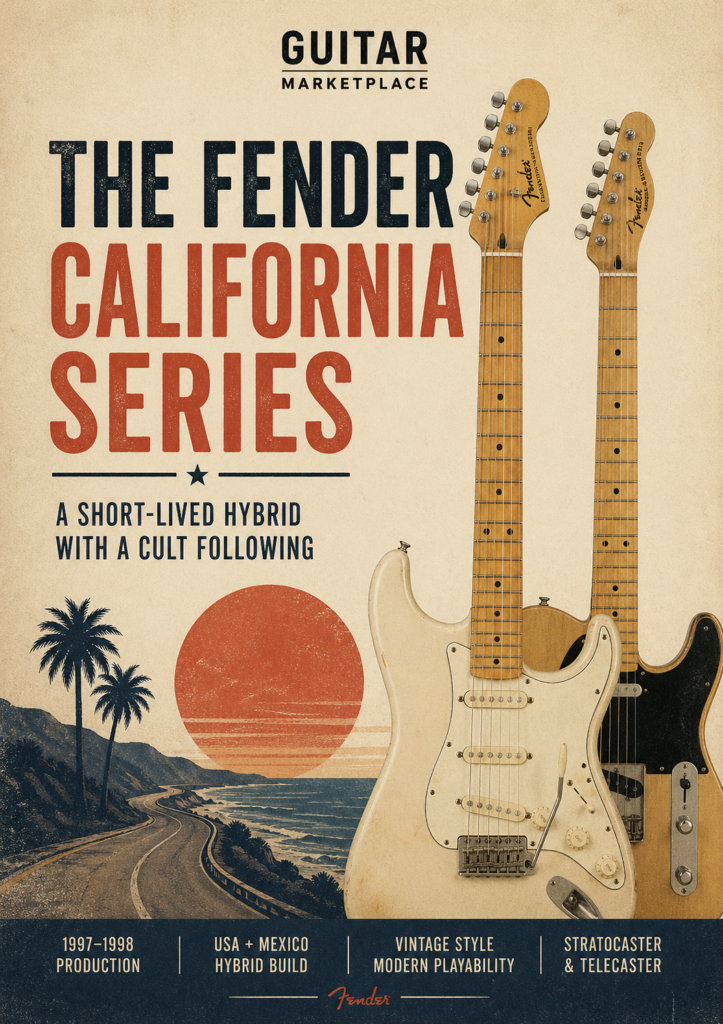
In the late 1990s, Fender found itself in a familiar position: balancing heritage with affordability. The American Standard line was strong, Mexican production was growing, and competition in the mid-price market was fierce.
The answer—albeit briefly—was the California Series.
Produced between 1997 and 1998, these guitars represent one of Fender’s more unusual manufacturing experiments: a true hybrid of USA and Mexico production, blending vintage-inspired specs with a novel cross-border build process.
Today, they’ve quietly become underrated cult favourites—especially among players who know what they’re looking at.
A Guitar Built on the Pacific Coast
The defining feature of the California Series wasn’t just its specs—it was how it was made.
Fender described the process as a “Pacific Coast Highway” collaboration:
- Bodies and necks were cut and shaped in Corona, California
- Sent to Ensenada, Mexico for finishing
- Returned to Corona for final assembly and setup
This wasn’t outsourcing in the usual sense—it was a deliberate hybrid workflow, combining:
- U.S. craftsmanship and final QC
- Mexican finishing efficiency
At a time when Fender was refining its post-CBS identity and production model, the California Series sits right in the middle of that transition.
Models in the Range
The California Series was refreshingly simple. It consisted of two core Fender staples:
- Fender Stratocaster (California Series)
- Fender Telecaster (California Series)
Both models leaned heavily into vintage aesthetics, but with subtle modern touches aimed at playability.
Stratocaster Highlights
- Alder body
- Vintage-style tremolo and tuners
- 9.5” radius neck (a modern-friendly upgrade)
- 21 medium jumbo frets
- Traditional 3-single coil or “Fat Strat” HSS configurations
Telecaster Highlights
- Alder body
- Vintage bridge with modern saddles
- “Fat Tele” humbucker option in the neck
- Medium jumbo frets for easier bending
- Classic styling with practical versatility
In short: vintage feel without vintage limitations.
Vintage DNA, Modern Feel
What made these guitars stand out was the balance.
At a time when true vintage reissues still leaned heavily toward period-correct quirks (7.25” radius, smaller frets, etc.), the California Series offered:
- Vintage looks
- Modern playability
- Accessible pricing
That 9.5” radius and medium jumbo frets made them far more approachable for contemporary players—especially those coming from modern Fender lines.
Why Was the Series So Short-Lived?
The California Series only lasted about a year—but not because it failed.
In fact, there’s a persistent belief among players that these guitars were almost too good for their price point.
Some reports suggest they:
- Competed directly with American Standard models
- Overlapped awkwardly with Fender’s existing lineup
- Blurred the lines between “Made in USA” and “Made in Mexico” offerings
From a business perspective, that kind of overlap can be more problematic than helpful.
So, quietly, the series disappeared.
Identifying a California Series Fender
For collectors and buyers, there are a few tell-tale signs:
- “Made in USA” on the headstock
- Serial numbers beginning with AMXN (with the first digit indicating the year)
- Late-‘90s production (1997–1998 only)
- Hybrid spec feel—vintage hardware with modern neck playability
They’re not especially flashy—but that’s part of their appeal.
The California Series Legacy
In hindsight, the California Series was ahead of its time.
Today, Fender regularly blends:
- Multi-country production
- Vintage aesthetics with modern specs
- Tiered pricing across global factories
But in 1997, this approach was still evolving.
The California Series represents:
- A bridge between eras
- A testbed for Fender’s global production model
- A hidden gem in the late-‘90s catalogue
Final Thoughts
The Fender California Series might not have the instant recognition of a ‘50s reissue or a Custom Shop build—but that’s exactly why it’s interesting.