Introduction
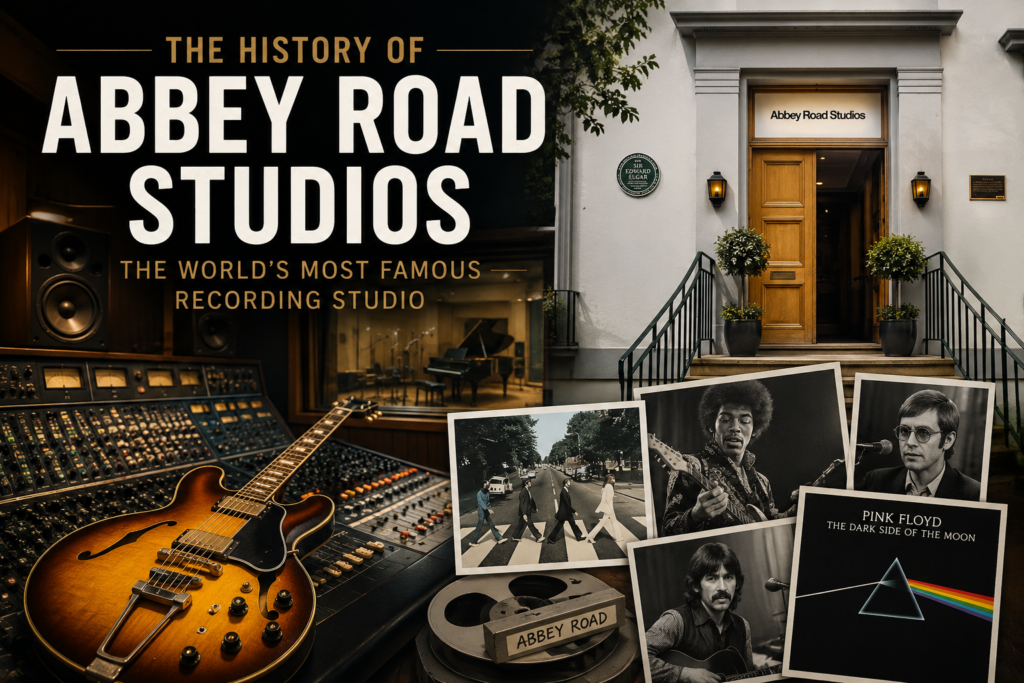
Few buildings in music history are as instantly recognisable as Abbey Road Studios. Situated at 3 Abbey Road in St John’s Wood, London, the studio has become synonymous with innovation, artistry, and some of the greatest recordings ever made. From the orchestral sessions of the 1930s to groundbreaking albums by The Beatles, Pink Floyd, Radiohead, Oasis, and countless others, Abbey Road has become far more than a recording facility — it is a cultural landmark.
For guitar players, producers, and music lovers alike, Abbey Road represents the pinnacle of studio recording history. The sounds created within its walls have shaped generations of musicians and continue to influence modern recording techniques today.
The Early Years
Abbey Road Studios officially opened in November 1931 as EMI Recording Studios. The building itself had originally been a Georgian townhouse before EMI transformed it into one of the world’s first purpose-built recording facilities.
At the time, the idea of a dedicated recording studio was revolutionary. Most recordings during the 1920s had been captured in makeshift rooms or adapted performance spaces, but EMI envisioned something entirely different — a technically advanced environment specifically designed for capturing music at the highest possible quality.
The facility initially focused on classical music and orchestral recordings. Early sessions featured artists such as Sir Edward Elgar, who conducted recordings of his own compositions at the studio shortly after it opened. These early classical recordings helped establish Abbey Road’s reputation for sonic excellence long before the arrival of rock and roll.
The studio complex was divided into several rooms, but Studio One quickly became renowned for its enormous size and acoustics, making it ideal for orchestral work. Even today, Studio One remains one of the largest purpose-built recording spaces in the world.
The Beatles and Abbey Road’s Global Fame
Although Abbey Road was already respected within the recording industry, it was The Beatles who transformed the studio into a global icon.
Beginning in 1962, The Beatles recorded almost all of their material at Abbey Road alongside producer George Martin and engineers such as Geoff Emerick and Norman Smith. The relationship between the band and the studio became one of the most important collaborations in music history.
Over the course of the 1960s, Abbey Road became a laboratory for sonic experimentation. The Beatles and the studio staff constantly pushed the boundaries of what was technically possible, pioneering recording techniques that are still used today.
Albums such as:
- Please Please Me (1963)
- A Hard Day’s Night (1964)
- Revolver (1966)
- Sgt. Pepper’s Lonely Hearts Club Band (1967)
- The White Album (1968)
- Abbey Road (1969)
were all largely created within the walls of the studio.
The sessions for Sgt. Pepper’s Lonely Hearts Club Band in particular changed recording forever. Tape loops, automatic double tracking, backwards guitar solos, orchestral overdubs, and experimental microphone placement all became part of Abbey Road’s identity.
For guitar enthusiasts, many legendary tones were captured during these sessions. George Harrison’s Epiphone Casino, John Lennon’s Rickenbacker 325, and Paul McCartney’s Hofner bass became inseparable from the sound of Abbey Road.
Perhaps most famously, the cover photograph for Abbey Road turned the zebra crossing outside the studio into one of the most visited music landmarks on Earth.
The Equipment That Defined an Era
Part of Abbey Road’s legendary sound came from the studio’s engineering department. EMI designed and built much of its own recording equipment during the 1950s and 1960s, including custom valve mixing consoles, compressors, microphones, and tape machines.
The REDD desks used throughout the Beatles era remain some of the most coveted recording consoles ever made. Combined with Studer tape machines and expertly treated recording rooms, these tools helped create the warm, rich analogue sound associated with classic British recordings.
Abbey Road also became known for its microphone collection. Neumann U47s, AKG D19s, STC ribbon microphones, and vintage valve microphones were used extensively throughout the 1960s and 1970s.
The studio’s engineers were often forced to innovate due to strict EMI technical rules. Ironically, those limitations encouraged creative solutions that helped define the sound of modern popular music.
Pink Floyd and Progressive Rock Innovation
Following The Beatles, Abbey Road continued to evolve throughout the 1970s as progressive rock exploded in popularity.
Pink Floyd became one of the studio’s most important artists during this era. The band used Abbey Road extensively while creating The Dark Side of the Moon (1973), one of the best-selling albums of all time.
The album showcased Abbey Road’s growing technical sophistication. Advanced multitrack recording, tape manipulation, synthesiser layering, and complex sound design all played a crucial role in the album’s immersive atmosphere.
Tracks such as “Time” and “Money” demonstrated how the studio itself had become an instrument.
Pink Floyd later returned to Abbey Road for additional projects, cementing the studio’s reputation as a home for ambitious and experimental music.
Film Scores and Orchestral Recordings
While rock music often dominates conversations about Abbey Road, the studio has also played an enormous role in film music.
Studio One became especially important for orchestral soundtrack recording thanks to its vast size and natural acoustics.
Legendary film scores recorded at Abbey Road include:
- Star Wars
- Raiders of the Lost Ark
- Harry Potter
- The Lord of the Rings
- The Hobbit
- Skyfall
- Black Panther
Composers such as John Williams, Hans Zimmer, Howard Shore, and Alexandre Desplat have all utilised the studio.
The combination of world-class acoustics, elite session musicians, and cutting-edge recording technology made Abbey Road one of the premier destinations for cinematic music.
Abbey Road in the Modern Era
Unlike many historic studios that struggled during the transition to digital recording, Abbey Road successfully adapted.
Throughout the 1990s and 2000s, artists continued flocking to the studio to capture its unmistakable atmosphere and sonic character.
Acts including:
- Oasis
- Radiohead
- Adele
- U2
- Muse
- Florence + The Machine
- Ed Sheeran
- Arctic Monkeys
all recorded material at Abbey Road.
Radiohead’s sessions for The Bends and orchestral work connected to later albums demonstrated that Abbey Road could still serve as a creative playground for innovative modern artists.
Oasis also embraced the studio’s heritage during the Britpop era, drawing inspiration from The Beatles while creating some of the defining British guitar music of the 1990s.
The Abbey Road Sound
What exactly gives Abbey Road its legendary sound?
Part of it comes from the rooms themselves. Every studio space has unique acoustics shaped by dimensions, wall materials, ceiling height, and room design. Studio Two in particular has become famous for its lively yet balanced ambience.
Another major factor is the staff. Abbey Road has long attracted some of the finest recording engineers, producers, and technicians in the world.
Finally, there is the intangible element of history. Musicians entering Abbey Road know they are walking into a space where some of the greatest records ever made came to life. That sense of occasion often inspires extraordinary performances.
Famous Guitars Heard at Abbey Road
Over the decades, countless iconic guitars have been recorded at Abbey Road Studios.
Some of the most famous include:
- John Lennon’s Rickenbacker 325
- George Harrison’s Gibson Les Paul “Lucy”
- George Harrison’s Rosewood Telecaster
- Eric Clapton’s Gibson ES-335
- David Gilmour’s Fender Stratocaster
- Noel Gallagher’s Epiphone Riviera
- Jonny Greenwood’s Fender Telecaster Plus
Many of the most recognisable guitar tones in recording history were captured through vintage valve amplifiers inside Abbey Road’s legendary live rooms.
Abbey Road’s Influence on Recording Culture
Abbey Road’s influence extends far beyond individual albums.
The studio helped establish the producer as a creative partner rather than merely a technical supervisor. It accelerated advances in multitrack recording, tape editing, stereo mixing, and experimental sound manipulation.
Techniques pioneered at Abbey Road eventually became standard studio practice across the entire music industry.
The studio also helped shape the mythology surrounding recording itself. For many musicians, Abbey Road symbolises the dream of creating timeless music in a legendary environment.
Why Abbey Road Still Matters
More than ninety years after opening its doors, Abbey Road Studios remains one of the most respected recording facilities in the world.
In an era where music can be created almost entirely on laptops, Abbey Road continues to prove the value of world-class recording spaces, experienced engineers, and analogue craftsmanship.
The studio stands as a bridge between musical history and modern creativity. Whether capturing a symphony orchestra, a vintage guitar amplifier, or a contemporary pop vocal, Abbey Road continues to define excellence in recorded sound.
For guitar players and music fans alike, Abbey Road is more than just a building — it is one of the most important creative spaces ever built.
Final Thoughts
Very few places in music history carry the same weight and cultural significance as Abbey Road Studios. From The Beatles and Pink Floyd to blockbuster film scores and modern chart-topping artists, the studio has played a central role in shaping the sound of recorded music.
Its influence can still be heard every day on records, in films, and in the techniques used by producers around the world.
For anyone passionate about guitars, recording, and music history, Abbey Road Studios remains the ultimate symbol of what can happen when great musicians, visionary engineers, and groundbreaking technology come together in the perfect environment.