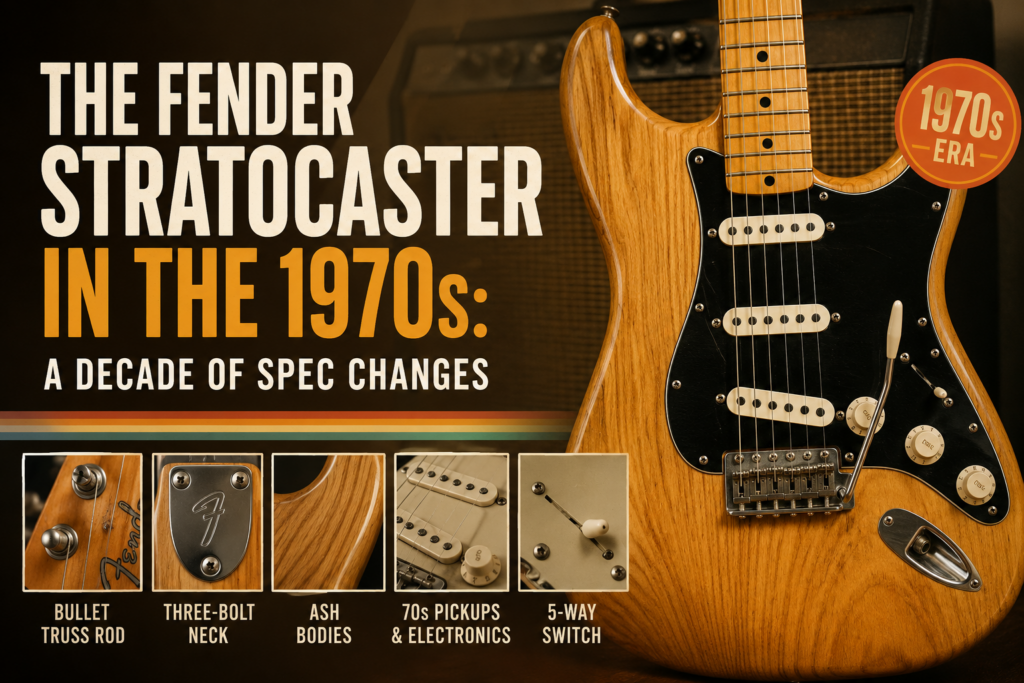
Few guitars inspire as much debate among players and collectors as the 1970s Fender Stratocaster. For some, the decade represents a low point in Fender production under CBS ownership. For others, it produced some of the most distinctive Stratocasters ever made — instruments that became synonymous with arena rock, funk, fusion and hard rock. Whatever side of the debate you fall on, the Stratocaster underwent major specification changes throughout the 1970s, many of which still influence modern Fender models today.
The 1970s were a transitional period for Fender. Manufacturing methods changed, styling became bolder, and production numbers increased dramatically. While some of these changes were driven by cost-saving measures, others reflected evolving musical trends and the demands of a new generation of guitarists.
Here is a closer look at how the Fender Stratocaster evolved throughout the decade.
The Early 1970s: The CBS Era Takes Hold
Although CBS purchased Fender in 1965, many of the larger visual and structural changes associated with “CBS-era” instruments became more pronounced in the 1970s.
By 1970, the Stratocaster already featured several changes from its pre-CBS ancestors:
- Larger headstock introduced in the late 1960s
- Bold black Fender logo
- Three-bolt neck plate beginning to appear
- Bullet truss rod adjustment
- Polyester finishes replacing thinner nitrocellulose lacquer
- Heavier ash bodies on many finishes
These guitars still retained much of the familiar Stratocaster DNA, but the feel and appearance were beginning to shift.
The Introduction of the Three-Bolt Neck
One of the most significant specification changes arrived in 1971 with the introduction of the three-bolt neck system.
Previous Stratocasters used a traditional four-bolt neck plate. Fender replaced this with a three-bolt design combined with a new “Micro-Tilt” adjustment system, intended to make neck angle adjustments easier without requiring shims.
In theory, the system was innovative. In practice, some instruments developed reputations for unstable neck joints or shifting alignment, particularly if tolerances were loose. It is important to note that not all three-bolt Strats suffer from these issues — many are excellent instruments — but the reputation became attached to the era.
The Micro-Tilt system itself survived and remains part of some modern Fender designs.
The Bullet Truss Rod
Another defining feature of the 1970s Stratocaster was the bullet truss rod adjustment nut.
Instead of adjusting the truss rod at the heel of the neck, Fender moved access to the headstock. The chrome “bullet” protruding from the headstock became one of the most recognisable visual traits of 1970s Strats.
Players appreciated the convenience of making neck adjustments without removing the neck, though aesthetically the look divided opinion.
Combined with the oversized headstock, the bullet truss rod gave 1970s Stratocasters a very distinctive silhouette.
Neck Construction and Fingerboards
Maple fingerboards became especially common during the 1970s. Fender introduced the “maple cap” neck in the late 1960s, eliminating the walnut “skunk stripe” seen on earlier one-piece maple necks.
By the mid-1970s, many Stratocasters featured:
- Maple fingerboards
- Large headstocks
- Black plastic dot markers
- Medium jumbo frets
- Satin-feeling polyester finishes
Rosewood fingerboards remained available, but maple necks became strongly associated with the visual identity of the era.
Neck profiles also varied considerably. Some guitars featured slim necks, while others had surprisingly chunky shapes. Quality consistency became one of the most discussed aspects of 1970s Fender production.
Heavier Bodies and Ash Construction
Many 1970s Stratocasters are noticeably heavier than their 1950s or 1960s counterparts.
Natural finishes became extremely popular during the decade, partly because players enjoyed seeing the wood grain beneath the finish. Fender frequently used northern ash for these guitars — a visually attractive but often very heavy wood.
As a result, some 1970s Stratocasters can exceed 10 lbs in weight.
This heavier construction contributed to:
- Strong sustain
- Bright, snappy attack
- More aggressive tonal character
However, it also led to criticism from players accustomed to lighter pre-CBS instruments.
Polyester Finishes
The 1970s saw Fender fully embrace thick polyester finishes.
Compared to earlier nitrocellulose lacquer:
- Polyester was more durable
- Easier to apply in production
- More resistant to wear and temperature changes
The downside was that these finishes were often substantially thicker, giving some instruments a harder, glossier appearance and feel.
Many players believe thick finishes affected resonance, though opinions remain divided. Regardless, the finish style became another defining characteristic of the decade.
Pickup and Electronics Changes
While Stratocaster pickups retained their familiar three single-coil layout, subtle changes occurred throughout the decade.
1970s pickups generally featured:
- Grey-bottom bobbins
- Staggered pole pieces
- Poly-coated wire
- Slightly hotter outputs in some years
Tone-wise, many 1970s Strat pickups are known for:
- Bright top end
- Glassy attack
- Tight bass response
- Pronounced clarity
These characteristics suited the music of the era perfectly, particularly funk, disco, fusion and high-volume rock.
The traditional 3-way switch remained standard throughout most of the decade. Players commonly jammed the switch between positions to achieve the now-famous “in-between” sounds. Fender would not officially introduce a 5-way selector switch until 1977.
The arrival of the 5-way switch became one of the most important practical upgrades in Stratocaster history.
Hardtail Stratocasters
Although tremolo-equipped Stratocasters remained standard, the 1970s also saw a noticeable number of hardtail Stratocasters produced.
These guitars omitted the vibrato bridge entirely in favour of a fixed bridge design.
Hardtail Strats offered:
- Increased sustain
- Greater tuning stability
- Stronger fundamental note attack
Today, many collectors actively seek out 1970s hardtail Stratocasters due to their rarity and distinctive tonal character.
The Rise of Natural Finishes and Bold Colours
1970s aesthetics differed dramatically from the custom colour culture of the early 1960s.
Popular finishes included:
- Natural
- Walnut
- Mocha Brown
- Antigua
- Olympic White
- Black
- Wine Red
Antigua remains one of the most polarising Fender finishes ever created. Originally intended to mimic natural ageing around the edges of a white guitar, it has since become highly collectible and unmistakably associated with the 1970s.
The Late 1970s: Quality Control Concerns
By the late 1970s, Fender was producing instruments in very large numbers. Quality control became increasingly inconsistent, leading to criticism regarding:
- Neck pocket fit
- Excessive weight
- Finish thickness
- Fretwork consistency
Despite this, many exceptional instruments still emerged from the factory. A good late-1970s Stratocaster can be an outstanding guitar, often delivering huge clean tones and exceptional sustain.
Players such as Ritchie Blackmore, Yngwie Malmsteen and Nile Rodgers all became strongly associated with 1970s-style Stratocaster tones.
Why 1970s Stratocasters Matter Today
For years, 1970s Stratocasters were undervalued compared to pre-CBS instruments. In recent years, attitudes have shifted considerably.
Players and collectors now appreciate these guitars for what they are rather than what they are not.
A great 1970s Stratocaster offers:
- Distinctive aesthetics
- Bright, articulate tone
- Incredible sustain
- Strong connection to 1970s rock and funk music
- Unique feel compared to earlier Strats
Modern Fender models have even revisited several 1970s features, including:
- Large headstocks
- Bullet truss rods
- Three-bolt necks
- Natural finishes
The decade may remain controversial among vintage enthusiasts, but there is no denying the influence the 1970s had on the ongoing evolution of the Fender Stratocaster.
For many players, the unmistakable look and sound of a 1970s Stratocaster represent an era when the electric guitar became bigger, louder and more visually striking than ever before.