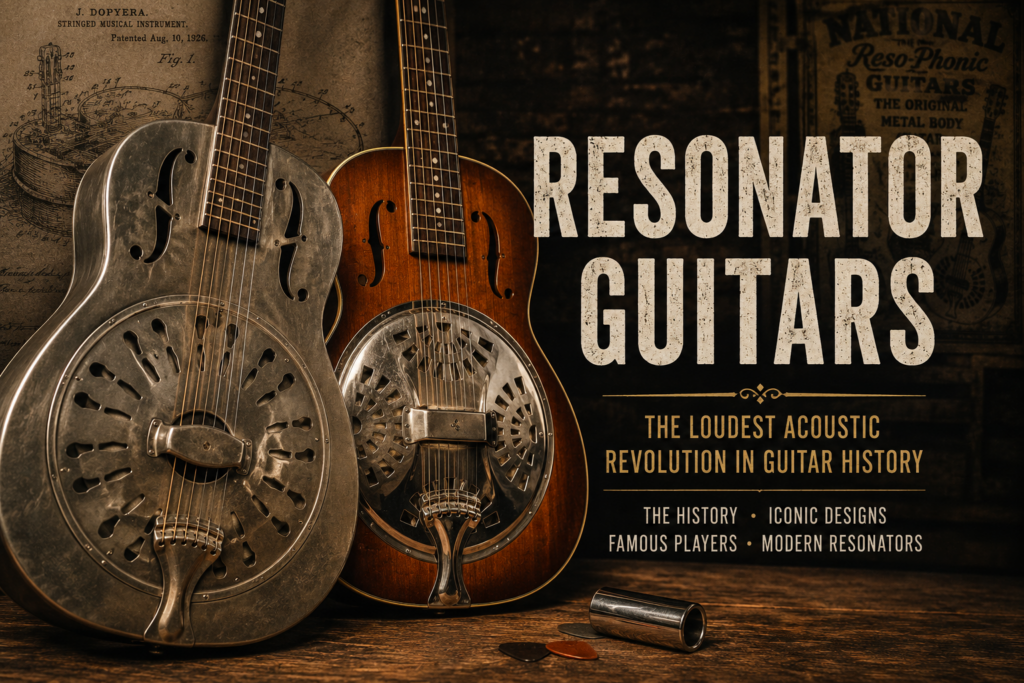
Long before electric guitars and towering valve amplifiers changed music forever, guitarists faced a simple problem: they couldn’t be heard.
In the 1920s, acoustic guitars often struggled to compete with brass sections, banjos, and percussion in dance bands and early jazz ensembles. The solution would become one of the most visually distinctive and sonically unique instruments ever created — the resonator guitar.
With their spun metal cones, metallic bark, and unmistakable projection, resonator guitars carved out a sound that became essential to blues, bluegrass, folk, country, and slide guitar music. Today, they remain some of the most characterful instruments ever built.
The Birth of the Resonator Guitar
The resonator guitar was developed during the late 1920s by Slovak-American inventor John Dopyera and musician George Beauchamp. Their goal was simple: create a guitar loud enough to cut through a full band before electric amplification existed.
Instead of relying solely on a wooden soundboard, the resonator used spun aluminium cones to mechanically amplify the strings’ vibrations. The result was dramatically louder than a traditional acoustic guitar.
The first commercially successful designs came from the National String Instrument Corporation, producing metal-bodied “tricone” resonators with three cones. Shortly afterwards, Dopyera left National and founded Dobro alongside his brothers, introducing the now-famous single-cone spider bridge design.
The word “Dobro” itself comes from “DOpyera BROthers,” though it also means “good” in Slovak.
National vs Dobro: The Two Classic Designs
When most players think of resonator guitars, they usually picture one of two classic styles:
National-Style Resonators
Typically metal-bodied with biscuit bridge cones, these instruments produce an aggressive, punchy tone with lots of midrange bite. They became closely associated with Delta blues and early slide guitar.
Dobro-Style Resonators
Usually wooden-bodied with spider bridge cones, Dobros offer a warmer and smoother sound often favoured in bluegrass and country music.
Over time, both designs became legendary in their own right.
Resonators and the Blues
Few instruments are as deeply tied to blues music as the resonator guitar.
During the 1920s and 1930s, many Southern blues musicians used resonators because their increased volume made them ideal for street performances, juke joints, and small venues without amplification.
The metallic growl and vocal-like sustain of slide guitar became a defining part of Delta blues
Famous Blues Resonator Players
- Son House
- Bukka White
- Tampa Red
- Blind Boy Fuller
- Bo Carter
Modern blues artists including Derek Trucks, Taj Mahal, and Eric Sardinas have also continued the tradition.
The resonator’s raw, expressive sound remains almost impossible to replicate with any other type of guitar.
Bluegrass, Country & The Rise of the Dobro
While metal-bodied Nationals became blues icons, wooden-bodied Dobros found a home in bluegrass and country music.
Played lap-style with a steel bar, the Dobro became a signature sound of American roots music thanks to players like Josh Graves, who helped establish the instrument as a core part of bluegrass arrangements.
The bright attack and singing sustain of a spider-cone resonator could cut through a full acoustic ensemble while still retaining warmth and clarity.
Today, the Dobro remains a staple instrument across:
- Bluegrass
- Americana
- Country
- Folk
- Acoustic rock
Famous Resonator Guitar Users
Over the decades, resonator guitars have appeared in countless legendary recordings and live performances.
Mark Knopfler
Perhaps one of the most recognisable modern users of a National resonator, famously featured on the cover of Dire Straits’ Brothers in Arms.
Eric Clapton
Used resonator guitars extensively during his acoustic blues performances, particularly during the Unplugged era.
Rory Gallagher
Frequently used National resonators for slide work and acoustic blues-inspired material.
Jerry Douglas
Widely regarded as one of the greatest Dobro players ever, helping modernise resonator guitar playing in bluegrass and beyond.
Final Thoughts
The resonator guitar represents one of the most important innovations in the history of the instrument.
Created to solve a practical problem in the 1920s, it went on to define the sound of Delta blues, bluegrass, folk, and slide guitar for generations.
From the dusty juke joints of the Mississippi Delta to modern festival stages, resonators continue to inspire players searching for something raw, expressive, and unmistakably authentic.
And once you hear that metallic bark and singing sustain, it’s easy to understand why these instruments never disappeared.