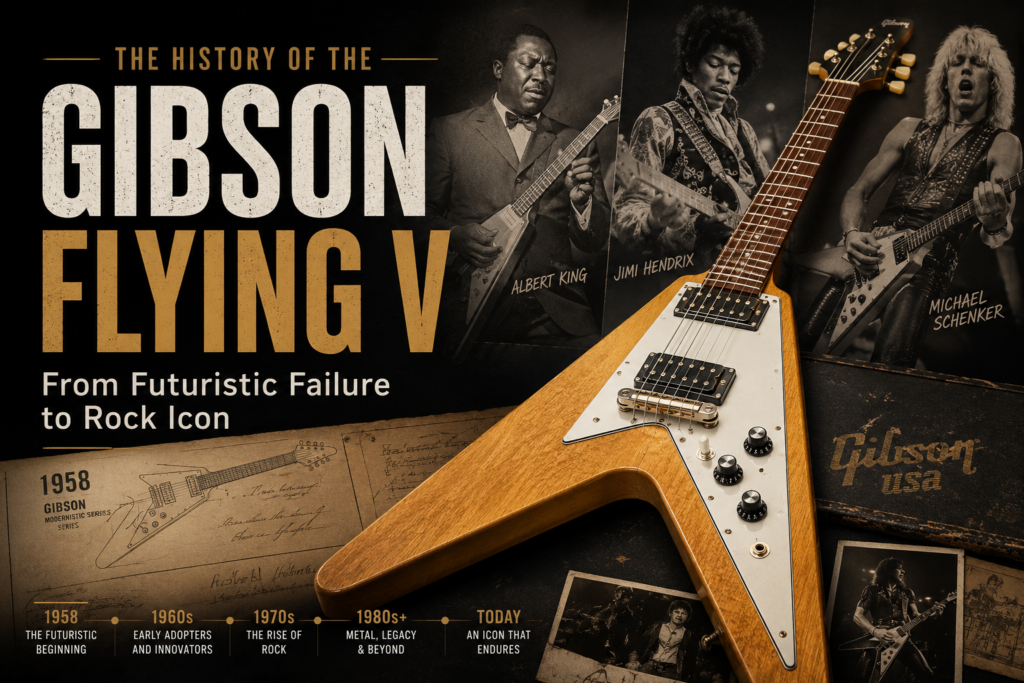
Few electric guitars are as instantly recognisable as the Gibson Flying V. With its sharp angular body, futuristic silhouette and unmistakable stage presence, the Flying V has become one of the most iconic designs in guitar history. Yet its journey to legendary status was anything but straightforward. What began as a commercial failure in the late 1950s would eventually become a defining instrument of hard rock, blues, metal and beyond.
Today, the Flying V stands as one of Gibson’s boldest creations — a guitar that challenged convention, survived decades of changing musical tastes, and ultimately became a symbol of rebellion, innovation and raw electric power.
Gibson Looks to the Future
By the mid-1950s, Gibson found itself in an unusual position. While the company had long dominated the archtop and professional guitar market, Fender was rapidly reshaping the electric guitar landscape with sleek, modern solid-body instruments like the Fender Stratocaster and Fender Telecaster.
Ted McCarty, Gibson’s visionary president during the company’s golden era, recognised that Gibson needed something radically different to compete with Fender’s futuristic appeal. Rather than imitate Fender directly, Gibson decided to push even further into modernism.
The result was a trio of experimental guitars unveiled in 1958:
- Gibson Flying V
- Gibson Explorer
- Gibson Moderne
These guitars became known collectively as Gibson’s “Modernistic” series.
Of the three, the Flying V was arguably the most daring. Its angular body shape looked more like a piece of contemporary sculpture than a traditional guitar. At a time when most players were still using conservative single-cut or hollowbody instruments, the Flying V seemed almost alien.
The Original 1958–1959 Flying Vs
The first production Flying Vs were built between 1958 and 1959 in very limited numbers. Estimates vary, but only around 80 to 100 original Korina Flying Vs were produced during the initial run.
The guitar was constructed from limba wood — commonly marketed by Gibson as “Korina.” The light-coloured timber gave the instrument a striking appearance while also contributing to its resonant and lively tonal character.
Original specifications included:
- Korina body and neck
- Two humbucking pickups
- String-through body bridge
- Large white pickguard
- Natural finish
- Slim neck profile
- 22-fret rosewood fingerboard
Visually, the guitar was unlike anything else available at the time. Commercially, however, it struggled badly.
Most players in the late 1950s simply found the design too extreme. Dealers reportedly had difficulty selling them, and many guitars sat unsold for years. Gibson discontinued the Flying V after only a short production period.
Ironically, these early “failures” would later become some of the most valuable vintage guitars in existence.
Blues Players Rediscover the Flying V
Although the Flying V disappeared from Gibson catalogues in the early 1960s, a small number of adventurous players began adopting the unusual guitar.
One of the most important early Flying V users was Albert King. His customised left-handed Flying V became inseparable from his image and sound. King’s aggressive bending style, huge vibrato and powerful blues tone helped transform the Flying V from a commercial oddity into a serious professional instrument.
Unlike many later rock players, King often played his Flying V in a highly unconventional way, using unusual tunings and upside-down stringing configurations. Nevertheless, his influence on generations of blues and rock guitarists was enormous.
Another significant early adopter was Lonnie Mack, whose 1958 Flying V — nicknamed “Number 7” — became one of the best-known original Korina Vs in existence.
These artists helped establish the Flying V as a guitar capable of exceptional sustain, expressive lead playing and powerful stage presence.
The Flying V Returns in the Late 1960s
By the mid-to-late 1960s, musical culture had changed dramatically. Psychedelia, hard rock and louder stage performances made the Flying V suddenly seem far more appropriate.
Gibson reintroduced the Flying V in 1967 with several changes from the original Korina models. The new versions featured:
- Mahogany construction
- Larger pickguards
- Vibrola tremolo options
- Updated hardware
- More contemporary finishes
While purists would later idolise the original Korina versions, these late-1960s Flying Vs became the foundation for the model’s growing popularity in rock music.
One of the most influential players to adopt the guitar during this era was Jimi Hendrix. Hendrix played several Flying Vs throughout his career, including custom-painted examples and left-handed models. His use of the guitar cemented its association with psychedelic rock and experimental performance.
The Flying V and Hard Rock
During the 1970s and 1980s, the Flying V found its true home in hard rock and heavy metal.
The guitar’s aggressive shape perfectly matched the visual energy of heavier music, while its dual humbuckers delivered the power and sustain demanded by louder amplifiers and increasingly distorted tones.
Notable Flying V players from this era included:
- Michael Schenker
- Rudolf Schenker
- K.K. Downing
- Andy Powell
- Dave Davies
Perhaps no guitarist became more closely associated with the Flying V than Michael Schenker of the UFO and Scorpions. His black-and-white Flying V became one of the defining visual images of 1970s hard rock guitar playing.
Meanwhile, metal players embraced the Flying V’s theatrical appearance. The guitar projected attitude before a single note was played.
Why the Flying V Worked So Well for Rock Music
The Flying V’s success in rock and metal was not purely visual. The design also offered several practical musical advantages.
The guitar’s body shape allows excellent upper fret access, making it ideal for lead guitar work. Its lightweight design and long body wings also contribute to strong resonance and sustain.
Tonally, Flying Vs often occupy a unique space within Gibson’s lineup. While sharing some characteristics with models like the Gibson Les Paul and Gibson SG, Flying Vs can sound slightly more open and aggressive, with a pronounced midrange attack that suits overdriven amplifiers particularly well.
The guitar also encouraged a more physical performance style. Its shape naturally stood out on stage, becoming part of the player’s visual identity.
The Cult of the Korina Flying V
As vintage guitar collecting exploded during the 1970s and 1980s, original 1958–1959 Korina Flying Vs became some of the most desirable electric guitars ever made.
Their rarity, historical importance and connection to influential artists pushed prices to extraordinary levels. Today, original Korina Flying Vs regularly command six-figure sums at auction and are considered among the holy grails of vintage guitar collecting.
The mythos surrounding these guitars has led Gibson to produce numerous reissues and Custom Shop recreations over the decades, attempting to capture the look, feel and tone of the originals.
Korina itself also became closely tied to the Flying V identity, despite many later production models using mahogany or other woods.
Flying Vs Beyond Gibson
The influence of the Flying V extended far beyond Gibson’s own catalogue. Numerous manufacturers created their own angular or V-shaped guitars inspired by the original design.
Companies such as Jackson Guitars, Dean Guitars and ESP Guitars all developed aggressive body styles aimed at rock and metal players.
The Flying V effectively helped establish the visual language of heavy guitar music. Without it, many later metal guitar designs may never have existed.
Modern Flying Vs
Today, the Flying V remains an important part of Gibson’s lineup. Modern versions range from historically accurate Korina reissues to contemporary high-output metal-oriented models.
Despite changing musical trends, the Flying V continues to attract players looking for something visually distinctive and sonically powerful.
Its appeal crosses multiple genres:
- Blues
- Hard rock
- Heavy metal
- Punk
- Stoner rock
- Alternative music
What once seemed impossibly futuristic has now become timeless.
Conclusion
The Gibson Flying V is one of the great comeback stories in guitar history. Rejected upon release, it survived through the passion of adventurous musicians who recognised its potential long before the wider market caught up.
From the blues innovations of Albert King to the hard rock heroics of Michael Schenker and the psychedelic experimentation of Jimi Hendrix, the Flying V evolved into far more than a novelty design.
It became a symbol of individuality.
Nearly seventy years after its introduction, the Flying V still looks radical — proof that truly bold design never goes out of style.