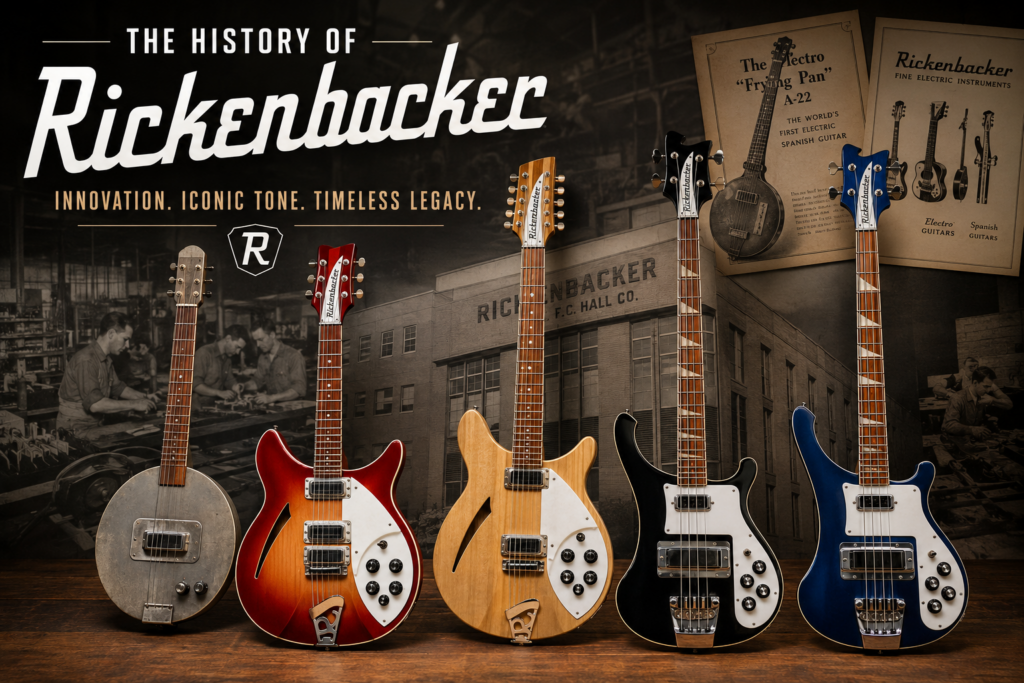
Few guitar manufacturers have shaped popular music quite like Rickenbacker. With instantly recognisable styling, unmistakable jangly tones, and a history that stretches back to the birth of the electric guitar itself, Rickenbacker has become one of the most influential instrument makers in history. From the British Invasion of the 1960s to progressive rock, power pop, indie, and alternative music, Rickenbacker instruments have left an indelible mark on generations of musicians.
In this article, we explore the fascinating history of Rickenbacker, the innovations that made the company famous, and the iconic instruments that continue to inspire players today.
The Birth of an Electric Guitar Pioneer
The story begins in Los Angeles during the late 1920s. Adolph Rickenbacker, a skilled engineer and cousin of World War I flying ace Eddie Rickenbacker (who famously used a different spelling of the family name), partnered with inventor George Beauchamp to create one of the world’s first companies dedicated to electric stringed instruments.
Originally operating as the Ro-Pat-In Corporation (Electro Patent Instruments), the company sought to solve one of the biggest challenges facing musicians at the time—making guitars loud enough to compete with horns and percussion in dance bands.
In 1931, George Beauchamp developed one of the first commercially successful magnetic pickups, forever changing the future of guitar design.
The “Frying Pan”
The company’s first instrument was unlike anything musicians had seen before.
Nicknamed the “Frying Pan” because of its circular body and long neck, the Electro A-22 lap steel became the first commercially produced electric guitar.
Rather than amplifying the body acoustically, it relied almost entirely on its revolutionary horseshoe magnetic pickup, producing a level of volume that had previously been impossible.
Many historians consider this instrument the true beginning of the electric guitar era.
Becoming Rickenbacker
During the 1930s, the company gradually adopted the Rickenbacker name, partly because it sounded distinctly American and was already familiar through Eddie Rickenbacker’s wartime fame.
Throughout the decade, the company expanded its range to include:
- Hawaiian lap steels
- Spanish-style electric guitars
- Amplifiers
- Electric basses
- Accessories
Although several manufacturers were experimenting with electric instruments, Rickenbacker quickly established itself as one of the industry’s leading innovators.
A New Era Under F.C. Hall
One of the most significant turning points came in 1953 when businessman F.C. Hall purchased the company.
Hall believed electric guitars were about to become mainstream and invested heavily in modern manufacturing, industrial design, and product development.
Working alongside German luthier Roger Rossmeisl, Rickenbacker developed an entirely new visual identity.
Rossmeisl introduced many features that remain signatures of the brand today:
- Rounded body edges
- Cresting-wave body shapes
- Bound fingerboards
- Distinctive slash soundholes
- Elegant German-inspired craftsmanship
These designs would define Rickenbacker’s appearance for decades.
The Capri Series
Released during the late 1950s, the Capri models introduced many of the company’s most famous designs.
These guitars featured:
- Semi-hollow construction
- Slim necks
- Double cutaways
- Distinctive body contours
- Brilliant, articulate single-coil pickups
The Capri series would eventually evolve into some of Rickenbacker’s most recognisable instruments.
The Arrival of the 300 Series
During the early 1960s, Rickenbacker refined its catalogue into the famous 300 Series.
Among the best-known models were:
- 330
- 340
- 360
- 365
Each offered slightly different pickup configurations and appointments while sharing the same unmistakable body shape.
The rounded edges, checkerboard binding (on many early examples), and sparkling clean tone became synonymous with the British Invasion.
Beatlemania Changes Everything
No single event transformed Rickenbacker’s reputation more than John Lennon’s use of a natural-finished 325 during The Beatles’ rise to international fame.
Its short scale, compact body and unique appearance stood out immediately on television.
Soon afterwards:
- George Harrison acquired a Rickenbacker 360/12.
- Roger McGuinn of The Byrds adopted the 360/12.
- Pete Townshend added Rickenbackers to The Who’s arsenal.
Suddenly the company found itself at the centre of popular music.
Demand exploded across Europe and America.
Inventing the Sound of Jangle
Perhaps no instrument is more responsible for defining an entire genre than the Rickenbacker 12-string.
Although twelve-string guitars had existed previously, Rickenbacker’s electric versions offered exceptional tuning stability, comfortable playability and a bright, chiming sound unlike anything else.
The company also reversed the traditional string order on octave pairs.
This subtle design choice contributed significantly to the famous shimmering attack players now simply describe as “Rickenbacker jangle.”
The sound became central to:
- Folk rock
- Jangle pop
- Psychedelic rock
- Power pop
- Alternative rock
The Legendary Basses
Rickenbacker basses are equally iconic.
4000 Series
Introduced in 1957, the 4000 Series represented another leap forward in electric instrument design.
Unlike many basses of the period, they featured:
- Neck-through-body construction
- Distinctive body wings
- Fast necks
- Powerful pickups
- Piano-like sustain
The 4001
Released in the early 1960s, the 4001 quickly became one of the world’s most recognisable bass guitars.
Its aggressive midrange, ringing sustain and unmistakable aesthetics made it a favourite among progressive and hard rock players.
Famous users include:
- Paul McCartney
- Chris Squire
- Geddy Lee
- Lemmy Kilmister
- Cliff Burton
Few basses possess such an instantly identifiable sound.
Innovation Beyond Appearance
Throughout its history, Rickenbacker has introduced numerous technical innovations.
These include:
- Neck-through-body bass construction
- Stereo “Rick-O-Sound” output systems
- Hi-Gain pickups
- Toaster Top pickups
- Dual truss rods
- Unique bridge and tailpiece designs
Many of these features remain in production today.
A Commitment to American Manufacturing
Unlike many competitors, Rickenbacker has remained committed to manufacturing in the United States.
The company continues to build instruments at its factory in Santa Ana, California.
Rather than chasing mass production, Rickenbacker has traditionally prioritised:
- Quality control
- Skilled craftsmanship
- Consistent specifications
- Domestic manufacturing
As a result, production numbers remain relatively limited compared to larger manufacturers.
This exclusivity has helped maintain strong demand among collectors and professional musicians alike.
Famous Rickenbacker Players
Over the decades, an astonishing list of musicians have relied on Rickenbacker instruments.
Some of the most notable include:
- John Lennon
- George Harrison
- Roger McGuinn
- Tom Petty
- Pete Townshend
- Paul Weller
- Peter Buck
- Johnny Marr
- Susanna Hoffs
- Carl Wilson
- Paul McCartney
- Chris Squire
- Geddy Lee
- Lemmy Kilmister
- Cliff Burton
Each brought their own unique voice while showcasing the unmistakable character of Rickenbacker instruments.
Collecting Vintage Rickenbackers
Vintage Rickenbackers have become increasingly desirable over recent decades.
Collectors particularly seek:
- Early Capri models
- 1950s examples
- 1960s 12-string guitars
- Checkerboard-bound instruments
- Original Fireglo finishes
- Vintage Toaster pickup models
- Early 4001 basses
Originality remains particularly important, as replacement parts can significantly affect value.
Rickenbacker Today
Modern Rickenbacker instruments remain remarkably faithful to their historical predecessors.
While manufacturing processes have improved and certain hardware has evolved, today’s guitars still embody the distinctive design language established more than sixty years ago.
Current favourites include:
- 330
- 360
- 620
- 660/12
- 4003 bass
These instruments continue to attract musicians seeking clarity, articulation and timeless style.
Why Rickenbacker Remains Unique
Few manufacturers possess such a distinctive identity.
A Rickenbacker rarely sounds like anything else. Its shimmering cleans, focused midrange and unmistakable visual design have helped define countless recordings without ever chasing industry trends.
Whether producing the chiming rhythm guitars of the British Invasion, the melodic bass lines of progressive rock or the jangling indie sounds of today, Rickenbacker instruments continue to occupy a unique place in music history.
Nearly a century after helping invent the electric guitar, Rickenbacker remains one of the industry’s true pioneers—proof that innovative engineering, bold design and uncompromising craftsmanship can create instruments that become timeless classics.