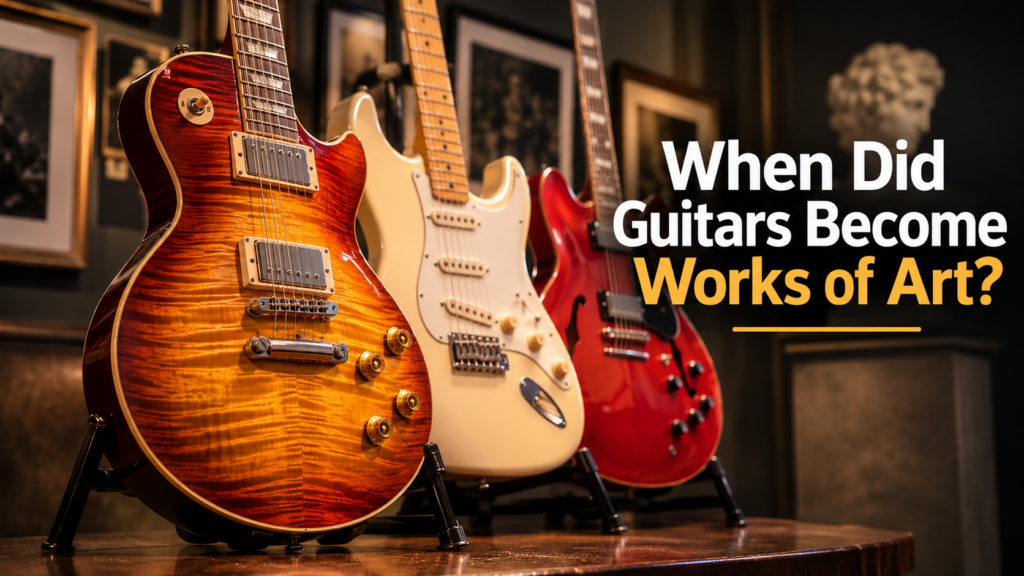
There’s something rather special about a beautiful guitar. Whether it’s a perfectly figured maple top, a rich sunburst finish, intricate fretboard inlays, or a beautifully aged nitrocellulose lacquer, some instruments are just as pleasing to look at as they are to play.
Of course, guitars have always been designed with appearance in mind. From the earliest days of electric guitar production, manufacturers understood that an instrument needed to sound good, feel comfortable, and look the part. But somewhere along the way, guitars became something more than simply tools for making music. They became objects of desire, collectable pieces of craftsmanship, and, in some cases, genuine works of art.
So when did that happen, and what is it about certain guitars that makes them so captivating?
Beauty in the Details
Part of the appeal of a beautifully made guitar is the sheer amount of detail that goes into its construction. Take a figured maple top, for example. No two pieces of wood are quite alike, and the natural grain patterns can produce some extraordinary results when combined with a carefully applied finish.
A Gibson Les Paul with a particularly striking flame maple top is a perfect example. The three dimensional appearance of the wood, combined with a traditional cherry sunburst finish, can make the instrument look almost sculpted. It’s one of those designs that never really gets old.
Then there’s the craftsmanship involved in the smaller details. Mother of pearl and abalone inlays, multi-ply binding, carefully shaped headstocks, and decorative pickguards all contribute to the overall character of an instrument. On some high-end guitars, these details are so elaborate that they wouldn’t look out of place on a piece of fine furniture.
Of course, beauty doesn’t always mean elaborate decoration. Sometimes it’s the simplicity of a design that makes it so appealing. A well finished Telecaster, a classic Olympic White Stratocaster, or a perfectly aged vintage Gibson can have just as much visual impact as the most extravagant custom build.
When Function Meets Design
One of the most interesting things about guitar design is how many iconic instruments were originally created with practicality in mind.
Take the Fender Telecaster. Introduced in the early 1950s, its straightforward construction, flat body, bolt-on neck, and simple controls were all part of a design intended to make electric guitars easier to manufacture, maintain, and play. There was nothing particularly extravagant about it, yet its clean lines and distinctive shape have become instantly recognisable.
The same could be said of the Stratocaster. Its contoured body was designed with player comfort in mind, while its double cutaway provided easier access to the upper frets. More than 70 years later, it’s difficult to imagine the electric guitar without that familiar silhouette.
Gibson took a rather different approach with the Les Paul. Its carved maple top, cream binding, trapezoid inlays, and elegant body shape gave it an altogether more luxurious appearance. It was a guitar that looked every bit as sophisticated as it sounded.
These designs demonstrate that practicality and aesthetics don’t have to compete. In many cases, the most successful guitars are those where the two work together.
The Art of the Finish
If there’s one area where guitar manufacturers have really been able to express their creativity, it’s in the finish.
Traditional sunbursts, solid colours, metallic finishes, natural wood, and custom graphics have all played a part in giving guitars their individual identities. Some finishes have even become as closely associated with particular models as their shapes or sounds.
Think of a Gibson Les Paul in Heritage Cherry Sunburst, a Fender Stratocaster in Olympic White, or a Gretsch hollowbody in a rich orange finish. These aren’t simply colour choices. They’ve become part of the visual language of the guitar world.
The introduction of increasingly sophisticated finishing techniques also opened up new possibilities. Figured woods could be enhanced with translucent colours, metallic paints could produce spectacular effects, and highly polished finishes could give instruments an almost glass like appearance.
Then, of course, there’s the opposite approach. Relic finishes and artificially aged instruments deliberately recreate the appearance of decades of use. Chipped paint, worn edges, faded colours, and tarnished hardware are all part of the appeal. It’s a slightly unusual concept when you think about it, paying extra for a guitar that looks as though it’s already been through years of wear and tear, but there’s no denying the attraction.
When Guitar Making Becomes an Art Form
While mass produced guitars can be incredibly impressive, it’s often in the world of custom instruments where craftsmanship really begins to resemble fine art.
High-end luthiers have long pushed the boundaries of what can be achieved with wood, finishes, and decorative detailing. Intricate marquetry, elaborate inlays, exotic tonewoods, and individually carved body shapes can transform a guitar into something truly unique.
Some instruments take hundreds of hours to complete, with individual components being shaped, fitted, finished, and polished by hand. The level of attention involved can be extraordinary, particularly when every detail has been carefully considered.
The Gibson Custom Shop and Fender Custom Shop are particularly good examples of how traditional guitar designs can be elevated through specialist craftsmanship. From historically accurate recreations of vintage instruments to highly personalised custom builds, these guitars demonstrate just how much artistry can go into making something that is ultimately designed to be played.
And that’s perhaps the most interesting part. Despite all the time, effort, and expense involved, these instruments are still musical tools. They’re made to be picked up, plugged in, and played.
Too Beautiful to Play?
There’s a certain irony to owning a particularly beautiful guitar. The more stunning it looks, the more tempting it can be to keep it safely in its case, away from scratches, knocks, and the inevitable signs of use.
Collectors will often go to extraordinary lengths to preserve an instrument in immaculate condition, particularly when it comes to rare vintage guitars or limited edition models. Original finishes, untouched hardware, and unmodified components can all have a significant impact on collectability and value.
But there’s another school of thought that says a guitar only really comes to life when it’s being played.
A little buckle rash, some worn frets, and a few marks from years of gigging aren’t necessarily things to be ashamed of. In fact, they can add to an instrument’s character. Some of the most desirable vintage guitars in existence have spent decades being played by musicians, rather than sitting untouched in a display cabinet.
Perhaps that’s the real beauty of guitars. They can be appreciated as objects of craftsmanship and design, but they also have a purpose that goes far beyond their appearance.
More Than Just Instruments
Whether it’s a modest Telecaster, a beautifully figured Les Paul, an extravagant Custom Shop creation, or a well loved vintage guitar with decades of history behind it, there’s no shortage of reasons to appreciate the way guitars look.
Some are beautiful because of their simplicity, others because of their intricate detailing, and some simply because of the memories and music associated with them.
Ultimately, a guitar doesn’t need to be expensive, rare, or particularly elaborate to be considered a work of art. Sometimes it’s simply a matter of finding an instrument that makes you stop and take a second look.
And if it also happens to sound fantastic, well, that’s just a bonus.