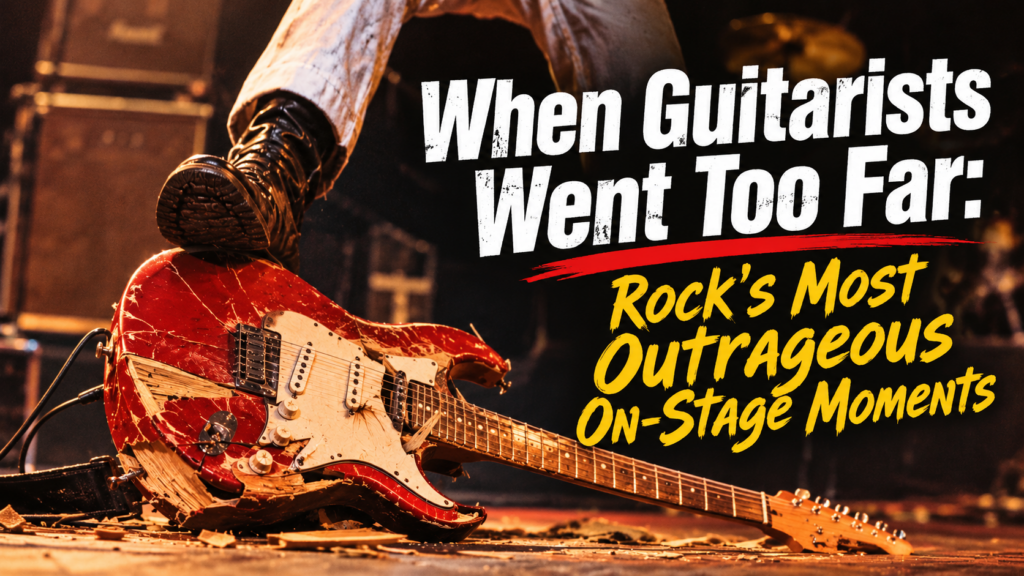
Rock music has never been particularly famous for its subtlety. From ear-splitting amplifiers and wild guitar solos to instruments being smashed, set on fire and occasionally launched across a stage, some guitarists have taken the idea of putting on a show to an entirely different level.
For many musicians, simply playing the right notes has never quite been enough. The guitar has become part of the performance itself, whether that means swinging it around like a prop, setting it alight or treating it as though it has personally offended them.
Of course, these moments have helped create some of rock’s most unforgettable performances. They’ve also left a fair few guitar-shaped casualties along the way.
Let’s revisit some of the occasions when guitarists decided that playing music was only part of the job.
Pete Townshend: The Man Who Made Guitar Smashing Famous
If there’s one guitarist who deserves a mention whenever stage destruction comes up, it’s Pete Townshend of The Who.
Today, smashing a guitar at the end of a rock performance might seem like a familiar cliché. But back in the 1960s, it was a considerably more shocking sight.
Interestingly, Townshend’s famous habit began entirely by accident. During a performance at the Railway Tavern in Harrow in 1964, he raised his guitar and accidentally struck the low ceiling. The neck was damaged, leaving him understandably annoyed.
When the audience didn’t seem particularly impressed by the accident, Townshend decided to make a much bigger event of it. He proceeded to smash the already-damaged instrument against the stage, before picking up his spare guitar and carrying on.
What began as an unfortunate accident soon became one of rock music’s most recognisable stage antics.
Townshend later explained that the destruction had become something of an artistic statement, although it wasn’t always an enjoyable one. After all, guitars weren’t exactly cheap, even in the 1960s!
His antics helped establish guitar smashing as a rock ‘n’ roll tradition, inspiring generations of performers to follow suit.
Jimi Hendrix: Setting the Guitar World on Fire
Pete Townshend might have popularised guitar destruction, but Jimi Hendrix took things rather more literally.
At the Monterey International Pop Festival in June 1967, Hendrix delivered one of the most famous performances in rock history. Having already dazzled the audience with his extraordinary playing, he finished the set with a moment nobody was likely to forget.
After playing his Fender Stratocaster, Hendrix poured lighter fluid over the instrument and set it alight. Kneeling beside the burning guitar, he continued to play and coaxed the flames higher before eventually smashing the instrument against the stage.
It was an extraordinary piece of performance theatre, and the photographs of Hendrix kneeling beside his burning Stratocaster have since become some of the most recognisable images in music history.
There was more to it than simply destroying an expensive guitar, though. Hendrix understood the power of visual performance, and the Monterey appearance helped introduce him to a huge American audience.
It’s fair to say that most guitarists are happy enough to experiment with a new pedal or pickup combination. Hendrix, meanwhile, was experimenting with combustion.
Ritchie Blackmore: When the Guitar Became a Weapon
Deep Purple guitarist Ritchie Blackmore has never been known as the most predictable performer, and his appearance at the California Jam festival in 1974 provided one particularly memorable example.
The band were playing in front of a huge audience, with television cameras capturing the performance. Blackmore was already famous for his fiery playing and unpredictable stage presence, but things took a more destructive turn towards the end of the set.
As Deep Purple performed, Blackmore became increasingly frustrated with the camera positioned close to him. Rather than simply asking the camera operator to move, he decided to deal with the problem in a rather more dramatic fashion.
He smashed his guitar into the camera, sending it crashing, before further chaos unfolded involving the band’s equipment and stage pyrotechnics.
The incident became part of Deep Purple folklore and perfectly captured the unpredictable spirit of 1970s hard rock.
It’s probably worth remembering that, while modern guitarists might complain about an awkward camera angle, Blackmore had a rather different approach to giving the cameraman a hint.
Kurt Cobain: The Art of the Post-Performance Smash
By the early 1990s, guitar smashing had become firmly established in rock culture. Few musicians embodied the rebellious spirit of the era quite like Nirvana frontman Kurt Cobain.
Cobain was known for his raw performances and his habit of destroying guitars at the end of particularly energetic shows. Rather than treating an instrument as something precious to be carefully protected, he often appeared perfectly happy to turn it into part of the performance’s finale.
Nirvana’s live shows could be chaotic, loud and unpredictable, with Cobain frequently smashing his guitar against the stage or amplifier.
Of course, this wasn’t simply an attempt to copy the theatrics of earlier rock stars. It fitted the band’s abrasive sound and the attitude of the grunge movement, which was often deliberately opposed to the polished image of mainstream rock.
There was also something rather ironic about the whole thing. The guitars being destroyed were often the very instruments fans would have loved to own.
For anyone watching from the front row, it must have been a strange experience seeing a perfectly good guitar turned into a pile of broken wood.
The Price of Rock ‘n’ Roll Destruction
While these moments have become legendary, there’s one detail that often gets overlooked: guitars cost money!
For touring musicians, repeatedly destroying instruments could become an expensive habit. Even when a guitar was relatively affordable, it still needed replacing, and the technical crew had to make sure there was another instrument ready to go.
Pete Townshend has spoken about the cost of his guitar-smashing habit, while other performers have had to consider the practicalities of replacing equipment after particularly enthusiastic performances.
And then there’s the question of what happens to the remains. Broken guitars have occasionally become valuable memorabilia, with fragments and damaged instruments finding their way into private collections and museums.
In some cases, the remains of a guitar can become almost as famous as the musician who destroyed it.
When the Show Becomes Bigger Than the Music
There’s no denying that these performances helped shape rock music’s reputation for excess and unpredictability.
Whether it was Townshend turning an accident into an art form, Hendrix creating one of the most iconic images in music history, Blackmore causing chaos at a major festival or Cobain embracing the raw energy of grunge, each musician found their own way to make the guitar part of the spectacle.
Of course, we’re not suggesting that the best way to finish your next gig is to set fire to your favourite Stratocaster. In fact, we’d probably recommend keeping hold of it!
But these moments remind us that the electric guitar has always been about more than just sound. It’s an instrument with personality, attitude and a remarkable ability to steal the spotlight.
And perhaps that’s why, decades later, we’re still talking about the guitars that didn’t quite make it through the show.
After all, there aren’t many other instruments that can produce a beautiful solo one minute and become stage debris the next.