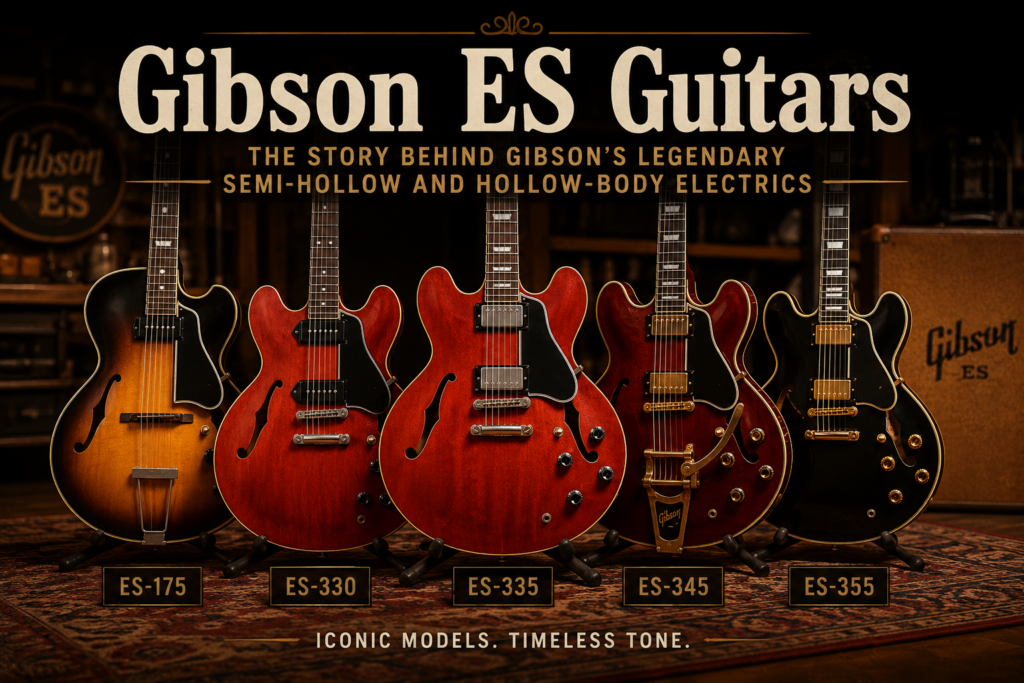
Few guitar ranges have had the impact and longevity of Gibson’s ES series. Introduced during the 1930s, the ES name — short for “Electric Spanish” — was Gibson’s way of distinguishing traditional electric guitars from Hawaiian lap steel instruments. What began as a line of amplified hollow-body jazz guitars eventually evolved into some of the most influential electric guitars ever made.
Today, the Gibson ES family covers everything from fully hollow jazz boxes to feedback-resistant semi-hollow instruments capable of handling blues, rock, funk and even high-gain music. Along the way, these guitars have become closely associated with legendary players including B.B. King, Larry Carlton, Chuck Berry, Alvin Lee, Noel Gallagher, Eric Clapton, Dave Grohl and countless others.
The Origins of the ES Series
The story begins in 1936 with the Gibson ES-150, widely regarded as Gibson’s first commercially successful electric Spanish guitar. Early ES models were fully hollow archtops designed primarily for jazz musicians seeking greater volume in big band settings. Over time, Gibson refined the concept with improved pickups, thinner bodies and eventually semi-hollow construction.
By the late 1950s, Gibson engineer Ted McCarty helped revolutionise electric guitar design with the introduction of the ES-335 — a guitar that would bridge the tonal gap between hollow-body warmth and solid-body sustain. That design became the foundation for much of the modern ES lineup. (Wikipedia)
Gibson ES-335: The Definitive Semi-Hollow
Released in 1958, the Gibson ES-335 remains the benchmark semi-hollow electric guitar. It introduced a revolutionary centre-block construction that dramatically reduced feedback while retaining the resonance and openness of a hollow-body instrument. (GuitarPlayer)
The ES-335 featured:
- Laminated maple top, back and sides
- Solid maple centre block
- Mahogany set neck
- Dual humbuckers
- 24.75” scale length
- Double cutaway body
- Tune-o-matic bridge and stop tailpiece
This combination created an instrument capable of exceptional versatility. The ES-335 could handle jazz, blues and rock equally well, making it one of the most adaptable guitars Gibson ever produced. (Guitar Guitar)
The tonal character of the ES-335 sits somewhere between a Les Paul and a full hollow-body guitar. It offers warmth and airiness while maintaining excellent sustain and resistance to uncontrollable feedback. This balance helped make it a favourite among session musicians and touring players alike.
Famous ES-335 players include:
- Chuck Berry
- Larry Carlton
- Eric Clapton
- Alvin Lee
- Noel Gallagher
- Dave Grohl
- Warren Haynes
Vintage late-1950s ES-335 models fitted with original PAF humbuckers are among the most desirable electric guitars in the vintage market today. (edgewaterguitars.com)
Gibson ES-345: The Sophisticated Middle Ground
Introduced in 1959, the ES-345 sat between the ES-335 and ES-355 in Gibson’s lineup. While sharing much of the same construction as the ES-335, the ES-345 featured more upscale appointments and additional electronics. (GuitarPlayer)
Key ES-345 features included:
- Split parallelogram fingerboard inlays
- Gold hardware
- Multi-ply binding
- Stereo output capability
- Varitone switch
The Varitone circuit allowed players to access a variety of filtered tonal options, although not every guitarist embraced the feature. Some players later modified their ES-345s to remove the stereo circuitry for a more straightforward setup. (guitarhq.com)
Despite sometimes being overshadowed by the ES-335, the ES-345 remains a hugely respected guitar with a distinctive aesthetic and tonal identity.
Notable ES-345 users include:
- Freddie King
- Steve Howe
- Bob Weir
- George Harrison
- Marty McFly — at least in Back to the Future
The cherry red ES-345 seen in Back to the Future became one of the most famous guitars in cinema history, even if the film accidentally used a model that technically did not exist in 1955. (GuitarPlayer)
Gibson ES-355: The Luxury Flagship
The ES-355 represented the top-tier version of Gibson’s semi-hollow lineup. Introduced alongside the ES-345 in 1958, the ES-355 combined the ES-335 platform with Custom Shop-style appointments and premium aesthetics. (GuitarPlayer)
Typical ES-355 specifications included:
- Ebony fingerboard
- Large block inlays
- Split diamond headstock inlay
- Gold hardware
- Bound headstock
- Varitone circuitry
- Stereo wiring
- Bigsby or Vibrola vibrato options
The ES-355 is perhaps most famously associated with B.B. King. His iconic “Lucille” guitars were based heavily on the ES-355 platform, eventually evolving into dedicated signature models without f-holes to reduce feedback. (Guitar World)
Other notable ES-355 players include:
- Keith Richards
- Johnny Marr
- Noel Gallagher
- Chuck Berry
- Bernard Butler
Visually, the ES-355 is one of Gibson’s most elegant electric guitars, combining the sophistication of a jazz archtop with the versatility of a modern semi-hollow instrument.
Gibson ES-330: Fully Hollow and Wildly Resonant
At first glance, the ES-330 resembles an ES-335, but structurally it is very different. Unlike the ES-335, the ES-330 is fully hollow and does not feature a centre block. (Gibson)
This gives the ES-330:
- Greater acoustic resonance
- Lighter overall weight
- More pronounced hollow-body warmth
- Increased susceptibility to feedback
The ES-330 also used P-90 pickups rather than humbuckers, giving it a rawer and more articulate voice with plenty of midrange bite.
The model became particularly associated with:
- Grant Green
- Thinline jazz players
- Early British Invasion bands
The Epiphone Casino — famously used by The Beatles — was heavily based on the ES-330 design, further cementing its importance in music history.
Gibson ES-175: The Jazz Standard
Long before the ES-335 arrived, the ES-175 had already established itself as one of Gibson’s definitive electric archtops. Introduced in 1949, the ES-175 became a cornerstone jazz guitar for generations of players. (Ultimate Pop Culture)
Unlike the thinner semi-hollow ES models, the ES-175 features a full-depth hollow body and a Florentine cutaway.
Traditional specifications include:
- Fully hollow maple body
- Mahogany neck
- Rosewood fingerboard
- Single or dual humbuckers
- Floating bridge
- Trapeze tailpiece
The ES-175 became synonymous with jazz guitar excellence thanks to players such as:
- Joe Pass
- Pat Metheny
- Herb Ellis
- Jim Hall
Its warm, woody tone and exceptional responsiveness made it a studio and stage favourite for decades.
Gibson ES-339: Compact Semi-Hollow Performance
The ES-339 takes the ES-335 concept and shrinks it into a smaller body size while retaining much of the same tonal character. (Jazz Guitar Online)
The smaller body offers:
- Improved comfort
- Reduced weight
- Greater resistance to feedback
- A slightly tighter tonal response
Players who love the sound of an ES-335 but prefer a more compact instrument often gravitate toward the ES-339.
Typical ES-339 specs include:
- 24.75” scale length
- 22 frets
- Mahogany neck
- Maple/poplar laminate body
- Centre block construction
- Dual humbuckers
The ES-339 has become increasingly popular among modern players seeking semi-hollow tones in a more manageable format.
Why ES Guitars Remain So Popular
Part of the enduring appeal of Gibson ES guitars lies in their versatility. Few instruments can move so naturally between genres while retaining such a strong personality.
Semi-hollow ES models deliver:
- Warmth and resonance
- Excellent sustain
- Reduced feedback compared to full hollow-bodies
- Dynamic response
- Outstanding clean and overdriven tones
Meanwhile, fully hollow ES models provide rich acoustic character and exceptional sensitivity for jazz and roots styles.
The visual appeal of the ES family also plays a major role. From cherry red ES-335s to ebony ES-355s with gold hardware, these guitars possess a timeless elegance that continues to inspire players decades after their introduction.
The Legacy of the Gibson ES Series
The Gibson ES family helped define what an electric guitar could be. By blending the resonance of archtop instruments with the practicality of solid-body design, Gibson created guitars that could thrive in almost any musical setting.
Whether it’s the blues authority of a Lucille-style ES-355, the versatility of an ES-335, the jazz warmth of an ES-175 or the raw edge of an ES-330, the ES range represents some of the finest electric guitar design ever produced.
More than seventy years after the introduction of the ES-335, these guitars remain as relevant as ever — not simply because of nostalgia, but because the designs still work brilliantly today.