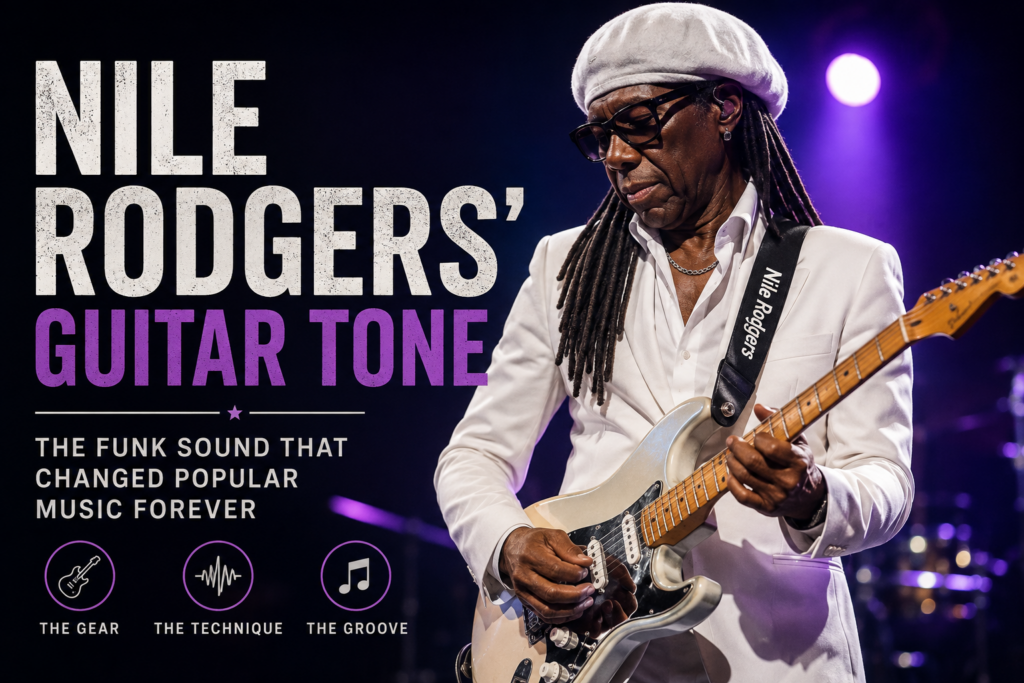
When guitarists talk about legendary tones, conversations often gravitate towards the soaring sustain of Eric Clapton, the fuzz-laden experimentation of Jimi Hendrix, or Eddie Van Halen’s revolutionary “Brown Sound.” Yet few guitar tones have been as influential—or as instantly recognisable—as that of Nile Rodgers.
With little overdrive, almost no sustain and an obsession with rhythm, Rodgers built a sound that has powered countless hit records spanning more than four decades. From Chic classics such as Le Freak and Good Times to productions for David Bowie, Madonna, Diana Ross, Daft Punk and Duran Duran, his playing has become one of the defining voices of modern popular music.
This is the story of how Nile Rodgers created one of the greatest rhythm guitar tones ever recorded.
Why Nile Rodgers’ Tone Is So Unique
Many guitarists spend years searching for more gain, thicker distortion or endless sustain.
Nile Rodgers did exactly the opposite.
His philosophy has always been that the guitar should function almost like a percussion instrument. Every note serves the groove rather than overpowering it.
His tone is characterised by:
- Crystal-clear articulation
- Bright but never harsh highs
- Tight, controlled low end
- Extremely fast attack
- Minimal compression
- Virtually no distortion
- Incredible rhythmic precision
It’s deceptively simple. The magic lies less in the equipment and more in how Rodgers plays.
The Foundation: “The Hitmaker”
At the centre of Rodgers’ sound is one of the world’s most famous guitars.
His beloved 1960 Fender Stratocaster, affectionately known as “The Hitmaker,” was purchased second-hand in Miami during the early 1970s.
Unlike a standard Stratocaster, it has several unusual features.
A Hardtail Strat
Perhaps most importantly, it doesn’t have a tremolo bridge.
Instead, it’s fitted with a hardtail bridge, meaning the strings anchor directly into the body.
This gives:
- More immediate attack
- Increased tuning stability
- Slightly stronger sustain
- A tighter response
For Rodgers’ rhythmic playing style, this proved to be ideal.
Maple Neck
“The Hitmaker” also features a maple fingerboard.
Compared with rosewood, maple often delivers:
- More snap
- Brighter attack
- Enhanced note definition
Combined with single-coil pickups, this helps produce the sparkling clarity heard on countless Chic records.
Pickup Selection
Rodgers almost always uses the neck and middle pickup together (Position 4 on a five-way selector).
This produces what many players call the famous “quack” tone.
Characteristics include:
- Hollow midrange
- Glassy highs
- Excellent note separation
- Reduced harshness
- Tight bass response
It’s one of the defining ingredients behind his instantly recognisable sound.
Strings and Action
One surprising aspect of Rodgers’ setup is how light his strings are.
He has frequently used gauges around:
.009–.042
The lighter strings allow:
- Faster rhythmic playing
- Easier muting
- Greater flexibility
- Reduced hand fatigue during long performances
His guitar is also set up with relatively low action, encouraging effortless sixteenth-note rhythm work.
Clean Doesn’t Mean Lifeless
Many assume that a clean guitar tone is easy to achieve.
In reality, truly great clean tones are among the hardest to master.
Without distortion hiding imperfections, every muted string, every pick attack and every rhythmic inconsistency becomes audible.
Rodgers’ tone remains exceptionally clean, but it never sounds sterile.
Instead, it feels:
- Dynamic
- Energetic
- Percussive
- Musical
Much of this comes from his picking hand.
The Right Hand Is Everything
If there is one lesson guitarists can learn from Nile Rodgers, it’s this:
Your picking hand matters more than your gear.
Rodgers employs an incredibly consistent right-hand technique.
Even when only a handful of notes are sounding, his hand continues moving in constant sixteenth notes.
This creates a natural groove and keeps the rhythm flowing.
Many of his chord voicings are deliberately incomplete, with muted strings making up much of what the listener hears.
The muted “chick” between notes becomes just as important as the notes themselves.
Chord Voicings
Rather than relying on full six-string barre chords, Rodgers favours compact voicings higher up the neck.
These include:
- Triads
- Four-note chords
- Ninth chords
- Minor seventh chords
- Dominant seventh chords
- Sixth chords
These smaller voicings leave plenty of room for:
- Bass guitar
- Keyboards
- Vocals
- Horn sections
- Percussion
The result is a rhythm guitar part that complements the arrangement instead of competing with it.
Amplifiers
Rodgers has used numerous amplifiers throughout his career, but they all share one common characteristic:
They’re clean.
Among the amps associated with his sound are:
- Fender Twin Reverb
- Fender Deluxe Reverb
- Roland JC-120 Jazz Chorus
- Various Mesa/Boogie clean channels
- Modern digital systems for live work
His amplifier settings are generally straightforward:
- Clean channel
- Bright but controlled treble
- Moderate mids
- Tight bass
- Minimal gain
The goal is maximum clarity.
Effects
Unlike many famous guitarists, Rodgers uses remarkably few pedals.
His sound is largely created by:
- Guitar
- Cable
- Clean amplifier
Occasionally he may employ:
- Compression
- Chorus
- Delay
- Reverb
However, these effects are subtle and designed to support the rhythm rather than dominate it.
The majority of his classic recordings feature very little processing.
Recording Techniques
One reason Rodgers’ guitar sounds so enormous despite being clean is careful recording.
His rhythm parts are often:
- Double-tracked
- Extremely tightly played
- Precisely edited
- Balanced against the bass guitar
Because every performance is incredibly accurate, layering multiple takes creates width without sounding messy.
It’s a masterclass in disciplined rhythm playing.
Famous Songs That Showcase His Tone
Le Freak (1978)
Perhaps the definitive Nile Rodgers guitar sound.
Sharp, muted sixteenth notes combine with bright Stratocaster sparkle to create one of disco’s greatest guitar performances.
Good Times (1979)
One of the most sampled songs in history.
Rodgers’ guitar sits perfectly alongside Bernard Edwards’ legendary bassline, proving that less can truly be more.
Let’s Dance – David Bowie (1983)
While Stevie Ray Vaughan supplied the lead guitar, Rodgers produced the album and contributed the instantly recognisable rhythm parts.
The clean funk guitar forms the backbone of the entire track.
Get Lucky – Daft Punk (2013)
This modern classic introduced Rodgers’ playing to an entirely new generation.
Remarkably, the core ingredients remained unchanged from the 1970s:
- Stratocaster
- Clean amp
- Perfect timing
- Impeccable groove
Sometimes the best ideas never need updating.
Can You Recreate Nile Rodgers’ Tone?
Absolutely.
The good news is that you don’t need expensive vintage gear.
A modern Stratocaster-style guitar with single-coil pickups can get surprisingly close.
Try this starting point:
Guitar
- Stratocaster
- Neck + middle pickup
- Volume on full
- Tone around 7–10
Amp
- Clean channel
- Gain: Low
- Bass: 4
- Mid: 5
- Treble: 6–7
- Reverb: Light
Playing Style
- Use light strings
- Keep your picking hand moving constantly
- Practise muting unused strings
- Focus on rhythm over speed
- Play slightly behind or right on the beat with consistency
Most importantly, resist the temptation to add overdrive.
The cleaner your sound, the more your technique will shine through.
Rodgers’ Lasting Influence
Few guitarists have shaped rhythm playing as profoundly as Nile Rodgers.
His influence extends far beyond disco, reaching into funk, pop, rock, R&B, dance music and modern production. Artists ranging from Prince and John Frusciante to Cory Wong, Mark Lettieri and countless session musicians have drawn inspiration from his approach to groove and economy.
In an era where guitarists often chase ever-heavier tones and increasingly complex effects chains, Rodgers remains a reminder that great rhythm playing is built on feel, precision and musical restraint. His unmistakable sound proves that a clean Stratocaster, a dependable amplifier and impeccable timing can create records that stand the test of time.
More than four decades after Chic first topped the charts, Nile Rodgers’ guitar tone continues to inspire players across every genre. It is bright, clean, endlessly rhythmic and instantly recognisable—a masterclass in how the simplest ingredients, placed in the right hands, can change the course of popular music.