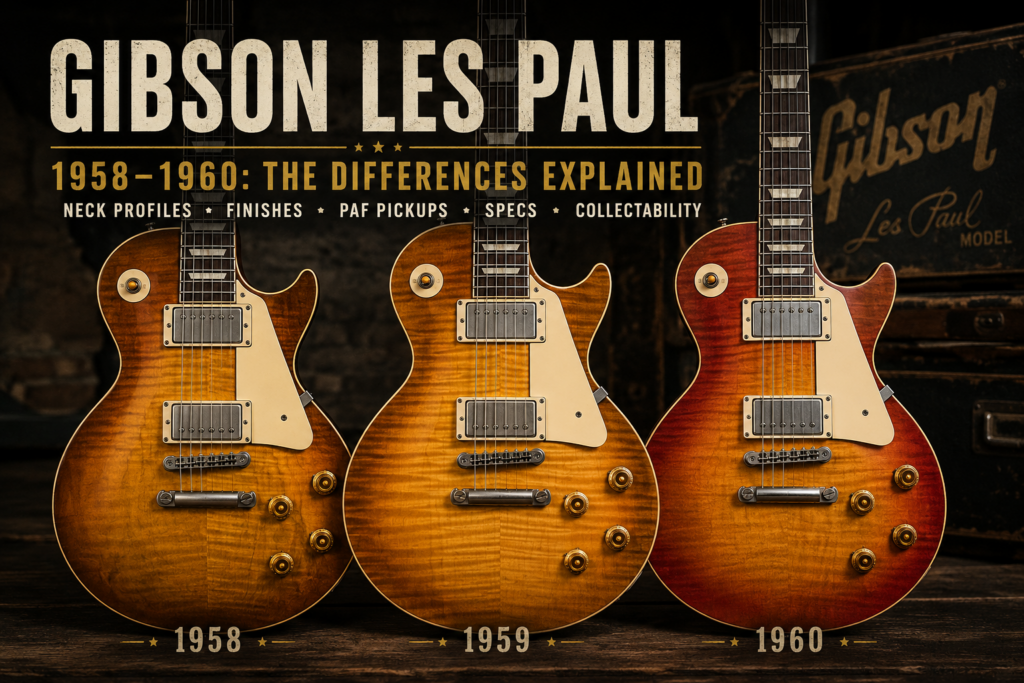
Few guitars have achieved the legendary status of the Gibson Les Paul Standard produced between 1958 and 1960. Collectively known as the “Bursts” because of their beautiful Sunburst finishes, these instruments represent the pinnacle of vintage electric guitar collecting. While they share many core features—including carved maple tops, mahogany bodies, PAF humbuckers and set mahogany necks—there are subtle but important differences from year to year that influence their feel, tone, collectability and value.
Whether you’re a vintage enthusiast, collector, or simply curious about why one Burst commands millions while another feels completely different in the hands, here’s a closer look at how the Les Paul evolved across these three iconic years.
1958: The Foundation of the Burst
When Gibson introduced the Sunburst Les Paul Standard in 1958, it marked the end of the Goldtop finish that had defined the model since 1952. Underneath, however, much remained familiar.
Key Specifications
- Plain to lightly figured maple tops
- Thick, rounded one-piece mahogany neck
- Rosewood fingerboard with trapezoid inlays
- Two Patent Applied For (PAF) humbuckers
- ABR-1 Tune-o-matic bridge
- Aluminium stop tailpiece
- Natural Cherry Sunburst nitrocellulose finish
Most 1958 Les Pauls feature relatively subtle maple figuring. At the time, dramatic flame tops weren’t considered desirable, and Gibson simply used whatever maple was available. Ironically, many of these understated tops have become incredibly sought-after today.
Neck Profile
The defining feature of a 1958 Burst is its substantial neck.
Often described as a “baseball bat,” the neck is noticeably larger than later years, typically measuring around:
- Approximately 0.90–0.93” at the 1st fret
- Approximately 1.00” or more by the 12th fret
Players who enjoy large necks often regard the 1958 profile as one of the most comfortable ever produced.
Tone
Thanks to their substantial neck mass, many players describe 1958 Bursts as having:
- Strong low-end response
- Thick midrange
- Excellent sustain
- Smooth, rounded attack
Of course, every vintage guitar is unique, but the larger neck is often credited with contributing to this powerful character.
1959: The Holy Grail
If there is one Les Paul that has become the benchmark for electric guitars, it is the 1959 Burst.
Only around 650 were produced, making them considerably rarer than modern guitars while still numerous enough to appear regularly in books, museums and famous collections.
What Changed?
The biggest change for 1959 was the neck profile.
Rather than the exceptionally thick carve of 1958, Gibson subtly slimmed the neck into what many players consider the perfect compromise.
Typical measurements include:
- Approximately 0.86–0.89” at the 1st fret
- Approximately 0.96–0.99” at the 12th fret
This shape fills the hand comfortably without feeling oversized.
Flame Maple Becomes More Common
Many of the most spectacular figured maple tops appeared during 1959.
This wasn’t an intentional design decision—Gibson simply received particularly attractive maple supplies during this period—but these highly figured tops helped create the iconic image of the Burst.
Some of the world’s most famous Les Pauls belong to this production year, including instruments owned by:
- Jimmy Page
- Joe Bonamassa
- Billy Gibbons
- Kirk Hammett
Tonal Reputation
Although electronics varied from guitar to guitar, many musicians associate 1959 Bursts with:
- Open, balanced response
- Exceptional clarity
- Rich harmonic complexity
- Outstanding dynamic range
Whether these differences are purely due to construction or decades of mythology remains open to debate—but there’s no denying the extraordinary reputation of the 1959 Les Paul.
1960: The Slim Neck Arrives
Production continued into 1960 with relatively few cosmetic changes, but one feature transformed the playing experience.
Slim Taper Neck
By mid-1960 Gibson introduced what became known as the Slim Taper neck.
Typical dimensions include:
- Approximately 0.79–0.82” at the 1st fret
- Around 0.88–0.92” at the 12th fret
Players moving from Fender instruments often found these slimmer necks easier to adapt to.
It’s worth noting that early 1960 guitars often retained neck dimensions remarkably similar to late 1959 examples, meaning there is considerable overlap.
Knob Changes
One easy visual identifier is the control knobs.
1958–1959 models typically used:
- Gold Top Hat knobs with dial pointers
Many later 1960 examples introduced:
- Reflector knobs (“Bonnet” style with silver inserts)
This change would continue throughout the 1960s.
Finish Evolution
The Cherry Sunburst finish often appeared brighter when new, but many original examples have faded significantly over the decades.
Depending on exposure to ultraviolet light, original finishes today may appear:
- Lemon Burst
- Honey Burst
- Iced Tea Burst
- Tobacco Burst
- Washed Cherry
These variations are largely the result of natural ageing rather than factory options.
The PAF Pickup Myth
One of the biggest misconceptions is that pickups changed dramatically each year.
In reality, Gibson continued using the same Patent Applied For humbuckers throughout 1958–1960.
However, because manufacturing tolerances were relatively loose, individual pickups varied considerably.
Original PAFs commonly measure anywhere between approximately:
- 7.2kΩ
- 9.0kΩ
Magnet types also varied between Alnico II, III, IV and V, depending on component availability.
As a result, no two Bursts sound exactly alike.
Construction Similarities
Across all three years, the Les Paul Standard retained its core recipe:
- Solid one-piece mahogany body
- Two-piece carved maple cap
- Set mahogany neck
- Brazilian rosewood fingerboard
- Long neck tenon
- Nitrocellulose lacquer finish
- PAF humbuckers
- ABR-1 Tune-o-matic bridge
- Aluminium stop tailpiece
- Kluson Deluxe tuners
These ingredients remain the blueprint for virtually every premium Les Paul produced today.
Why Are They So Valuable?
Ironically, the Burst was not a commercial success when new.
Production numbers were relatively low:
| Year | Estimated Production |
|---|---|
| 1958 | Approximately 434 |
| 1959 | Approximately 643 |
| 1960 | Approximately 635 |
By 1961, Gibson had replaced the original single-cutaway Les Paul with the new double-cutaway design that would later become known as the SG.
As influential players including Eric Clapton, Mike Bloomfield, Peter Green and Duane Allman rediscovered the original Bursts during the 1960s, demand exploded.
Today, exceptional examples regularly sell for hundreds of thousands of pounds, while historically significant guitars have achieved prices well into the millions.
Which Burst Is Right for You?
If you were fortunate enough to choose between the three years, your preference would likely come down to feel rather than tone.
Choose a 1958 if you like:
- Large vintage necks
- Strong fundamental tone
- Subtle maple figuring
- Maximum vintage character
Choose a 1959 if you want:
- The most versatile neck profile
- Highly figured maple tops
- The model most closely associated with legendary players
- The quintessential Burst experience
Choose a 1960 if you prefer:
- Faster, slimmer necks
- Reflector-knob styling
- Bright Cherry Sunburst aesthetics
- A feel that’s closer to many modern Gibson necks
Final Thoughts
The differences between 1958, 1959 and 1960 Les Paul Standards are more evolutionary than revolutionary. Each year built upon the same winning formula, with Gibson making subtle refinements rather than dramatic redesigns.
For many players, the neck profile is the deciding factor. Collectors may gravitate toward the dramatic flame tops of 1959 or the rarity of particular finish fades, while musicians often discover that an individual guitar matters far more than the year stamped on its serial number.
Perhaps that’s the real magic of the Burst. Despite sharing the same basic blueprint, every surviving example has developed its own unique voice over more than six decades. Whether it’s a chunky-necked 1958, an iconic 1959 or a sleek 1960, each remains one of the most inspiring electric guitars ever built—and a benchmark against which countless modern instruments continue to be measured.