Few things are guaranteed to start a lively conversation among guitarists quite like a debate about gear. Whether it’s the age-old Stratocaster versus Les Paul argument, the endless search for the perfect tone, or the question of whether vintage guitars really are better, everyone seems to have an opinion.
The beauty of the guitar world is that there is no single right answer. What works brilliantly for one player might be completely wrong for another, and some of the most interesting instruments and sounds have come from musicians doing things a little differently.
From pickups and amplifiers to playing styles and collecting habits, there are certain subjects that guitarists will probably never agree on.
So, we’ve picked out ten of the biggest debates in the guitar world. Some have been going on for decades, while others have become increasingly relevant as technology continues to change the way we play.
Let’s see where you stand.
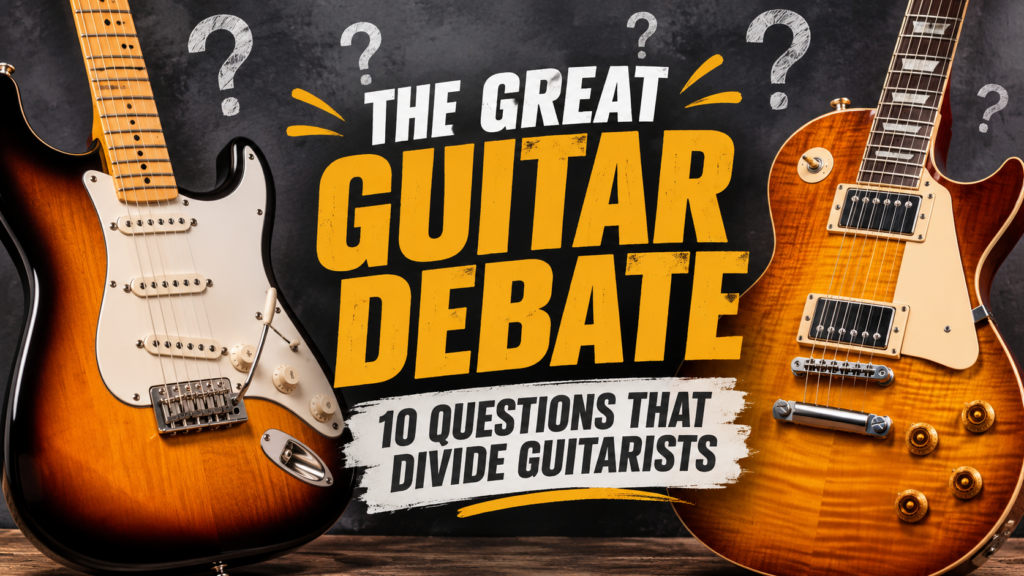
1. Fender Stratocaster vs Gibson Les Paul: Which Is the Ultimate Electric Guitar?
Perhaps the greatest debate in electric guitar history.
On one side, you have the Fender Stratocaster: comfortable, versatile, and instantly recognisable. With its three single-coil pickups, contoured body, and distinctive tremolo system, the Strat has been the weapon of choice for everyone from Jimi Hendrix and Eric Clapton to David Gilmour and John Mayer.
On the other side sits the Gibson Les Paul. With its mahogany body, carved maple top, shorter scale length, and typically two humbucking pickups, the Les Paul offers a very different playing experience. Its thick, sustaining sound has helped define the music of players such as Jimmy Page, Slash, and Gary Moore.
Of course, the differences go well beyond their specifications. The Stratocaster is often associated with bright, articulate tones and expressive playing, while the Les Paul is renowned for its powerful midrange and rich, sustained sound.
Both have become icons for good reason, and both are capable of far more than their traditional reputations suggest.
But if you could only keep one, which would it be?
2. Single Coils vs Humbuckers: Which Pickup Sounds Better?
Few components have a greater influence on an electric guitar’s character than its pickups.
Single-coil pickups are known for their clarity, brightness, and distinctive attack. They can deliver everything from the sparkling clean tones of a Fender Telecaster to the glassy sounds of a Stratocaster. They’re particularly popular with blues, country, funk, and indie players.
Humbuckers, meanwhile, offer a thicker, fuller sound, with greater output and a natural resistance to electrical interference. They became particularly popular with rock and blues players looking for more power, sustain, and a smoother response when driving an amplifier.
Of course, neither is limited to a particular genre. David Gilmour has produced enormous sounds with single coils, while players such as Larry Carlton have demonstrated just how expressive humbuckers can be.
Then there are P-90s, Filter’Trons, mini humbuckers, and countless other pickup designs that make the decision even more complicated.
Ultimately, it’s a question of personal taste. Some players swear by the clarity of single coils, while others wouldn’t dream of giving up the warmth and punch of a humbucker.
And if you can’t decide, there’s always the option of owning one of each.
3. Vintage vs Modern: Are Older Guitars Really Better?
There’s something undeniably special about a vintage guitar.
The history, the character, the worn finishes, and the feeling of holding an instrument that might have spent decades on stages and in recording studios all contribute to their appeal.
For many players and collectors, guitars from the 1950s, 1960s, and 1970s represent some of the finest instruments ever produced. Vintage Fender and Gibson models, in particular, have achieved legendary status, with certain examples becoming highly sought-after collector’s pieces.
But does older automatically mean better?
Modern guitar manufacturing has come a long way. Improved consistency, refined construction techniques, better quality control, and a huge range of available specifications mean that today’s instruments can be every bit as impressive as their vintage counterparts.
Modern guitars also offer features that weren’t widely available decades ago, including advanced tremolo systems, noiseless pickups, compound-radius fingerboards, and alternative neck profiles.
There is also the question of practicality. A vintage guitar might have enormous character, but a modern instrument can be easier to maintain, more consistent, and better suited to the demands of regular gigging.
Of course, there are fantastic examples of both, and plenty of modern guitars deliberately recreate the look and feel of classic instruments.
Perhaps the real question isn’t whether vintage or modern guitars are better, but whether you would rather own a piece of history or an instrument built with today’s technology.
4. Valve Amps vs Digital Modellers: Is the Traditional Amplifier Becoming Obsolete?
For generations, the valve amplifier has been at the heart of electric guitar tone.
From the unmistakable crunch of a cranked Marshall to the clean headroom of a Fender Twin Reverb, valve amps have shaped the sound of countless recordings and live performances.
Many guitarists love the way they respond to playing dynamics, the natural compression they produce, and the way their sound changes as you turn up the volume.
But digital technology has changed the landscape considerably.
Modern modelling systems from companies such as Kemper, Line 6, Fractal Audio, and Neural DSP can recreate the sounds of a huge range of amplifiers, cabinets, and effects. They offer enormous flexibility, often in a compact and relatively lightweight package.
For gigging musicians, the advantages are obvious. Consistent sounds from venue to venue, easy access to multiple presets, silent recording options, and reduced transportation requirements make digital systems increasingly attractive.
That doesn’t mean traditional amplifiers have lost their appeal. There is still something very satisfying about plugging a guitar into a great valve amp and feeling the room respond.
But as modelling technology continues to improve, it’s becoming harder to argue that every guitarist needs a traditional amplifier.
Would you rather have one incredible valve amp or an entire collection of digital amplifiers at your fingertips?
5. Maple vs Rosewood: Does Your Fingerboard Really Matter?
It’s one of the most frequently discussed details when choosing a guitar, particularly when it comes to Fender-style instruments.
Maple and rosewood have been the two traditional fingerboard choices for many iconic electric guitars, and both have their devoted followers.
Maple fingerboards are often associated with a bright, snappy appearance and a smooth playing surface. They are commonly finished with a protective coating, although some modern and vintage-style instruments use unfinished or lightly treated maple.
Rosewood, on the other hand, usually has a darker, more natural appearance and an open-pore surface. It has been a popular choice on countless Fender and Gibson models, and many players simply prefer its feel.
There are also practical and aesthetic differences. Maple can show wear differently over time, while rosewood is often associated with the classic appearance of vintage Stratocasters and Telecasters.
But what about tone?
There has been plenty of debate over whether the wood used for an electric guitar’s fingerboard makes a significant difference to its sound. While construction and materials can influence an instrument’s overall behaviour, pickups, strings, electronics, and amplification play much more obvious roles in shaping the amplified tone.
For many players, the decision ultimately comes down to feel and appearance.
Do you prefer the classic look of a maple board or the understated appeal of rosewood?
6. Pedalboards vs Multi-Effects: How Much Gear Do You Really Need?
Ask a guitarist about their pedalboard and there’s a good chance you’ll be there for a while.
For some, building the perfect pedalboard is almost as enjoyable as playing guitar itself. Carefully selected overdrives, delays, reverbs, modulation effects, and compressors can create a completely individual setup.
There is also something appealing about having physical controls for every effect, allowing you to make adjustments on the fly and experiment with different combinations.
But multi-effects units offer a very different approach.
Modern processors from brands such as BOSS, Line 6, and Fractal Audio can pack an enormous range of effects into a single unit. Many also offer preset switching, amp modelling, cabinet simulation, and direct recording capabilities.
For musicians who regularly perform live, this can make life considerably easier. Rather than transporting a large pedalboard and dealing with multiple cables and power supplies, everything can be controlled from one device.
Of course, dedicated pedals still have their appeal. Some players love the simplicity of a favourite overdrive or the character of a particular analogue delay, and there’s no denying the enjoyment of experimenting with individual effects.
So, are you a traditional pedalboard enthusiast or a multi-effects convert?
7. Heavy Strings vs Light Strings: Does Gauge Make All the Difference?
String gauge might seem like a relatively minor detail, but it can have a surprisingly significant impact on the way a guitar feels.
Lighter strings are generally easier to bend, require less physical effort, and can be particularly comfortable for players who favour expressive lead playing. They are also popular with players who use a lot of vibrato and string bending.
Heavier strings offer greater tension and can feel more substantial under the fingers. Some players prefer them for rhythm playing, lower tunings, and a firmer response when attacking the strings.
There are plenty of famous examples of players taking very different approaches.
Billy Gibbons of ZZ Top has famously favoured unusually light string gauges, while Stevie Ray Vaughan was well known for using heavier strings, although his setups varied over time.
Neither approach is necessarily better, and string gauge is only one part of the equation. Scale length, tuning, setup, and playing technique all influence how a guitar feels.
The important thing is finding a gauge that allows you to play comfortably and get the response you’re looking for.
But if you had to choose, would you go light and bendy or heavy and substantial?
8. Vintage-Style Guitars vs High-Performance Modern Designs: Which Way Should Guitar Building Go?
There is something reassuring about a guitar that sticks to the classics.
A traditional Telecaster, a vintage-style Stratocaster, or a beautifully finished Les Paul doesn’t need much explaining. These designs have stood the test of time, and their familiar shapes and specifications continue to inspire guitarists around the world.
But not every player wants a recreation of an instrument from sixty years ago.
Modern guitar design has introduced a huge range of alternative features, from ergonomic body contours and lightweight construction to locking tuners, stainless steel frets, advanced tremolo systems, and compound-radius fingerboards.
Brands such as Music Man, Suhr, Ibanez, and Kiesel have all developed instruments that cater to players looking for something a little different.
Then there are the more radical designs. Headless guitars, extended-range instruments, multiscale fingerboards, and alternative body shapes all demonstrate how far manufacturers are willing to push the traditional electric guitar.
For some players, these developments represent genuine improvements. For others, the appeal of a guitar lies in its simplicity, familiarity, and connection to the instruments that inspired them to play in the first place.
Is there really a need to reinvent the electric guitar, or did the original designs get it right the first time?
9. Playing by Ear vs Learning Through Tabs and Tutorials: What’s the Best Way to Learn Guitar?
Learning guitar has never been easier.
Today, players have access to thousands of online lessons, video tutorials, tablature websites, backing tracks, and apps designed to make learning new songs as straightforward as possible.
For beginners in particular, these resources can be invaluable. Being able to watch someone demonstrate a chord progression or explain a difficult technique can save hours of frustration.
But there is another approach that many experienced musicians swear by: learning by ear.
Working out a song without relying on tabs or tutorials encourages you to listen more carefully, recognise musical patterns, and develop a better understanding of how music fits together.
It can also be incredibly rewarding. There’s a particular satisfaction in hearing a guitar part on a recording, picking up your instrument, and gradually working out exactly what’s being played.
Of course, the two approaches are not mutually exclusive. Tabs and tutorials can be excellent learning tools, while ear training helps develop musical independence.
Perhaps the best guitarists are those who are comfortable using both.
Do you reach for a tab when learning a new song, or do you prefer to work everything out yourself?
10. One Perfect Guitar vs A Collection of Different Instruments: How Many Guitars Is Too Many?
Finally, perhaps the most personal debate of all.
Some guitarists believe in finding one instrument that does everything. A versatile Stratocaster, a great HSS guitar, or a well-equipped modern instrument can cover an enormous range of musical styles without the need for anything else.
There is a lot to be said for this approach. You become familiar with every aspect of the instrument, learn how it responds to different playing techniques, and can develop a real connection with it over time.
Then there are the collectors.
For these players, one guitar is never quite enough. A Telecaster for country and rock, a Les Paul for heavier sounds, a semi-hollow for jazz and blues, an acoustic for songwriting, and perhaps a vintage offset thrown in for good measure.
Every instrument has its own personality, and discovering the differences between them is part of the enjoyment.
Of course, the more guitars you own, the harder it becomes to justify the next purchase. There is always another finish you’ve fallen in love with, another model you’ve wanted to try, or another instrument that promises to fill a gap in your collection.
But is there really such a thing as too many guitars?
We’ll leave that one for you to decide.
So, Where Do You Stand?
The wonderful thing about the guitar world is that these debates are unlikely to be settled any time soon.
There will always be players who swear by their vintage valve amps, collectors who believe nothing compares to a 1960s original, and musicians who are perfectly happy with a single guitar and a handful of pedals.
Equally, there will always be those embracing the latest technology, experimenting with unusual designs, and searching for sounds that haven’t been heard before.
And that’s exactly what makes the instrument so interesting.
Ultimately, there is no universal formula for the perfect guitar, amplifier, or setup. The best equipment is the equipment that inspires you to play, helps you express yourself, and makes you enjoy picking up your instrument.