or decades, the formula for great electric guitar tone seemed almost untouchable.
A great guitar. A quality cable. A handful of pedals. And, most importantly, a loud valve amplifier.
From Fender combos and Vox AC30s to towering Marshall stacks, the amplifier became as much a part of the guitarist’s identity as the instrument itself. Players discussed valves, speakers and transformers with the same enthusiasm normally reserved for vintage guitars.
Then something changed.
Today, an increasing number of professional guitarists are walking onto some of the world’s biggest stages without a traditional guitar amplifier anywhere in sight. Recording studios are capturing world-class guitar tones without microphones, speaker cabinets or isolation booths.
Instead, guitarists are plugging into digital modellers and amp simulation software.
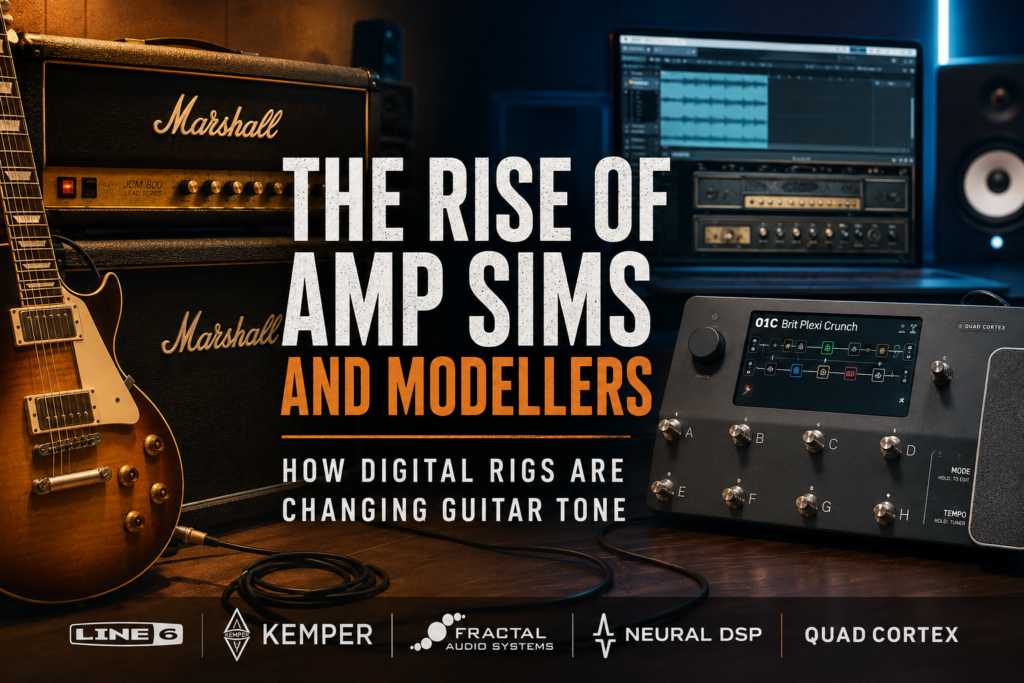
Kemper. Fractal. Line 6. Neural DSP. Quad Cortex. Helix. TONEX.
Digital guitar technology has moved incredibly quickly over the past two decades, and the argument that amp modelling is simply a “cheap alternative” to a real amplifier is becoming increasingly difficult to make.
So how did we get here?
The Early Days of Digital Amp Modelling
The idea of digitally recreating guitar amplifiers isn’t particularly new.
During the 1980s and early 1990s, digital effects processors became increasingly common in guitar rigs. Rack systems from companies such as Rocktron, Digitech and ADA allowed guitarists to build complex programmable setups.
However, accurately recreating the sound and behaviour of a valve amplifier was another matter entirely.
Early digital guitar processors often had a distinctive character. While they offered enormous flexibility, many guitarists described the sounds as thin, fizzy or artificial.
The problem wasn’t simply recreating the frequency response of an amplifier.
A valve amplifier is an incredibly dynamic system.
The guitar interacts with the amplifier’s input stage. Preamp valves distort. Power valves compress. Transformers saturate. Speakers move air and react differently depending on volume.
Even the impedance relationship between the amplifier and speaker cabinet can affect the final sound.
Trying to reproduce all of this digitally was an enormous technical challenge.
Line 6 and the Modelling Revolution
One of the biggest turning points came during the late 1990s.
Line 6 introduced the AxSys 212 in 1996, followed shortly afterwards by the now legendary POD.
The original Line 6 POD looked unlike almost any guitar processor that had come before it.
Its kidney-shaped red enclosure became instantly recognisable.
More importantly, it allowed guitarists to access simulations of multiple famous amplifiers from a single device.
A guitarist could move from a Fender-style clean tone to a heavily distorted British stack without changing amplifiers.
For home recording, this was revolutionary.
Suddenly, guitarists could record directly into an audio interface without needing a microphone, amplifier or acoustically treated room.
The POD wasn’t perfect.
By modern standards, its amplifier models were relatively simple. But it proved that guitarists were willing to embrace digital amplifier technology if it offered enough convenience.
The modelling race had begun.
The Problem of “Feel”
For many guitarists, the biggest criticism of early amp modelling wasn’t necessarily the sound.
It was the feel.
Traditional valve amplifiers respond dramatically to a guitarist’s playing dynamics.
Play softly and the amplifier may remain relatively clean.
Dig into the strings and the sound begins to compress and distort.
Roll the guitar’s volume control back and the amplifier cleans up.
These small interactions are a major part of the playing experience.
Early digital processors often struggled to recreate this behaviour convincingly.
A digital amplifier might sound good when playing a sustained power chord but react unnaturally when the guitarist changed their picking dynamics.
This became one of the major battlegrounds for amplifier modelling technology.
Manufacturers weren’t simply trying to recreate the sound of an amplifier.
They were trying to recreate its behaviour.
Fractal Audio and High-End Modelling
During the 2000s, digital modelling began to move into far more serious territory.
Fractal Audio’s Axe-Fx became particularly influential.
Rather than presenting modelling as a budget alternative to a traditional amplifier, the Axe-Fx was positioned as a professional guitar processing system.
Its detailed amplifier models, extensive effects and deep editing capabilities attracted touring and studio musicians.
Suddenly, digital modelling was appearing in professional guitar rigs.
The advantages were obvious.
A guitarist could store hundreds of sounds in a single unit.
Complex effects chains could be recalled instantly.
MIDI switching allowed entire rigs to change with a single command.
Most importantly, the guitarist could send a consistent signal directly to the front-of-house mixing desk.
There was no microphone to move.
No amplifier volume to manage.
No speaker cabinet changing tone from venue to venue.
For touring musicians, consistency was incredibly valuable.
Kemper and the Rise of Profiling
In 2011, the Kemper Profiling Amplifier introduced a different approach.
Instead of digitally modelling the individual components of an amplifier circuit, Kemper allowed users to “profile” an existing amplifier setup.
The process involved sending test signals through an amplifier and analysing the resulting sound.
The Kemper would then create a digital profile designed to reproduce the characteristics of that amplifier.
This opened up fascinating possibilities.
A guitarist could profile their favourite amplifier in the studio and take the resulting digital profile on tour.
Studios began profiling rare and valuable amplifiers.
Vintage Marshalls.
Dumbles.
Trainwrecks.
Fender Tweeds.
Boutique amplifiers that might cost tens of thousands of pounds could effectively be captured and stored digitally.
The idea of the “digital amp collection” had arrived.
Impulse Responses Changed Everything
Another crucial development was the widespread adoption of impulse responses, commonly known as IRs.
For many years, speaker cabinet simulation was one of the weakest elements of digital guitar technology.
A great amplifier model running through an unrealistic speaker simulation could still sound artificial.
Impulse responses dramatically improved this.
An IR can capture the sonic characteristics of a speaker cabinet, microphone and microphone position.
This meant guitarists could digitally recreate highly specific recording setups.
A 4×12 cabinet loaded with Celestion Greenbacks.
A Shure SM57 positioned slightly off-axis.
A ribbon microphone placed further from the speaker.
All of these combinations could be captured and recalled digitally.
Suddenly, the virtual speaker cabinet became almost as important as the virtual amplifier.
The Helix Generation
When Line 6 introduced the Helix in 2015, amp modelling had entered a new phase.
The Helix combined advanced amplifier modelling with a large colour screen and a relatively intuitive interface.
This was important.
Earlier professional modelling systems could be incredibly powerful but sometimes required extensive menu navigation.
The Helix made complex digital rigs easier to understand.
Guitarists could visually build signal chains.
Amplifiers, cabinets and effects could be dragged into different positions.
Parallel signal paths could be created.
Multiple amplifiers could be blended together.
For many guitarists, the modeller was no longer simply replacing an amplifier.
It was replacing the entire rig.
Neural DSP and the Quad Cortex
The rise of Neural DSP demonstrated just how quickly guitar technology was evolving.
The company’s software plugins became particularly popular with modern metal and progressive guitarists.
Neural DSP’s Archetype series allowed guitarists to access carefully designed virtual rigs associated with individual artists.
Rather than presenting hundreds of amplifier models, these plugins often focused on a smaller collection of carefully curated sounds.
The Quad Cortex took the concept into dedicated hardware.
Its Neural Capture technology allowed users to capture amplifiers, pedals and complete signal chains.
Combined with a touchscreen interface and compact floorboard design, the Quad Cortex represented a new generation of modeller.
Digital rigs were becoming smaller, faster and increasingly powerful.
The Plugin Revolution
While hardware modellers transformed live guitar rigs, software plugins completely changed home recording.
A guitarist no longer needed an amplifier to record professional-quality guitar tracks.
All that was required was a guitar, an audio interface and a computer.
Companies including Neural DSP, IK Multimedia, Positive Grid, STL Tones and Universal Audio developed increasingly sophisticated amplifier simulations.
For bedroom musicians, the advantages were enormous.
You could record a cranked amplifier tone at midnight without disturbing anyone.
You could change amplifiers after recording the guitar part.
You could automate effects.
You could run multiple amplifier setups simultaneously.
Perhaps most importantly, guitarists could experiment with equipment they might never be able to afford in the real world.
The traditional barrier between professional studio equipment and home recording began to disappear.
Why Touring Guitarists Love Modellers
One of the biggest reasons for the rise of modelling technology is touring logistics.
Traditional guitar rigs can be incredibly complicated.
Amplifier heads are heavy.
Speaker cabinets are even heavier.
Vintage amplifiers can be unreliable.
Valves fail.
Microphones move.
Different venues have different acoustics.
A digital modeller solves many of these problems.
A guitarist can carry an entire rig in a flight case or backpack.
The same presets used during rehearsals can be used on stage.
The front-of-house engineer receives a consistent signal every night.
For international touring, the benefits become even greater.
Instead of shipping valuable vintage amplifiers around the world, a guitarist can travel with a modeller and load their presets.
Some touring guitarists even carry a second identical unit as a backup.
If the main modeller fails, the backup can be connected within minutes.
Try doing that with a 1968 Marshall Plexi.
The Rise of Full-Range Speakers
The popularity of modelling also created demand for a different type of guitar speaker.
Traditional guitar speakers deliberately colour the sound.
A Celestion Greenback sounds very different from a Jensen-style speaker.
However, a modeller may already be digitally recreating the speaker cabinet.
Running that signal through another traditional guitar speaker can dramatically alter the tone.
This led to the rise of FRFR speakers.
FRFR stands for “Full Range, Flat Response”.
These speakers are designed to reproduce the signal from the modeller as accurately as possible.
The idea is that the modeller controls the entire guitar sound.
Amplifier.
Speaker cabinet.
Microphone.
Effects.
The FRFR system simply makes that sound louder.
Are Amp Sims Really Indistinguishable From Real Amps?
This remains one of the most controversial questions in the guitar world.
In a blind recording test, high-quality amp simulations can be incredibly difficult to distinguish from real amplifiers.
Particularly once the guitar is placed within a full band mix.
However, playing through an amplifier in a room is a different experience.
A loud valve amplifier physically moves air.
The guitar interacts with the speaker.
Feedback develops naturally.
The sound changes depending on where the guitarist stands.
These physical interactions can be difficult to reproduce through headphones or studio monitors.
For this reason, many guitarists who happily use amp sims for recording still prefer traditional amplifiers for live playing.
Others use hybrid systems.
A modeller may provide the amplifier sound while a traditional power amplifier and guitar cabinet provide the physical playing experience.
There is no single correct solution.
The Cost Question
Modelling technology has also changed the economics of guitar equipment.
A single high-end modeller may cost more than a traditional amplifier.
However, that modeller might contain digital recreations of hundreds of amplifiers, speaker cabinets and effects.
Building an equivalent physical collection would cost an extraordinary amount of money.
Even software plugins have become remarkably accessible.
For the price of a single boutique pedal, a guitarist can purchase a virtual amplifier suite containing multiple amplifiers and cabinets.
This has allowed a new generation of musicians to experiment with an enormous variety of guitar tones.
The Return of Simplicity
Interestingly, as digital guitar systems have become more powerful, some manufacturers have started moving back towards simplicity.
Many guitarists don’t want 300 amplifier models.
They want three great sounds.
Clean.
Crunch.
Lead.
This has led to a new generation of simplified modelling products.
Devices such as the Universal Audio UAFX amp pedals and compact amp-in-a-box modellers focus on recreating a small number of specific amplifier styles.
Rather than replacing an entire guitar rig, these devices can simply sit on a pedalboard.
The technology is digital.
The experience feels increasingly traditional.
Are Valve Amps Disappearing?
Probably not.
Vinyl records didn’t disappear when digital music arrived.
Film cameras didn’t disappear when smartphones became capable of taking excellent photographs.
And valve amplifiers are unlikely to disappear because modelling technology exists.
Traditional amplifiers offer something digital technology cannot completely replicate.
History.
Physical interaction.
Mechanical simplicity.
And, perhaps most importantly, character.
There is something undeniably satisfying about plugging a Telecaster directly into a cranked valve amplifier.
No menus.
No firmware.
No presets.
Just guitar and amplifier.
But modelling technology offers something equally compelling.
Convenience.
Consistency.
Flexibility.
And access to an almost unlimited collection of sounds.
The Future of Guitar Amplification
The most interesting development may be the growing overlap between traditional and digital equipment.
Modern amplifiers increasingly include digital technology.
Digital modellers are designed to interact with traditional speaker cabinets.
Pedals can capture amplifiers.
Software can recreate complete recording chains.
The distinction between “real” and “digital” guitar rigs is becoming increasingly blurred.
For younger guitarists, amp simulation is often completely normal.
Their first experience of a Marshall Plexi may not be a vintage amplifier.
It might be a plugin.
Their first Fender Twin might exist inside a laptop.
And their entire guitar rig might fit inside a backpack.
The valve amplifier isn’t dead.
But for the first time in the history of the electric guitar, it is no longer the automatic centre of the guitar rig.
The amplifier has become a choice.
And in many ways, that may be the biggest revolution of all.