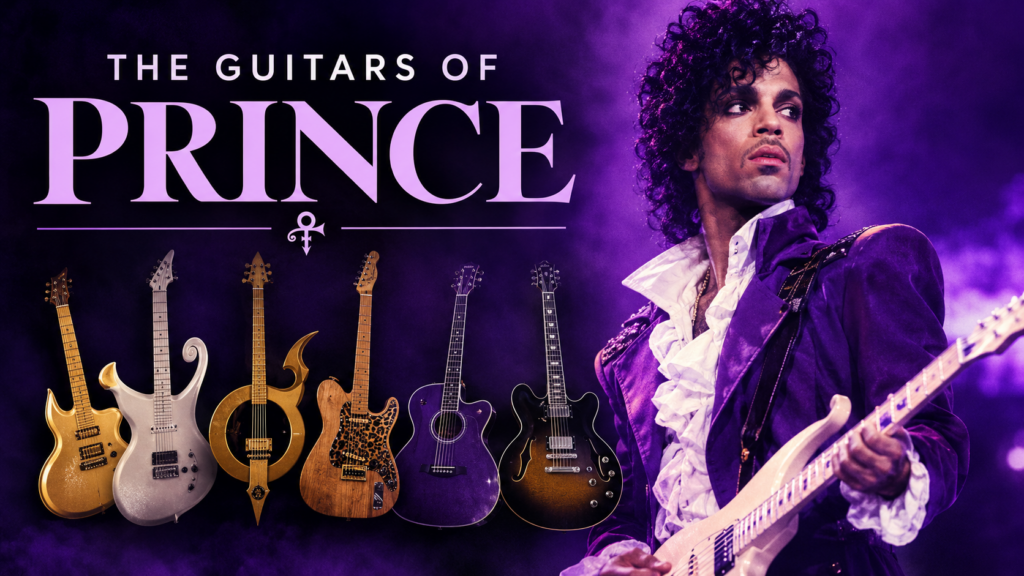
Prince was one of the most versatile musicians of his generation. A singer, songwriter, producer, multi instrumentalist, and electrifying performer, he moved effortlessly between funk, rock, soul, pop, and psychedelia, often blurring the boundaries between them in a way that few artists could match.
His guitar playing was a vital part of that identity. Although his extraordinary vocals, flamboyant stage presence, and command of the studio sometimes overshadowed his ability on the instrument, Prince was a formidable guitarist. He could deliver razor sharp funk rhythms, expressive blues phrasing, and searing rock solos, often within the same performance. His playing was technically assured, but it was his sense of melody, timing, and dynamics that made it truly distinctive.
Just as individual as his playing was his choice of instruments. From custom built guitars with instantly recognisable silhouettes to classic American designs and unusual boutique creations, Prince assembled a collection that reflected his refusal to follow convention. His guitars were not simply stage props. They were carefully chosen tools for a musician who understood that sound, feel, and visual identity were all part of the same artistic statement.
Here, we explore some of the most memorable guitars associated with Prince, the stories behind them, and the sounds that helped make his music so unmistakable.
The Hohner HG-490 Mad Cat: The Guitar Behind the Legend
For all the attention given to Prince’s spectacular custom instruments, one of his most important guitars was comparatively conventional in appearance. The Hohner HG-490, widely known as the Mad Cat, became one of the defining instruments of his career and remained a favourite across multiple decades.
Prince acquired the guitar around 1979, before his rise to international superstardom. Its familiar Telecaster inspired outline was paired with distinctive figured timber, a walnut centre section, and a striking pickguard with a leopard print appearance. Despite the resemblance to a Fender design, the Mad Cat had its own construction and electronics, including Stratocaster style pickups and a hardtail bridge arrangement. It was manufactured in Japan by Moridaira and distributed under several names, including Hohner and H.S. Anderson.
The guitar’s reputation was built through use rather than novelty. It became a key instrument during the Dirty Mind, Controversy, 1999, and Purple Rain eras, and was particularly important in the studio. Its combination of bright attack, clarity, and responsive dynamics made it well suited to Prince’s intricate rhythm playing, where clipped chord stabs and tightly controlled accents were every bit as important as lead guitar.
That rhythmic precision was central to his sound. Prince could make a guitar part feel almost percussive, locking into the groove alongside bass and drums while leaving space for vocals, keyboards, and other instruments. The Mad Cat offered a practical, direct voice for this style, while remaining capable of delivering the cutting lead tones that appeared throughout his recordings and live performances.
There are plenty of stories about Prince acquiring the guitar cheaply, sometimes placing it at a petrol station purchase for around $30. The precise circumstances are difficult to establish, so the story is best treated as an anecdote rather than settled fact. What is beyond doubt is that the instrument became far more significant than its price or original market position might suggest.
Prince also had copies made by New York guitar builder Roger Sadowsky, particularly for touring. These helped provide reliable alternatives to the original as his performances became larger and more demanding. The original Mad Cat remains an important part of his surviving collection at Paisley Park.
The Mad Cat is a reminder that an iconic guitar does not need exotic specifications or a radical silhouette. Sometimes the connection between an instrument and a player is built through years of recording, performing, and developing a musical language that becomes inseparable from its sound.
The Cloud Guitar: An Icon of the Purple Rain Era
If the Mad Cat represents Prince the working guitarist, the Cloud guitar represents Prince the visual innovator. Its flowing, asymmetrical body shape became one of the most recognisable guitar designs in popular music, forever associated with the Purple Rain film and the extraordinary period that transformed him into a global superstar.
The original Cloud was built in Minneapolis in 1983 by luthier Dave Rusan at Knut-Koupée Music. Its design drew inspiration from a distinctive Sardonyx bass Prince had acquired in the late 1970s, itself influenced by the shape of Gibson’s F-style mandolins. The result was an instrument unlike anything normally seen on a mainstream rock stage.
The Cloud’s visual drama was matched by serious construction. The original design featured a maple neck through body, a 24.75 inch scale length, a brass nut, and active EMG pickups, including an SA single coil in the neck position and an 81 humbucker at the bridge. Schaller hardware and straightforward master volume and tone controls completed an instrument designed for the demands of Prince’s live performances.
Its appearance in Purple Rain ensured that the guitar became part of the film’s identity. Yet the Cloud was not merely a prop. Prince continued to use Cloud guitars on stage and in later recording periods, with additional examples built to serve different touring requirements. The original and its successors underwent repairs and refinishing over the years, reflecting the realities of instruments used in an energetic live show.
The original Cloud was also more individual than later production versions. The early instruments differed in construction details and finish, and their fretboard markings were changed during their working lives. Subsequent versions were built by other luthiers, while Schecter eventually introduced production models that brought the distinctive design to a wider audience.
The Cloud’s importance goes beyond its unusual outline. It demonstrated that a guitar could be both a functional musical instrument and an essential part of an artist’s visual identity. Its unmistakable shape was perfectly suited to Prince’s theatrical performances, but it was also a reminder that he approached every aspect of his work as an opportunity to create something individual.
For guitar design, the Cloud remains one of the most recognisable examples of an artist working closely with a builder to turn a personal idea into an instrument with a life of its own.
The Auerswald Symbol Guitar: Music Meets Identity
In the early 1990s, Prince made one of the most unusual decisions in modern popular music by adopting an unpronounceable symbol as his name. The change was accompanied by a guitar that took the same visual idea and translated it into a playable instrument.
Built by German luthier Jerry Auerswald, the Symbol guitar was a custom creation that reflected Prince’s growing interest in instruments that existed outside conventional guitar design. Its body followed the outline of the symbol, making it instantly identifiable in photographs and performances from the period.
The original gold instrument featured maple construction, active EMG pickups, a custom bridge, and distinctive heart shaped tuning buttons. Its electronics combined an EMG SA single coil at the neck with an EMG 81 humbucker at the bridge, giving Prince a range of sounds suited to both clean passages and heavier lead work. The shorter 24.75 inch scale also placed it in familiar territory for players accustomed to Gibson style instruments.
The guitar appeared in the videos for Endorphinmachine and Gold, providing a visual counterpart to the music of The Gold Experience. Prince’s decision to have the instrument built was characteristic of his approach to creativity: rather than choosing an existing model and making it his own through performance, he worked with a builder to create something that directly expressed his identity.
Other versions followed. Andy Beech built copies in different finishes, while Schecter later produced a related design known as the Habibe. Prince continued to use symbol shaped instruments through subsequent periods of his career, although the precise identities and origins of individual examples can be difficult to establish from photographs alone.
The Symbol guitar is perhaps the clearest expression of Prince’s belief that an instrument could communicate something before a single note was played. Its design was unconventional, but it was not novelty for novelty’s sake. It was an extension of an artist who treated music, fashion, performance, and personal identity as parts of a single creative vision.
The Auerswald Model C: Prince’s Rock Guitar
Another instrument from Prince’s custom guitar collection was the Auerswald Model C, a striking design that first appeared publicly in the late 1980s. Built by the same German luthier responsible for the Symbol guitar, the Model C offered a very different approach to guitar construction.
Its headless design, unusual body profile, and distinctive hardware gave it a futuristic appearance. Rather than placing conventional tuning machines on a headstock, the instrument incorporated its tuning mechanism into the bridge, with the strings secured at the opposite end of the neck. The construction also featured a sustain bow, intended to improve sustain and add stability to the neck.
Like the Symbol guitar, the Model C used active EMG pickups, combining a single coil and humbucker configuration. Prince reportedly regarded it as his rock guitar, reflecting its role as a contrasting voice to the brighter, more rhythmically focused sounds associated with the Mad Cat.
The Model C suited Prince’s willingness to experiment with heavier sounds and more aggressive lead playing. Its unconventional construction also demonstrated that he was interested in the engineering of his instruments, not just their appearance.
For a musician who could move from delicate funk rhythms to explosive rock solos within a single show, having instruments with distinct personalities was a practical advantage. The Model C occupied a different space from the Cloud and Mad Cat, while remaining unmistakably part of Prince’s musical world.
The Gibson L6-S Deluxe: An Early Working Instrument
Before the Cloud guitars and custom Auerswald instruments became synonymous with Prince, his equipment was more closely associated with the conventional designs of the 1970s. Among the most significant guitars from this period was the Gibson L6-S Deluxe, an instrument that accompanied him during his early touring career.
Introduced in the mid 1970s, the L6-S was an unusual departure from Gibson’s traditional electric guitar designs. Its all maple construction, slim body, 24 fret neck, and versatile switching system gave it a modern feel, while its two humbuckers provided a broad range of tones. The six position rotary switch offered combinations beyond the standard pickup selector arrangements found on many electric guitars of the period.
Prince used an L6-S Deluxe during his first touring period, and the instrument remains part of the collection at Paisley Park. It represents an interesting chapter in his development, before his later custom guitars became so closely associated with his image.
The L6-S is also a reminder that Prince’s interest in unusual instruments did not begin with the Cloud. Even early in his career, he was drawn to guitars that offered something different, whether through their appearance, electronics, or playing feel.
The Ibanez GB12: A Different Side of Prince
Prince’s guitar playing was often associated with funk and rock, but his musical interests extended well beyond those genres. His appreciation for jazz harmony, sophisticated chord voicings, and expressive melodic playing makes his association with the Ibanez GB12 particularly interesting.
The GB12 is a George Benson signature hollow body electric guitar, designed around the traditional jazz archtop format. Its carved body, floating style bridge and tailpiece arrangement, and warm sounding pickups offer a very different playing experience from a solid body instrument such as the Mad Cat.
Prince acquired an Ibanez GB12 after jazz guitarist George Benson recorded at Paisley Park in 1996 and left the instrument as a gift. It subsequently became one of Prince’s preferred guitars for live performances and studio work over the following decade.
The instrument makes sense in the context of Prince’s broader musical vocabulary. His playing could be sharp and percussive, but he was equally capable of fluid melodic lines and sophisticated chord work. A quality hollow body guitar offers a different response under the fingers, with a rounded attack and a resonance that can be particularly appealing for jazz influenced playing.
The GB12 also illustrates an important point about Prince’s collection: his choices were not governed by a single signature sound. He selected instruments according to the musical situation, and his collection reflected the breadth of his interests as a guitarist.
The Vox HDC-77: A Modern Guitar for a Changing Sound
By the later years of his career, Prince was continuing to explore contemporary guitar designs alongside his established favourites. One of the more interesting instruments associated with this period was the Vox HDC-77, a modern semi hollow electric guitar that offered a different combination of resonance, sustain, and attack.
The HDC-77 formed part of Vox’s modern electric guitar range, with a distinctive body design that departed from traditional hollow body and solid body templates. Its construction and electronics were intended to offer a broad palette of sounds, making it a useful instrument for players who wanted to move between clean textures and more driven tones.
Prince was introduced to the Vox by Ida Kristine Nielsen, bassist in his later band 3rdeyegirl. He subsequently played HDC-77 guitars in finishes including Blackburst and White Ivory.
The choice is particularly revealing because it shows that Prince’s interest in guitars did not remain fixed on the instruments that had defined his earlier career. Even with the Mad Cat and Cloud already firmly established as icons, he continued to experiment with new designs and sounds.
For a guitarist whose work spanned decades and an extraordinary range of styles, that willingness to explore was entirely consistent with his approach to music.
Taylor Guitars and the Acoustic Side of Prince
Although Prince is most readily associated with electric guitars, acoustic and electro acoustic instruments also played an important role in his work.
During the 1980s, he used acoustic guitars from manufacturers including Ovation and Guild. Later, his collection expanded to include instruments such as the Gibson Chet Atkins SST, Godin Acousticaster, and Fernandes electro acoustic models. These offered different ways to bring acoustic style sounds into a studio environment or amplified performance.
In 2004, Prince began a more visible association with Taylor Guitars during the period surrounding the release of Musicology. Among the instruments he played was a custom purple Taylor 612ce, and he also worked with the company in connection with its T5 Thinline design.
The Taylor T5 is particularly relevant to Prince’s approach to tone. Designed to bridge the gap between acoustic and electric guitars, it combines a chambered body with a pickup system intended to provide several different tonal voices. This sort of versatility is valuable for a player who might need a more acoustic character for one song and a fuller electric sound for another.
Prince’s acoustic choices reflect a side of his musicianship that can sometimes be overlooked. Behind the flamboyant stage performances and explosive solos was a songwriter who understood the importance of harmony, melody, and arrangement. Acoustic instruments were another part of that musical toolkit, helping him create textures that were distinct from the sharp funk rhythms and overdriven lead tones of his electric work.
What Made Prince’s Guitar Playing So Distinctive?
The instruments Prince used were fascinating in their own right, but their significance becomes clearer when considered alongside his playing style.
He was a remarkably complete guitarist. His rhythm work was economical and precise, built around carefully placed chord stabs, muted strings, and subtle variations in timing. Rather than filling every available space, he understood how a guitar could contribute to a groove by leaving room for the other musicians.
His lead playing was equally distinctive. Prince could move from blues influenced bends and expressive vibrato to fast, technically demanding passages without losing the melodic thread. His solos often built gradually, beginning with a simple phrase before developing into something more intense. The result was music that felt spontaneous and emotionally direct, even when the playing itself was highly accomplished.
The Purple Rain album and film offer perhaps the clearest illustration of this balance. The Cloud guitar became an enduring visual symbol of the period, but the music itself demonstrates why Prince’s playing mattered. His guitar parts served the songs, whether supporting the rhythm section or taking centre stage during a climactic solo.
It is also worth remembering that the guitar was only one part of his musical identity. Prince frequently wrote, arranged, performed, and produced his own material, and his understanding of the relationship between instruments gave his guitar playing a particularly strong sense of context. He knew when to step forward and when to let the groove carry the music.
The Lasting Legacy of Prince’s Guitars
Prince’s guitar collection tells the story of a musician who refused to be confined by convention. The Hohner Mad Cat demonstrated that a relatively understated instrument could become legendary in the right hands. The Cloud guitar transformed an imaginative custom design into one of the most recognisable instruments in popular music. His Auerswald guitars pushed the boundaries of shape and construction, while instruments such as the Ibanez GB12 and Taylor T5 reflected his wider musical interests.
Together, these guitars reveal a player who valued individuality, versatility, and creative freedom. Some were chosen for their practical qualities, others for their distinctive appearance, and many for a combination of both. What united them was the fact that Prince made them part of his own musical language.
For guitar enthusiasts, his collection is a reminder that there is no single formula for finding the right instrument. A guitar does not need to follow tradition to be great, nor does an unusual design automatically make it special. What matters is the relationship between the player, the instrument, and the music they create together.
Prince understood that relationship better than most. His guitars were extensions of his personality, but they were also working instruments, used to write songs, shape recordings, and deliver unforgettable performances. Long after his passing in 2016, they remain an essential part of the story of one of music’s most original and influential talents.