When discussing the greatest guitars ever made, certain names dominate the conversation. The Gibson Les Paul, Fender Stratocaster and Telecaster have earned their places in music history, shaping the sound of everything from blues and classic rock to country, funk and heavy metal.
But what about the guitars that never quite received the same recognition?
For every legendary instrument that commands the spotlight, there are countless others that have delivered exceptional tone, innovative design and serious playing credentials without ever achieving quite the same level of fame. Some were misunderstood when they first appeared, others were overshadowed by more successful models, and a few simply never received the attention they deserved.
For guitarists, these overlooked instruments can be some of the most interesting guitars to explore. They offer something a little different from the usual suspects, whether that means unusual styling, distinctive pickups, alternative construction or simply a sound that stands apart from the crowd.
So, let’s take a closer look at ten underrated guitars that deserve far more recognition than they often receive.
1. Fender Jazzmaster: The Alternative Classic
When Fender introduced the Jazzmaster in 1958, it was originally aimed at jazz musicians. With its offset body, floating tremolo system and distinctive rhythm circuit, it represented a different approach to electric guitar design.
However, the Jazzmaster never quite conquered the jazz market as Fender had hoped.
Instead, it eventually found a home with surf rockers, alternative musicians and indie guitarists who appreciated its unique character.
The Jazzmaster’s wide, flat single-coil pickups deliver a sound that’s different from the brighter, more familiar Stratocaster voice. Depending on the setup, they can offer a warm, full-bodied tone with plenty of clarity and an appealing edge when pushed through an amplifier.
Its offset body also makes it comfortable to play, while the tremolo system provides a softer, more subtle approach to pitch movement than many conventional vibrato designs.
Artists across alternative rock and indie music helped bring the Jazzmaster back into the spotlight, proving that its unusual design was far from a disadvantage.
Why it deserves more recognition: The Jazzmaster offers a distinctive combination of vintage character, expressive controls and alternative-rock versatility. For players looking beyond the traditional Stratocaster or Telecaster, it’s a seriously compelling option.
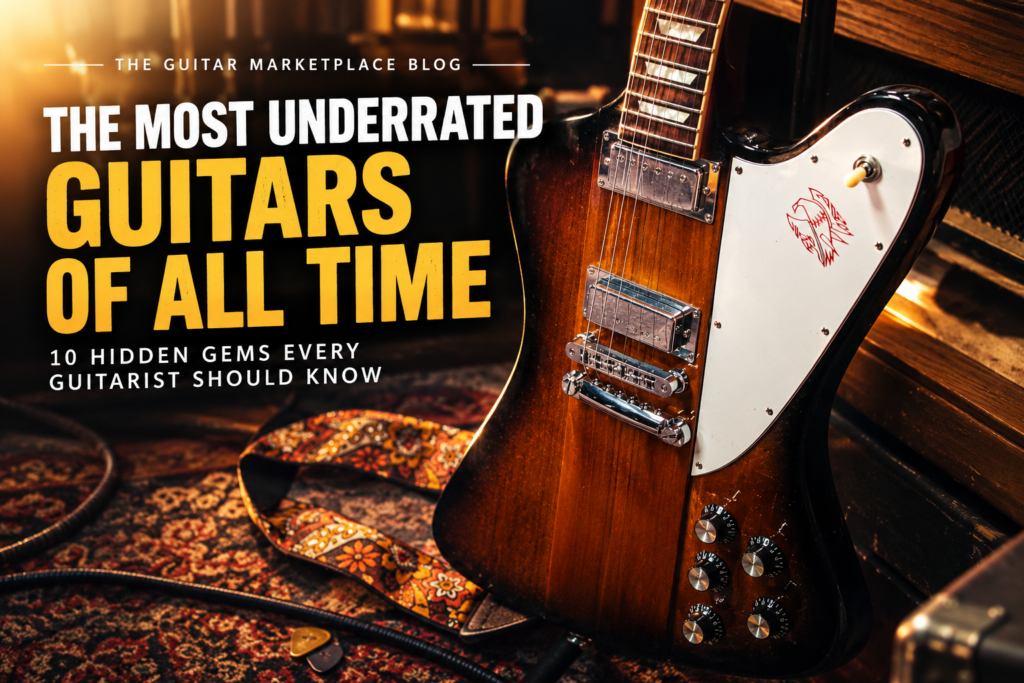
2. Gibson Firebird: A Bold Design with Serious Bite
Introduced in 1963, the Gibson Firebird was one of the company’s most adventurous designs.
With its reverse body shape, elongated headstock and distinctive construction, it looked unlike almost anything else on the market at the time.
The design was developed with input from automotive designer Ray Dietrich, whose background helped give the Firebird its unmistakable styling.
But the Firebird was never just about looks.
Its mini-humbucking pickups provide a distinctive voice, combining clarity and definition with enough power to handle blues, rock and heavier styles. Compared with the fuller sound often associated with traditional Les Paul humbuckers, Firebirds can deliver a more focused, cutting tone that sits particularly well in a band mix.
The guitar has been embraced by players such as Johnny Winter, whose fiery blues-rock playing demonstrated just how expressive the instrument could be.
Despite its impressive pedigree, the Firebird often remains in the shadow of Gibson’s more familiar models.
Why it deserves more recognition: The Firebird combines one of the most distinctive silhouettes in guitar history with a sound that stands apart from the usual Gibson formula. It’s a great example of a guitar that rewards players willing to look beyond the obvious choices.
3. Yamaha SG Series: Japanese Craftsmanship at Its Finest
Yamaha might be best known by many guitarists for its acoustic instruments, affordable electrics and musical equipment, but the company’s SG series deserves a place in any conversation about serious electric guitars.
The SG-2000, introduced in the 1970s, became one of Yamaha’s flagship electric models. Built with premium materials and a strong emphasis on craftsmanship, it was designed to compete with some of the finest instruments available.
Its substantial construction, set-neck design and carefully developed electronics helped produce a powerful, sustaining tone suited to rock, fusion and blues.
One of the guitar’s most notable champions was Carlos Santana, who used Yamaha SG instruments during parts of his career. His playing demonstrated how effectively the guitar could deliver rich sustain and expressive lead tones.
Despite this association, Yamaha SG models rarely receive the same attention as comparable instruments from Gibson.
Part of their appeal today is that they offer a different route into high-quality vintage guitar ownership. Rather than following the most obvious path towards a familiar American classic, players can discover a well-built instrument with its own identity.
Why it deserves more recognition: The Yamaha SG series proves that outstanding guitars have never belonged exclusively to the biggest American brands. For players who value craftsmanship, sustain and a distinctive alternative to the usual classics, it’s well worth investigating.
4. Guild Starfire: Hollow-Body Character Without the Usual Hype
Guild has produced some exceptional guitars throughout its history, yet the brand often finds itself overshadowed by Gibson and Fender.
The Starfire series is a perfect example.
Combining elegant semi-hollow and hollow-body designs with a range of pickup configurations, Starfire guitars offer a distinctive blend of warmth, resonance and vintage character.
Different models have their own specifications and tonal qualities, but many Starfires are particularly well suited to blues, jazz, rockabilly and classic rock.
Their semi-hollow construction can provide a lively, open response, while suitable pickup configurations offer everything from rounded, clean tones to gritty overdriven sounds.
The Guild Starfire also has a strong musical heritage. Artists including Kim Thayil of Soundgarden have used Starfire models, demonstrating that these guitars can handle far more than traditional jazz or vintage blues.
For players who love the idea of a semi-hollow guitar but want to explore beyond the familiar Gibson ES-335, Guild deserves serious consideration.
Why it deserves more recognition: The Starfire combines vintage styling, expressive tone and genuine versatility. It’s a reminder that some of the best alternatives to iconic guitars come from brands with their own rich histories.
5. Gretsch Duo Jet: The Rock Machine That Isn’t a Hollow-Body
Gretsch is often associated with big hollow-body guitars, rockabilly, country and the unmistakable sounds of players such as Brian Setzer.
However, the Duo Jet offers something a little different.
First introduced in the 1950s, the Duo Jet features a chambered body construction beneath its solid-looking exterior. This gives it a different feel and response from both traditional hollow-body Gretsches and conventional solid-body guitars.
Depending on the model and pickup configuration, the Duo Jet can deliver a focused, punchy sound with plenty of character.
Its place in rock history is particularly significant thanks to George Harrison, who used a Gretsch Duo Jet early in his career with The Beatles. The instrument became an important part of his early guitar identity and remains closely associated with that period.
Despite its historical significance, the Duo Jet sometimes gets overlooked by players who immediately gravitate towards a Les Paul or a more familiar Gretsch hollow-body.
That would be a mistake.
Why it deserves more recognition: The Duo Jet offers a distinctive alternative for players who want vintage character, strong midrange presence and a guitar with genuine rock history. It can occupy a different tonal space from the instruments most guitarists instinctively reach for.
6. Fender Mustang: Small Body, Big Personality
The Fender Mustang arrived in 1964 as part of Fender’s student-guitar range.
Originally designed to appeal to younger players, it featured a shorter scale length, compact body and distinctive switching system.
For years, the Mustang was viewed as a more affordable alternative to Fender’s flagship models rather than a serious instrument in its own right.
Then alternative rock came along.
Musicians drawn to the Mustang’s compact feel and distinctive sound helped transform its reputation. Kurt Cobain became one of its most recognisable users, bringing the guitar to a much wider audience during Nirvana’s rise.
The Mustang’s shorter scale length can make it comfortable for players who prefer a more compact feel, while its pickup and switching arrangements give it a voice that differs from the Stratocaster and Telecaster.
It isn’t simply a smaller version of another Fender. Its design has a personality all of its own.
Different Mustang models vary considerably, so it’s worth checking the specific pickups, switching and hardware when comparing instruments.
Why it deserves more recognition: The Mustang is proof that a guitar doesn’t need a full-sized body or a conventional configuration to deliver serious musical results. It’s particularly appealing to players who value comfort, character and an alternative approach to the classic Fender sound.
7. Music Man Silhouette: A Modern Classic That Deserves More Attention
While vintage guitar discussions often revolve around instruments from the 1950s and 1960s, some more modern designs deserve a place in the conversation too.
The Music Man Silhouette is one such guitar.
Introduced in 1986, it combined Music Man’s reputation for quality construction with a more contemporary take on the double-cutaway electric guitar.
Depending on the version, features can include humbuckers, single-coil pickups, locking tuners and other refinements designed to deliver reliable performance.
The result is an instrument that can cover a wide range of musical styles without feeling like a copy of a traditional Stratocaster.
Music Man has long attracted players who appreciate precision, comfortable necks and carefully engineered hardware. The Silhouette embodies that approach, offering a different perspective on what a versatile electric guitar can be.
Although the brand has a loyal following, its guitars can still be overlooked by players who focus primarily on Fender, Gibson and PRS.
Why it deserves more recognition: The Silhouette demonstrates how modern guitar design can build on familiar ideas while improving playability and versatility. For players who want something refined without sacrificing personality, it’s well worth exploring.
8. Rickenbacker 330: More Than Just a Jangle Machine
Rickenbacker guitars are instantly recognisable, thanks to their distinctive body shapes, unique styling and association with some of the most influential bands in music history.
Yet the 330 can sometimes be pigeonholed as a guitar designed exclusively for jangly, vintage pop tones.
That’s selling it short.
The Rickenbacker 330 is a semi-hollow electric guitar featuring the company’s distinctive pickup designs and a sound that can be bright, articulate and remarkably expressive.
Its association with The Beatles helped establish its place in music history, while its continued use by alternative and indie musicians has demonstrated its versatility across different eras.
The guitar’s natural clarity makes it particularly effective for chiming chords and melodic lines, but it can also deliver more aggressive sounds when paired with the right amplifier and effects.
Its neck feel and playing response differ from those of more conventional electric guitars, which means it won’t suit everyone. For the right player, however, that individuality is precisely the attraction.
Why it deserves more recognition: The 330 is far more versatile than its reputation sometimes suggests. It’s an instrument with a distinctive voice, a strong musical heritage and a character that’s difficult to replicate with anything else.
9. Reverend Double Agent: A Modern Guitar with Its Own Identity
Not every underrated guitar needs decades of history behind it.
Reverend has built a loyal following by producing instruments that combine familiar guitar concepts with thoughtful design choices, and the Double Agent is a strong example.
Depending on the version, the Double Agent combines a humbucker with a P-90-style pickup, giving players access to two distinctly different tonal characters in one instrument.
The humbucker provides a fuller, thicker sound, while the P-90-style pickup offers a more open, midrange-focused response with plenty of bite.
That combination makes the guitar particularly appealing to players who move between clean passages, crunchy rhythm work and expressive lead tones.
Reverend guitars also tend to prioritise practical details, with features varying by model and production year. The brand has developed a reputation for offering distinctive designs without relying entirely on vintage nostalgia.
Although it doesn’t have the same mainstream recognition as Fender or Gibson, the Double Agent offers a compelling option for players looking for something different.
Why it deserves more recognition: Its contrasting pickup voices make it a genuinely versatile instrument, while its distinctive design helps it stand apart from the crowded world of conventional double-cutaway guitars.
10. Epiphone Casino: A Classic That Still Gets Overshadowed
Including the Epiphone Casino on a list of underrated guitars might seem a little surprising.
After all, it has a famous history, particularly through its association with The Beatles and John Lennon.
However, the Casino is still sometimes dismissed as the more affordable alternative to the Gibson ES-330 or other semi-hollow instruments, rather than appreciated for what it actually is.
Unlike a semi-hollow guitar with a solid centre block, the Casino has a fully hollow body. Combined with its P-90 pickups, this gives it a lively, resonant character that can be wonderfully expressive.
It excels at chiming clean tones, gritty rhythm sounds and the kind of edge-of-breakup response that works beautifully for blues and classic rock.
The hollow construction also means it can be more susceptible to feedback at high volume than many solid-body guitars. In the right setting, though, that responsiveness is part of its appeal.
The Casino has earned its place in music history, but its appeal extends well beyond nostalgia.
Why it deserves more recognition: The Casino is a distinctive instrument with a sound and playing response all its own. It offers an alternative to conventional solid-body guitars and remains a compelling choice for players who appreciate character over conformity.
What Makes an Underrated Guitar Worth Owning?
Of course, calling a guitar underrated doesn’t automatically make it a bargain or a better instrument than a more famous model.
Every guitar has its strengths, weaknesses and intended audience. The right choice depends on what you want from an instrument, how it feels in your hands and whether its sound inspires you to play.
There are, however, a few things worth considering when exploring guitars that sit outside the mainstream.
Don’t judge a guitar by its badge
A famous logo can be reassuring, but it isn’t the only indicator of quality. Instruments from brands such as Yamaha, Guild, Gretsch and Music Man have demonstrated that excellent design and craftsmanship can be found well beyond the most obvious names.
Think about the sound you actually need
A guitar that works brilliantly for one player might be completely wrong for another. Pickup configuration, body construction, scale length and hardware all influence the playing experience.
If you’re looking for something different, consider what your current guitar doesn’t do particularly well. A semi-hollow instrument might provide the openness you’re missing, while a guitar with contrasting pickups could offer greater tonal flexibility.
Research individual models, not just brands
Specifications can change significantly between model years and versions. Two guitars carrying the same model name may have different pickups, neck profiles, bridges or construction details.
This is particularly important when buying used or vintage instruments.
Remember that underrated doesn’t always mean inexpensive
Some overlooked guitars have developed strong followings, and certain vintage examples can command substantial prices. Condition, rarity, originality, provenance and demand all play a part.
The best reason to buy an underrated guitar is that it offers something you genuinely value, not simply because you hope it will become more collectible.
Final Thoughts
The guitar world will probably always have its headline acts.
The Gibson Les Paul and Fender Stratocaster aren’t going anywhere, and their influence on music is impossible to overstate.
But some of the most rewarding instruments to own are those that take a slightly different path.
From the unmistakable shape of the Gibson Firebird to the versatile Yamaha SG, the alternative character of the Fender Jazzmaster and the distinctive voice of the Rickenbacker 330, there’s a huge amount to discover beyond the usual classics.
For players, exploring these guitars can open up new sounds, new playing experiences and fresh inspiration. For collectors, it can provide a deeper appreciation of the design choices and musical stories that make each instrument unique.
And sometimes, the guitar that suits you best isn’t the one everyone else is talking about.
It’s the one that makes you want to pick it up, turn the amplifier on and play for another hour.