There are certain guitar sounds that are instantly recognisable, even before you know which instrument is being played. The bright, shimmering tones heard on some of the most memorable recordings of the 1960s are a perfect example. Often described as having a distinctive ‘jangle’, this sound became closely associated with one particular guitar manufacturer: Rickenbacker.
From George Harrison’s chiming twelve-string on The Beatles’ recordings to Roger McGuinn’s unmistakable guitar work with The Byrds, Rickenbacker instruments helped shape the sound of an entire generation of musicians.
However, the company’s influence extended well beyond its famous twelve-string guitars. Its distinctive six-string models and electric basses also became important parts of the British Invasion and the wider development of rock music.
So, how did a relatively unusual American guitar manufacturer become so closely associated with the music of the 1960s, and what exactly makes the Rickenbacker sound so distinctive?
The Early History of Rickenbacker
Although Rickenbacker became particularly famous during the 1960s, the company’s history goes back much further.
Its origins can be traced to 1931, when George Beauchamp and Adolph Rickenbacker established the Electro String Instrument Corporation in Los Angeles. The company was responsible for producing some of the earliest commercially successful electric guitars, at a time when musicians were beginning to experiment with amplification as a way of making their instruments louder.
One of its most recognisable early designs was the so-called ‘Frying Pan’, a lap steel guitar featuring a circular aluminium body and an electromagnetic pickup. Its unusual appearance reflected the experimental nature of electric instrument design during this period.
Rickenbacker continued developing electric instruments throughout the 1930s and 1940s, gradually establishing a reputation for innovative pickups and unconventional construction methods.
However, the company entered a new chapter in 1953, when businessman F.C. Hall acquired the business and began modernising its guitar range.
During the following years, Rickenbacker introduced a series of increasingly sophisticated electric guitars, including the Capri range of semi-hollowbody instruments. Designed with significant input from German guitar designer Roger Rossmeisl, these guitars featured elegant body shapes, distinctive finishes and construction details that would become closely associated with the brand.
By the end of the 1950s, Rickenbacker had developed a range of instruments that looked and sounded quite different from the guitars being produced by Fender and Gibson.
It was a distinctive identity that would soon prove extremely valuable.
The Beatles and the Rise of the Rickenbacker Twelve-String
Few bands have had a greater influence on the popularity of a particular guitar than The Beatles had on Rickenbacker.
The connection began in the early 1960s, when John Lennon acquired a Rickenbacker 325 during the band’s time in Hamburg, Germany. With its compact semi-hollow body, short scale length and distinctive appearance, the guitar quickly became one of his most recognisable instruments.
Lennon continued using the 325 throughout the band’s early years, helping introduce the Rickenbacker name to audiences around the world.
However, it was George Harrison’s adoption of the Rickenbacker twelve-string that would have an even greater impact on the company’s reputation.
In early 1964, Harrison received a Rickenbacker 360/12, an unusual electric guitar featuring twelve strings arranged in six pairs. Each pair consisted of a standard string and an accompanying octave string, creating a much fuller and more complex sound than a conventional six-string guitar.
Although electric twelve-string guitars had existed before, Rickenbacker’s design helped bring the instrument into the mainstream.
The guitar’s contribution can be heard particularly clearly on recordings from the band’s 1964 and 1965 period. Tracks such as ‘A Hard Day’s Night’, ‘You Can’t Do That’ and ‘Eight Days a Week’ helped demonstrate just how effective an electric twelve-string could be in a pop and rock setting.
Rather than simply adding extra volume or distortion, the instrument created a bright, shimmering texture that filled out the arrangement without overwhelming the other instruments.
For many listeners, this became the defining Rickenbacker sound.
What Makes the Rickenbacker Sound So Distinctive?
One of the most interesting aspects of Rickenbacker guitars is that their distinctive sound comes from a combination of design features rather than a single component.
The company’s famous twelve-string models are perhaps the clearest example.
Unlike a conventional six-string guitar, a twelve-string has six pairs of strings. Four of these pairs typically combine a standard string with another tuned an octave higher, while the remaining two pairs use strings tuned in unison.
When played together, these strings produce a naturally layered sound. The slight differences in pitch, timing and vibration create a shimmering effect that gives twelve-string guitars their characteristic richness.
Rickenbacker’s approach to string arrangement also helped distinguish its instruments. On many of its twelve-string models, the octave strings are positioned so that they are struck before their corresponding lower-pitched strings during a downstroke. This contributes to the instrument’s distinctive response and feel.
The pickups are another important part of the equation.
Rickenbacker became particularly well known for its ‘toaster-top’ pickups, named after their distinctive metal covers. These single-coil pickups produce a clear, bright sound with plenty of definition, making them particularly effective for chord work and melodic playing.
Combined with the company’s semi-hollowbody construction and relatively lightweight designs, they helped create an unmistakable tonal character.
Of course, not every Rickenbacker sounds exactly the same. Different models, pickup configurations, amplifiers and playing techniques all influence the final result.
Nevertheless, the combination of bright pickups, distinctive construction and, in the case of the twelve-string models, paired strings created a sound that was difficult to replicate with other instruments.
The Byrds and the Birth of Jangle Pop
While The Beatles introduced Rickenbacker’s twelve-string sound to a huge international audience, another band would take it in an entirely different direction.
The Byrds emerged in the mid-1960s, combining folk music influences with the energy and instrumentation of rock.
At the centre of their sound was guitarist Roger McGuinn and his Rickenbacker 360/12.
McGuinn had already been interested in twelve-string guitars before discovering the Rickenbacker. However, after seeing George Harrison playing his instrument in the film ‘A Hard Day’s Night’, he became determined to find one of his own.
He soon acquired a 360/12 and began using it as a central part of The Byrds’ musical identity.
The results were extraordinary.
On recordings such as ‘Mr. Tambourine Man’, ‘Turn! Turn! Turn!’ and ‘I’ll Feel a Whole Lot Better’, the Rickenbacker’s bright, chiming sound became almost as important as the band’s vocal harmonies.
McGuinn also experimented with his equipment, using compression and other effects to achieve a particularly consistent, ringing tone.
The combination of the Rickenbacker twelve-string and his distinctive playing style helped create what became known as the ‘jangle’ sound.
Its influence was enormous, inspiring countless musicians to explore the possibilities of electric twelve-string guitars and helping establish a style that would continue to influence folk rock, power pop and alternative music for decades.
Rickenbacker Wasn’t Just About Twelve-String Guitars
Although the twelve-string models often receive the most attention, Rickenbacker’s influence during the 1960s extended to its six-string guitars and basses.
John Lennon continued using his Model 325, while other musicians became attracted to the company’s distinctive Capri and solid-body designs.
The Who’s Pete Townshend, for example, used Rickenbacker guitars during parts of the band’s early career, helping demonstrate their suitability for the increasingly aggressive sound of British rock.
However, it was arguably the company’s bass guitars that would have one of its most lasting influences.
Paul McCartney began using a Rickenbacker 4001S bass during the mid-1960s, adding another distinctive instrument to The Beatles’ collection.
Its solid-body construction, slim neck and powerful pickup configuration offered a different playing experience from his familiar Hofner violin bass.
The instrument also produced a punchier, more defined sound that became increasingly prominent on the band’s later recordings.
Rickenbacker basses would go on to become particularly popular among rock and progressive rock musicians. Players such as Chris Squire of Yes helped establish the 4001 as one of the most recognisable electric bass designs ever produced.
This demonstrated that Rickenbacker’s reputation was about much more than the chiming sound of its twelve-string guitars.
The Design That Refused to Follow Fashion
Another reason Rickenbacker instruments became so recognisable was their appearance.
At a time when many guitar manufacturers were developing increasingly familiar solid-body designs, Rickenbacker continued producing instruments with distinctive body shapes, unusual finishes and individual styling details.
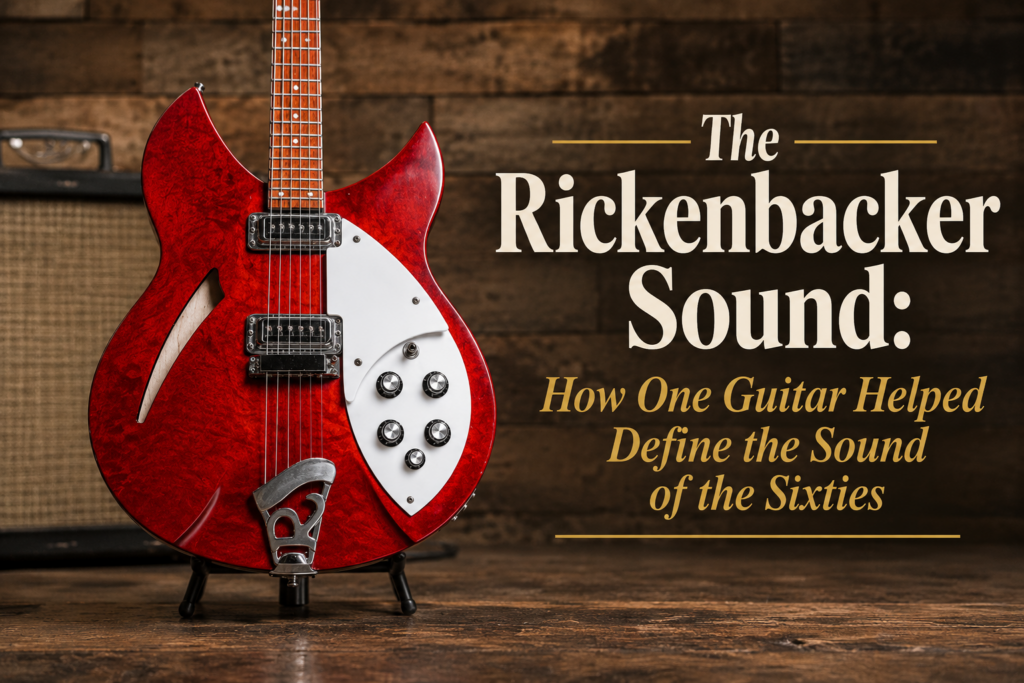
Models such as the 330 and 360 featured elegant semi-hollow bodies, distinctive cutaways and the company’s familiar slash-shaped sound holes on many versions.
The 360 also became particularly recognisable for its rounded body edges and binding, while the company’s solid-body guitars offered something quite different from the traditional Fender and Gibson designs.
Finishes such as Fireglo, with its distinctive red sunburst appearance, became closely associated with the brand and remain popular among collectors today.
These instruments were not simply designed to look different. Their construction, electronics and overall feel reflected Rickenbacker’s willingness to take a different approach to electric guitar manufacturing.
That individuality has become an important part of the company’s appeal.
For vintage guitar enthusiasts, details such as pickup types, body construction, finish variations and original hardware can all help establish the age and desirability of a particular instrument.
The Lasting Legacy of the Rickenbacker Sound
More than sixty years after The Beatles and The Byrds helped introduce Rickenbacker guitars to a worldwide audience, the company’s instruments remain closely associated with some of the most influential music ever recorded.
Their impact can be heard in the work of countless musicians who followed, from Tom Petty and The Jam to R.E.M. and many of the alternative rock bands that emerged during the 1980s and 1990s.
The electric twelve-string, in particular, has retained a special place in popular music. While modern effects and digital technology can recreate some aspects of its sound, there is still something distinctive about the natural shimmer produced by a well-played Rickenbacker.
The company’s instruments have also become increasingly interesting to collectors. Original 1960s examples, particularly those associated with famous musicians or important periods in the brand’s history, can attract considerable attention.
However, their appeal isn’t purely about rarity or historical significance.
For many guitarists, a Rickenbacker offers something genuinely different from the familiar sounds of a Stratocaster, Telecaster or Les Paul. Its distinctive appearance, unique playing characteristics and unmistakable tonal qualities make it an instrument with a personality all of its own.
Ultimately, Rickenbacker’s contribution to the sound of the 1960s was about more than creating a successful guitar design. It helped introduce new tonal possibilities into popular music, influencing how generations of musicians approached rhythm, melody and arrangement.
And while the music of that era continues to inspire guitarists today, the unmistakable Rickenbacker sound remains one of its most enduring legacies.