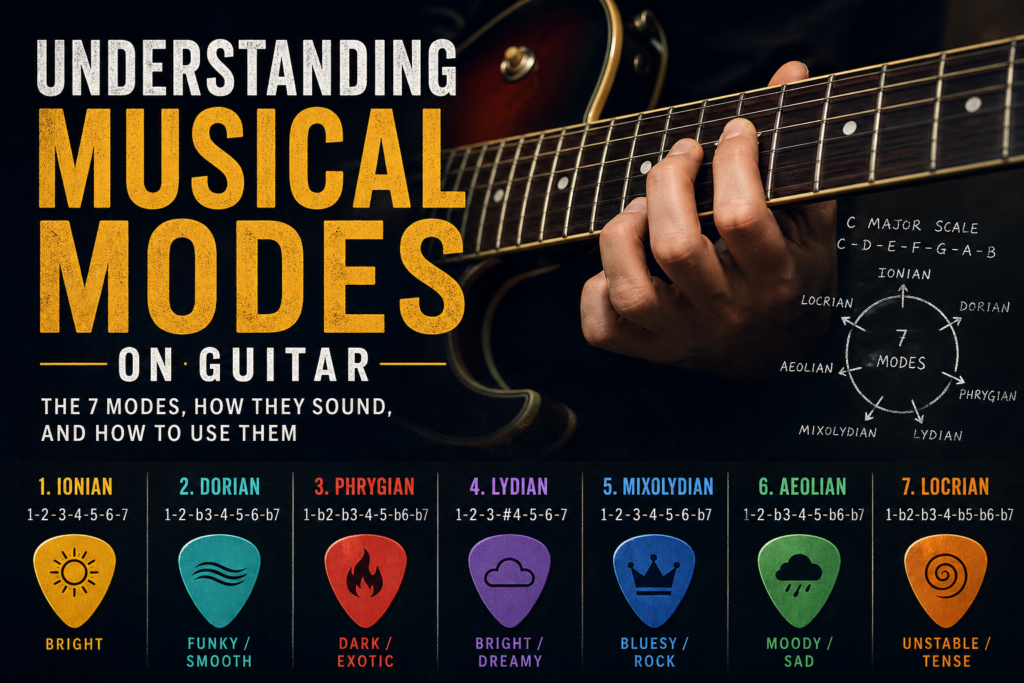
If you’ve spent any time exploring scales beyond the standard major and minor, you’ve likely come across modes. They can seem abstract at first, but on the guitar, they’re incredibly practical tools for shaping mood, phrasing, and improvisation. This guide breaks them down in a way that’s useful on the fretboard—no unnecessary theory tangles.
What Are Musical Modes?
At their simplest, modes are variations of a parent scale—most commonly the major scale. Each mode starts on a different note of that scale, creating a new sequence of intervals and, importantly, a new sound.
Take the C major scale:
C – D – E – F – G – A – B
If you start from each note in turn, you get seven different modes. Same notes, different tonal centres—completely different feel.
The Seven Modes (And What They Sound Like)
1. Ionian (The Major Scale)
- Formula: 1–2–3–4–5–6–7
- Sound: Bright, resolved, familiar
- Use: Pop, rock, country—your “default” major sound
2. Dorian
Formula: 1–2–♭3–4–5–6–♭7
Sound: Minor, but slightly hopeful or funky
Use: Funk, jazz, blues-rock
Think of it as a minor scale with a raised 6th—it gives it that smooth, groovy character.
3. Phrygian
- Formula: 1–♭2–♭3–4–5–♭6–♭7
- Sound: Dark, tense, exotic
- Use: Metal, flamenco-inspired playing
That flattened 2nd gives it an unmistakable bite.
4. Lydian
- Formula: 1–2–3–♯4–5–6–7
- Sound: Bright, dreamy, floating
- Use: Film music, ambient, progressive rock
The raised 4th is the magic here—it removes tension and adds lift.
5. Mixolydian
- Formula: 1–2–3–4–5–6–♭7
- Sound: Major with a bluesy edge
- Use: Classic rock, blues, jam bands
Think major scale, but with a flattened 7th—great over dominant chords.
6. Aeolian (Natural Minor)
- Formula: 1–2–♭3–4–5–♭6–♭7
- Sound: Sad, moody, familiar
- Use: Rock, metal, pop ballads
This is your standard minor scale.
7. Locrian
Formula: 1–♭2–♭3–4–♭5–♭6–♭7
Sound: Dissonant, unstable
Use: Jazz, experimental
Rarely used as a tonal centre, but useful in certain contexts.
How Modes Apply to Guitar
Here’s where modes stop being theory and start being useful:
1.
Position Playing
Modes naturally fall under your fingers when you play scales across the neck. Each position of the major scale corresponds to a mode.
For example:
- C major starting on D = D Dorian
- C major starting on E = E Phrygian
Same shape, different tonal focus.
2.
Targeting Chord Tones
Modes shine when matched to chords. Instead of thinking “what scale fits?”, think:
- Over a minor chord → Dorian or Aeolian
- Over a dominant chord → Mixolydian
- Over a major chord → Ionian or Lydian
This is how players move from “running scales” to actually sounding musical.
3.
Changing the Mood Without Changing Key
One of the most powerful uses of modes is shifting feel without leaving the parent scale.
Example in C major:
- Emphasise C → sounds like C Ionian (major)
- Emphasise A → sounds like A Aeolian (minor)
- Emphasise D → sounds like D Dorian (funky minor)
Same notes—completely different vibe.
4.
Improvisation and Soloing
Modes give you a palette of colours:
- Want brighter? Try Lydian
- Want bluesy? Mixolydian
- Want darker? Phrygian or Aeolian
On guitar, this often comes down to where you resolve phrases—not just what notes you play.
A Simple Way to Start Practising
- Pick one key (e.g. C major)
- Learn one scale shape across the neck
- Play it starting from different root notes
- Focus on landing phrases on that root
You’ll start hearing the modal differences far quicker than trying to memorise formulas alone.
Final Thoughts
Modes aren’t separate, mysterious scales—they’re all connected. On the guitar, they’re especially intuitive because of the instrument’s layout. Once you understand that it’s about where the tonal centre lies, everything starts to click.
For players looking to move beyond pentatonics or add more colour to their phrasing, modes are one of the most rewarding next steps.