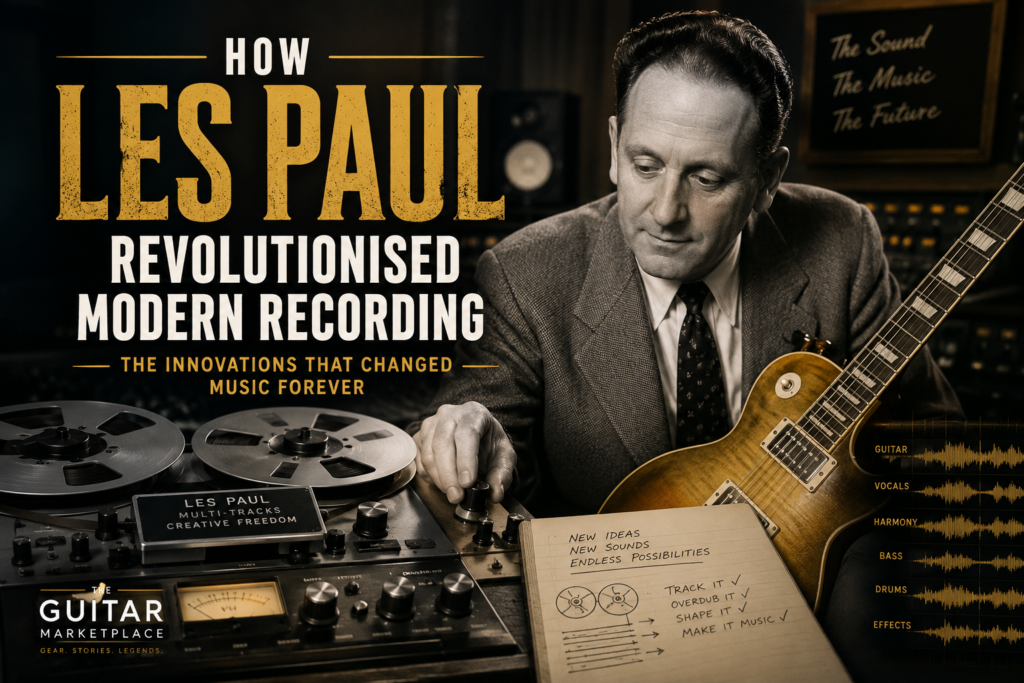
Few individuals have left as profound a mark on music recording as Les Paul. While many guitarists know him as the namesake behind Gibson’s iconic Les Paul guitar, his influence stretches far beyond instruments. In fact, many of the recording techniques that producers, engineers and musicians rely on today can be traced directly back to his relentless experimentation in the studio.
Long before digital audio workstations, plug-ins and unlimited recording tracks became commonplace, Les Paul was pioneering techniques that transformed recording from a method of documenting performances into a creative tool in its own right. His innovations fundamentally changed how records were made and continue to shape modern production more than 70 years later.
A Musician Who Thought Like an Engineer
Born Lester William Polsfuss in 1915, Les Paul possessed a rare combination of musical talent and technical curiosity. Rather than accepting the limitations of contemporary recording technology, he constantly asked how it could be improved.
During the 1930s and 1940s, recording sessions were remarkably restrictive. Most performances were captured live in a single take, with musicians gathered around one or two microphones. Mistakes often meant starting over from scratch, and editing possibilities were extremely limited.
Les Paul envisioned something entirely different.
He believed that recording should allow musicians to build performances layer by layer, giving artists complete creative control over every element of a song.
That philosophy would ultimately reshape the recording industry.
The Birth of Multi-Track Recording
Perhaps Les Paul’s greatest contribution was the development and refinement of multi-track recording.
Today, recording each instrument separately seems entirely normal. Vocals, guitars, drums, keyboards and orchestral parts are routinely captured on individual tracks before being mixed together.
Before Les Paul, this approach simply didn’t exist.
By modifying existing recording equipment and experimenting with multiple tape machines, he discovered methods of recording new performances over previously recorded material while maintaining audio quality. This process—known as overdubbing—allowed musicians to perform alongside themselves.
The implications were revolutionary.
Instead of requiring every musician to play simultaneously, artists could:
- Record rhythm instruments first
- Add lead guitars later
- Perfect vocal performances separately
- Experiment with harmonies
- Replace individual mistakes without repeating an entire session
These concepts form the foundation of virtually every modern recording workflow.
Overdubbing Changed Everything
Les Paul’s recordings with vocalist Mary Ford became demonstrations of what this new technology could achieve.
Rather than featuring just one vocal performance, Mary Ford often sang multiple harmony parts, all recorded separately and layered together. Likewise, Les Paul recorded numerous guitar parts, creating rich arrangements that would have been impossible to perform live at the time.
Songs such as How High the Moon astonished audiences in the early 1950s.
Listeners heard enormous vocal choirs and intricate guitar arrangements, yet only two performers had created the entire recording.
Today, overdubbing is so commonplace that most listeners rarely think about it.
Whether it’s:
- Double-tracked vocals
- Layered acoustic guitars
- Stacked backing harmonies
- Multiple lead guitar parts
- Additional percussion
…the basic concept remains exactly what Les Paul pioneered decades ago.
Tape Delay and Echo Effects
Les Paul also helped popularise creative uses of tape delay.
By manipulating tape machines, he discovered ways to create natural echo and repeating delays that added depth and excitement to recordings.
Rather than treating recording equipment as merely a way to capture sound, he viewed it as another musical instrument.
Modern digital delay pedals, plug-ins and rack processors owe much of their heritage to these early experiments.
Even today’s sophisticated delay algorithms emulate the warm, slightly imperfect echoes produced by analogue tape—an effect that remains highly sought after by guitarists and producers alike.
Close-Miking Instruments
Recording practices during the early twentieth century typically involved placing musicians at varying distances from a single microphone.
Les Paul challenged these conventions.
He favoured placing microphones much closer to instruments, particularly electric guitars, allowing engineers to capture greater clarity, detail and presence.
Close-miking is now standard practice for:
- Guitar amplifiers
- Snare drums
- Bass cabinets
- Acoustic instruments
- Vocals
The ability to isolate individual sound sources has become essential in both studio recording and live sound reinforcement.
Viewing the Studio as an Instrument
Perhaps Les Paul’s greatest philosophical contribution was changing how musicians viewed the recording studio itself.
Before his innovations, studios were largely considered neutral spaces where performances were documented.
Les Paul believed the studio should actively shape music.
He embraced experimentation through:
- Layering sounds
- Altering playback speed
- Creating artificial ambience
- Editing performances
- Building arrangements piece by piece
Modern producers routinely manipulate recordings using software, automation, pitch correction, sample replacement and countless digital effects.
Although today’s technology is vastly more advanced, the underlying mindset remains identical.
Recording is no longer simply about capturing a performance.
It is about creating one.
Influencing Every Recording Genre
Les Paul’s techniques quickly spread beyond popular music.
Rock, jazz, country, blues, soul, progressive rock, heavy metal and modern pop production all rely heavily on methods that evolved from his work.
Artists including:
- The Beatles
- Queen
- Pink Floyd
- Fleetwood Mac
- Steely Dan
- Def Leppard
…all built ambitious studio productions using layered recording techniques that owe a considerable debt to Les Paul’s innovations.
Modern producers working with digital audio workstations such as Pro Tools, Logic Pro, Cubase or Ableton Live still follow workflows based on concepts he established in the 1940s and 1950s.
Guitar Recording Was Changed Forever
As an accomplished guitarist, Les Paul naturally focused much of his experimentation on electric guitar recording.
Rather than recording a single guitar performance, he frequently layered multiple takes with different tones and playing styles.
Today this remains one of the most common recording techniques.
A modern rock production might include:
- Two rhythm guitars panned left and right
- Additional overdubbed rhythm parts
- Multiple lead guitar layers
- Harmonised solos
- Ambient texture guitars
- Acoustic doubles
The huge guitar sounds heard on countless classic and contemporary albums stem directly from the recording philosophy Les Paul helped establish.
Inspiration for Home Recording
Perhaps one of Les Paul’s most enduring legacies is the democratisation of recording.
His experiments demonstrated that creativity often matters more than expensive equipment.
Today’s musicians can build professional-quality productions from home using affordable interfaces, laptops and software, but the underlying principles remain remarkably similar:
Record one layer.
Listen back.
Add another.
Refine the arrangement.
Build something greater than the sum of its parts.
That workflow is essentially the same one Les Paul pioneered more than half a century ago.
Beyond the Gibson Guitar
Although the Gibson Les Paul remains one of the world’s most iconic instruments, it arguably represents only half of Les Paul’s legacy.
His work transformed recording from a technical necessity into a limitless creative medium. Concepts such as overdubbing, multi-track recording, close-miking and tape-based effects underpin almost every recording made today, regardless of genre.
Whether you’re tracking guitars in a professional studio, recording demos in a spare bedroom or producing music entirely inside a laptop, you’re benefiting from ideas that Les Paul developed through decades of curiosity and experimentation.
Few musicians can claim to have changed both the instrument they played and the way music itself is recorded.
Les Paul did exactly that, and his influence continues to resonate every time the red recording light comes on.
Final Thoughts
Modern recording owes an enormous debt to Les Paul. While technology has evolved from modified tape machines to powerful digital workstations, the creative principles he championed remain unchanged. His willingness to experiment challenged the conventions of his era and opened the door to virtually every recording technique musicians now take for granted.
For guitarists, producers and engineers alike, Les Paul’s greatest contribution may not simply be the legendary instrument that bears his name, but the revolutionary belief that the recording studio itself could become an instrument of creativity. Every layered guitar part, perfectly stacked harmony and meticulously crafted production serves as a reminder that one curious musician helped redefine how music is made forever.