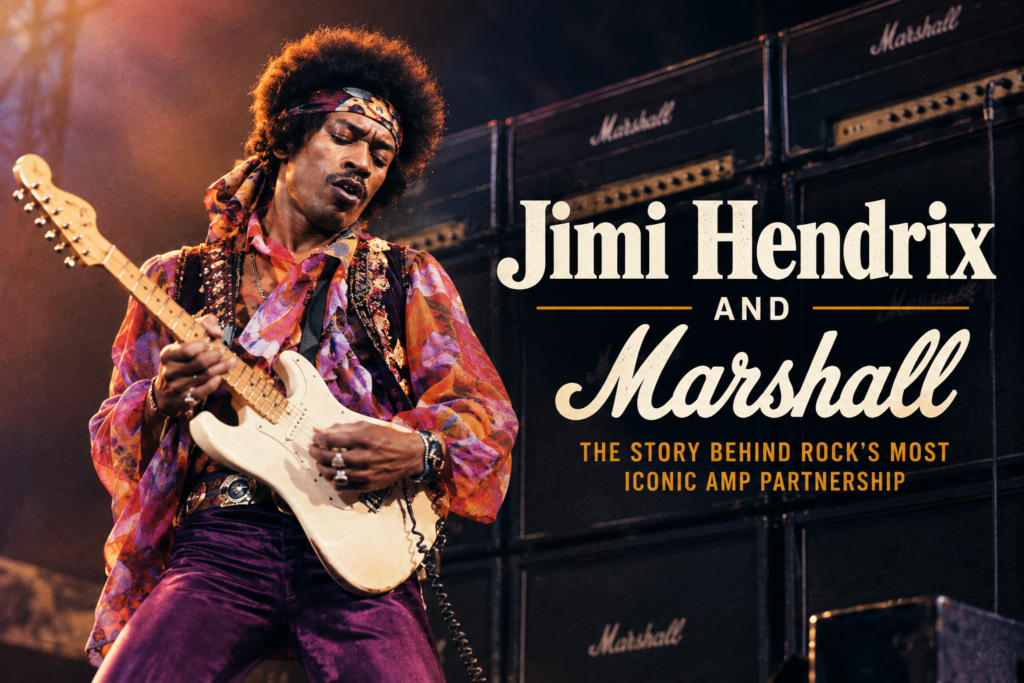
Few combinations in music history are as instantly recognisable as Jimi Hendrix and a wall of Marshall amplifiers.
Hendrix changed the possibilities of the electric guitar in just a few short years. His playing was expressive, experimental, and often completely unpredictable, but his sound was just as important as his technique. Behind the Stratocaster, fuzz pedals, wah, and feedback was another essential part of the equation: Marshall amplification.
Hendrix did not simply use Marshall amps because they were loud. He pushed them into territory they had never been designed to explore, using volume, distortion, feedback, and sheer physical power as part of his instrument.
The relationship between Hendrix and Marshall began in London in 1966 and would continue until the guitarist’s death in 1970. Along the way, it helped turn Marshall from a British amplifier manufacturer into one of the most recognisable names in rock music.
A Meeting of Two Jims
When Jimi Hendrix arrived in London in 1966, he was still relatively unknown in Britain. That changed rapidly after he began performing with The Jimi Hendrix Experience alongside Mitch Mitchell and Noel Redding.
Hendrix first became interested in Marshall after hearing one of the company’s amplifiers being used at Ronnie Scott’s jazz club. According to Marshall’s own account, Hendrix was immediately impressed by the sound and remarked that he wanted some of the same amplification.
There was also an amusing coincidence. Hendrix’s full name was James Marshall Hendrix, while Marshall’s founder was Jim Marshall.
Through drummer Mitch Mitchell, who had previously been a student of Jim Marshall’s, Hendrix was introduced to the man behind the amplifiers.
What followed was the beginning of one of the most important artist and amplifier relationships in rock history.
Hendrix initially ordered four double sets of Marshall amplifiers, paying full retail price. Marshall’s account of the meeting also records that Hendrix wanted Jim Marshall to provide service and support wherever the amps were being used.
The relationship quickly became more than a simple customer and manufacturer arrangement. Jim Marshall later described Hendrix as the company’s “greatest ambassador”, while the two became friends as Hendrix’s international career exploded.
The Marshall Super Lead
The amplifier most closely associated with Hendrix was the Marshall Super Lead 100 watt head.
The Super Lead was already an enormously powerful amplifier by the standards of the mid 1960s. Hendrix took that power and pushed it even further.
Rather than relying on modern high gain circuitry, the classic Marshall sound came from driving the amplifier’s valves extremely hard. Hendrix was known for running his amplifiers at very high settings, producing a combination of natural compression, saturation, sustain, and feedback.
Marshall itself has described Hendrix as someone who would “dime the amp”, effectively turning the controls up to their maximum. The resulting sound was anything but clean. It was aggressive, saturated, dynamic, and capable of responding dramatically to the slightest change in Hendrix’s playing.
This was crucial to Hendrix’s approach.
The amplifier was not simply reproducing the sound of his guitar. At extreme volume, the amplifier became part of the instrument.
Hendrix could move closer to the cabinets to generate feedback, pull away to control it, alter his picking dynamics, and use the guitar’s volume control to manipulate the amount of distortion. The interaction between his Stratocaster, effects, amplifier, and speaker cabinets became an essential part of his playing style.
Building the Wall of Sound
Hendrix’s use of Marshall was not particularly subtle.
His live rig often consisted of multiple 100 watt Super Lead heads connected to 4×12 speaker cabinets. As his popularity increased, so did the size of his amplification setup.
Photographs of The Jimi Hendrix Experience show the guitarist surrounded by towering Marshall stacks, creating one of the most recognisable stage images of the 1960s.
Marshall’s own historical records suggest Hendrix purchased up to around 100 amplifiers from the company between 1966 and 1970. While the exact number of amps Hendrix personally owned or used at any one time is difficult to establish, there is no question that Marshall equipment became a defining part of his live setup.
The sheer number of amplifiers also solved a practical problem. Hendrix was now playing enormous venues and festivals, and his sound needed to reach increasingly large audiences.
The Marshall stack was perfectly suited to the job.
Monterey Pop Festival, 1967
One of Hendrix’s most famous performances took place at the Monterey International Pop Festival in June 1967.
It was The Jimi Hendrix Experience’s major introduction to American audiences, and Hendrix made sure it was impossible to forget.
The performance culminated in “Wild Thing”, during which Hendrix famously set his Stratocaster on fire before smashing it against the stage.
Behind him stood his Marshall amplification.
The combination of the burning guitar, psychedelic stage presence, deafening volume, and towering amplifier stacks became one of the defining images of the Summer of Love. Fender’s historical account describes the Monterey performance as a pivotal moment in Hendrix’s rise to international superstardom, while Marshall places the performance among the key moments in the company’s history.
It was more than a memorable piece of stage theatre.
Hendrix was demonstrating what could happen when a guitar and amplifier were treated as one expressive instrument.
Are You Experienced?
By the time The Jimi Hendrix Experience recorded their debut album, Are You Experienced, Hendrix had already established his relationship with Marshall.
The album was released in 1967 and contained many of the songs that would become synonymous with his sound, including “Purple Haze”, “Foxey Lady”, and “Manic Depression”.
Although studio recordings are often more complicated than simply identifying one amplifier used throughout an album, Marshall amplification was already an important part of Hendrix’s setup during this period.
Hendrix’s sound on these recordings demonstrates just how much he could achieve from a relatively straightforward signal chain. A Stratocaster, effects pedals, and a loud valve amplifier were transformed into an enormous range of sounds through his playing technique and control of the equipment.
His use of feedback was particularly important.
Rather than treating unwanted noise as something that needed to be eliminated, Hendrix incorporated it into the music. The amplifier became capable of screaming, sustaining, and interacting with the guitar in ways that were still relatively unfamiliar to audiences.
Axis: Bold as Love and Electric Ladyland
Hendrix’s relationship with Marshall continued as his recording career developed.
Axis: Bold as Love followed Are You Experienced in 1967, while Electric Ladyland arrived in 1968.
By this point Hendrix was using the recording studio as an experimental environment. His sounds became increasingly complex, incorporating effects, studio manipulation, multiple guitar parts, and unconventional recording techniques.
Marshall remained an important part of his tonal palette.
Tracks such as “Voodoo Child (Slight Return)” demonstrate the sheer range of sounds Hendrix could extract from his equipment. The famous opening combines wah, fuzz, aggressive picking, and an amplifier being driven hard, resulting in one of the most recognisable guitar tones ever recorded.
It is tempting to think of Hendrix’s sound as simply being “a Strat through a Marshall”, but that misses what made it special.
The equipment provided the ingredients. Hendrix supplied the imagination.
Woodstock, 1969
If Monterey introduced Hendrix to America, Woodstock gave the world one of the defining images of his career.
Hendrix headlined the festival in August 1969, performing with a new lineup that included Billy Cox and Mitch Mitchell.
Once again, Marshall amplification was an important part of the visual and sonic landscape.
By this stage, Hendrix’s use of large Marshall rigs had become almost synonymous with his live performances. His version of “The Star Spangled Banner” demonstrated how far he had pushed the electric guitar beyond conventional rock playing, using feedback, distortion, volume, and effects to transform a familiar melody into something entirely new.
The performance remains one of the most famous moments in the history of electric guitar.
And behind Hendrix stood the Marshall stacks.
Marshall has subsequently described Woodstock, alongside Monterey and other major Hendrix performances, as a key part of the shared history between the guitarist and the company.
The Band of Gypsys
Hendrix’s experimentation did not stop with The Jimi Hendrix Experience.
At the end of 1969, he formed Band of Gypsys with Billy Cox and drummer Buddy Miles. The group performed a series of shows at the Fillmore East in New York on New Year’s Eve and New Year’s Day.
Hendrix’s equipment during this period continued to include Marshall Super Lead amplifiers.
One particular Hendrix Super Lead that has since surfaced on the vintage market was reportedly used during the summer of 1969 and subsequently at Woodstock, the Isle of Wight Festival, and other performances. The same amplifier was also reportedly used during rehearsals and recording sessions involving Band of Gypsys.
These surviving pieces of equipment offer a fascinating physical connection to Hendrix’s performances.
They were not museum pieces when Hendrix used them.
They were working amplifiers, pushed extremely hard night after night.
Isle of Wight and the Final Chapter
Hendrix’s relationship with Marshall continued right up to the final months of his life.
One of his final major performances came at the Isle of Wight Festival in August 1970, where he once again performed through Marshall amplification.
Photographs from the period show Hendrix surrounded by the familiar wall of cabinets, although his musical direction had continued to evolve considerably from the days of the Experience.
Hendrix died less than a month later, on 18 September 1970, aged just 27.
His career had lasted only a few years at the highest level.
His influence, however, was only beginning.
How Hendrix Changed Marshall
It is easy to think of Hendrix as simply another famous musician who happened to use Marshall amplifiers.
The reality was much more significant.
Marshall was already becoming one of Britain’s most important amplifier manufacturers before Hendrix arrived. The company’s high powered designs had helped answer the demands of increasingly loud British rock bands, with players such as Pete Townshend pushing amplifier technology towards ever greater volume.
Hendrix took that technology somewhere different.
He showed that extreme volume could be used creatively. Distortion could become musical. Feedback could become an expressive technique. Speaker breakup could become part of a performance.
Most importantly, he demonstrated to a worldwide audience what a Marshall stack could do.
As Hendrix’s fame grew, so did the visibility of Marshall.
The relationship was mutually beneficial. Marshall gave Hendrix the power and tonal character he needed, while Hendrix helped establish Marshall amplifiers as an essential part of the visual and sonic identity of rock guitar.
Jim Marshall himself recognised this, calling Hendrix the company’s greatest ambassador.
The Legacy of Hendrix and Marshall
More than half a century after Hendrix’s death, the image remains instantly recognisable.
A Fender Stratocaster, a fuzz pedal, a wah, and a towering wall of Marshall amplifiers.
Of course, Hendrix’s sound was never really about equipment alone. His technique, musical instincts, use of effects, approach to feedback, and willingness to experiment were all fundamental to what he created.
But Marshall was an important part of the equation.
In 2026, Marshall is marking 60 years since Hendrix first plugged into one of its amplifiers with the Marshall x Hendrix 60th Anniversary Collection, including a Hendrix inspired 1959 style half stack. The company describes the relationship as one that changed both the sound of rock music and the possibilities of the amplifier itself. In the hands of Jimi Hendrix, it became part of rock history.