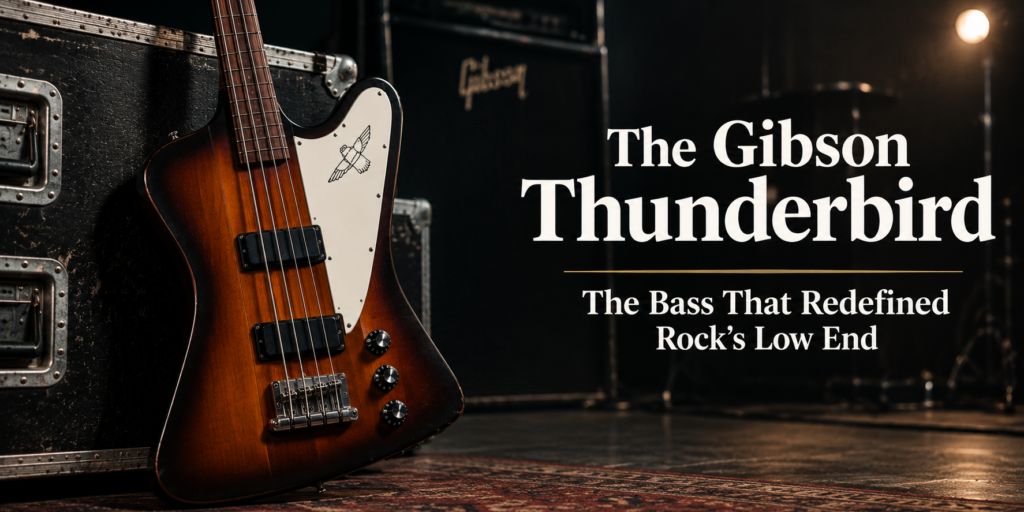
Few bass guitars have ever looked quite as dramatic as the Gibson Thunderbird. With its elongated body, sweeping curves, reverse headstock, and unmistakable silhouette, the Thunderbird looked more like something from a futuristic car showroom than a traditional instrument shop.
Introduced in 1963, it was Gibson’s answer to the growing popularity of Fender’s long scale electric basses. It was also one of the company’s boldest attempts to rethink what a bass guitar could look and sound like.
The Thunderbird did not immediately become a commercial success. In fact, its early history was marked by low sales, redesigns, and periods when the model disappeared from Gibson’s catalogue altogether.
Yet its influence would prove far greater than its original sales figures suggested.
From The Who and Mott The Hoople to Motörhead and Kiss, the Thunderbird became associated with some of the most distinctive bass players and bands in rock history. More than sixty years after its introduction, the design remains instantly recognisable, and Gibson continues to build modern versions of the instrument.
So how did a bass that initially struggled to find an audience become one of Gibson’s most enduring designs?
Gibson Looks to the Future
By the early 1960s, the electric bass market was dominated by Fender.
The Precision Bass had established the basic blueprint for the modern electric bass, while the Jazz Bass had added a second pickup, a longer scale, and a more streamlined design. Fender’s instruments were becoming increasingly influential, particularly as rock and roll evolved into louder and more ambitious forms of popular music.
Gibson had already produced bass guitars, but its earlier instruments had largely followed more conventional designs.
The Thunderbird represented a very different approach.
Gibson introduced the instrument in 1963 alongside the Firebird guitar, creating a matching pair of radical new instruments. Both were designed by Raymond Dietrich, an automotive designer whose career included work for Chrysler, Lincoln, and other major American manufacturers.
The influence of automotive design is immediately apparent.
Rather than simply adapting an existing guitar or bass shape, Dietrich created something that looked fast, dramatic, and distinctly modern. The body was asymmetrical, with sweeping lines and exaggerated curves that were unlike anything else in Gibson’s catalogue.
The original Thunderbird was also significant mechanically. It was Gibson’s first bass to use a 34 inch long scale, bringing it into direct competition with Fender’s long scale instruments. It was also Gibson’s first neck through body bass, with a laminated neck running through the centre of the instrument and mahogany wings forming the body.
The Original Thunderbird II and IV
When the Thunderbird arrived, Gibson offered two versions.
The Thunderbird II featured a single pickup, while the Thunderbird IV used two pickups. The numbering was not intended to suggest that there were Thunderbird I and III models. Instead, the names were designed to sit alongside the Firebird guitar range, which used the same numbering system.
The Thunderbird IV would ultimately become the more recognisable version of the instrument.
The early basses featured the now famous reverse body shape. The upper horn extended further than the lower horn, while the headstock was similarly distinctive.
Underneath the striking appearance was a serious piece of engineering.
The neck through construction provided a continuous central section of wood running through the instrument, with the body wings attached either side. Gibson’s early Thunderbirds used mahogany and walnut in a multi ply laminated neck, helping provide stability and sustain.
The result was a bass with plenty of sustain, a powerful low end, and a visual identity that was impossible to mistake for anything else.
There was just one problem.
Not enough people bought them.
The Non Reverse Thunderbird
The original Thunderbird proved difficult and expensive to manufacture, while sales were nowhere near the levels Gibson had hoped for.
There were also complications surrounding the design itself. Fender objected to similarities between the Thunderbird and its Jazzmaster, contributing to Gibson’s decision to rethink the shape.
By 1965, Gibson had introduced a new version known as the non reverse Thunderbird.
The name sounds slightly confusing, but the principle is simple. The body shape was effectively reversed compared with the original, creating a design that looked considerably more conventional. Gibson also moved away from the expensive neck through construction and introduced a set neck.
The new design was produced through the latter part of the 1960s, but the Thunderbird’s commercial problems continued.
Production finally ended in 1969.
For a model that had arrived with such ambition, the original Thunderbird had lasted just six years.
But its story was far from over.
The Thunderbird Returns
By the 1970s, rock music had changed dramatically.
Amplifiers were louder, stages were bigger, and the visual identity of an instrument was becoming increasingly important. The Thunderbird’s aggressive appearance suddenly made more sense in this environment.
Gibson brought the model back in 1976 with the Thunderbird ’76.
Although production was relatively short lived, the return demonstrated that there was still an audience for Gibson’s distinctive bass design.
Further versions appeared over the following decades, while Epiphone also became an important part of the Thunderbird story by offering more accessible versions of the instrument.
The Thunderbird had gradually moved from being an unconventional Gibson experiment to becoming an established part of the company’s identity.
The Sound of the Thunderbird
Part of the Thunderbird’s appeal has always been its appearance, but its sound is equally important.
Thunderbirds are generally associated with a powerful, aggressive low end, strong sustain, and a distinctive midrange presence. The combination of humbucking pickups and the long scale gives the instrument plenty of authority in a rock mix.
That made it particularly well suited to players who wanted their bass to be heard as an important part of the band’s overall sound rather than simply providing a background foundation.
The modern Gibson Thunderbird continues this tradition, with the current model using two high output ceramic humbucking pickups and the traditional nine ply mahogany and walnut neck through construction. Gibson describes the design as providing a powerful low end response and piano like sustain.
It is not a subtle looking bass, and it has never really tried to be one.
John Entwistle and The Who
One of the most important players in the Thunderbird’s history was John Entwistle of The Who.
Entwistle was already known for treating the bass guitar as a lead instrument rather than simply a rhythmic support. His playing combined aggression, melody, speed, and an almost orchestral approach to the instrument.
He began using Thunderbird IV basses in the early 1970s.
Interestingly, Entwistle was not completely satisfied with the original Thunderbird neck. After Gibson discontinued the model, he acquired several Thunderbirds and began modifying them. Some of these instruments were rebuilt using Fender Precision Bass necks, creating the unusual instruments that became known as “Fenderbirds”.
It is a fitting story for the Thunderbird.
Even one of its most famous users was willing to take the design apart and rebuild it to suit his own playing style.
Glenn Cornick and Mott The Hoople
Entwistle was far from the only British rock bassist attracted to the Thunderbird.
Glenn Cornick, the original bassist with Jethro Tull, used several Gibson Thunderbirds during his career. The instrument also became closely associated with Overend Watts of Mott The Hoople.
For bands operating in the louder and heavier end of late 1960s and early 1970s rock, the Thunderbird’s combination of visual impact and powerful tone made considerable sense.
It was a bass that looked like it belonged on a large stage.
Lemmy and Motörhead
Few players are more closely associated with the attitude of rock bass than Lemmy Kilmister.
Although Lemmy’s best known instrument was his heavily modified Rickenbacker bass, the Gibson Thunderbird became another important part of the instrument’s rock history.
The Thunderbird’s aggressive appearance and powerful sound fitted naturally into the world of hard rock and heavy metal.
Its association with players such as Lemmy helped reinforce the idea that a bass could have its own visual identity and personality. It did not need to sit quietly behind the guitars.
It could be part of the band’s image.
Nikki Sixx and the Next Generation
The Thunderbird’s influence continued into the world of 1980s hard rock and metal.
Mötley Crüe bassist Nikki Sixx became another high profile Thunderbird user, helping introduce the distinctive Gibson design to a new generation of rock fans.
The bass suited the theatrical nature of the era particularly well. By this point, instruments were increasingly becoming part of the overall visual presentation of a band.
A Thunderbird was never going to disappear into the background.
That quality has helped the instrument remain popular with players who want something that feels different from the more familiar Precision and Jazz Bass designs.
More Than a Rock Bass
Although the Thunderbird is most strongly associated with rock, its influence has never been limited to one particular style.
Players including Justin Chancellor of Tool and Les Claypool have used Thunderbirds, while the instrument has also appeared in alternative rock, punk, metal, and other genres.
That variety says something important about the design.
The Thunderbird has never been defined entirely by its specifications. Its identity comes from the combination of its sound, feel, appearance, and history.
A player picking up a Thunderbird is making a different visual and musical statement from someone picking up a Precision Bass.
That does not necessarily make it better or worse.
It simply makes it different.
Why Does the Thunderbird Still Matter?
The Thunderbird is an interesting example of how guitar and bass history does not always follow the path of immediate commercial success.
When Gibson introduced the Thunderbird in 1963, the company was attempting to compete in an increasingly competitive market. The result was a bass that was technically ambitious, visually radical, and difficult to manufacture.
It did not dominate the market.
Instead, it developed something arguably more valuable in the long term: an identity.
The Thunderbird became a cult instrument.
Its distinctive shape has survived multiple generations of musicians, changes in musical fashion, and periods when Gibson stopped producing the model altogether. It has been modified, reissued, redesigned, copied, and reinvented, yet the basic character of the original remains immediately recognisable.
Gibson itself continues to embrace that heritage. In 2026, the company introduced an updated regular production Thunderbird Bass in Ebony and Tobacco Burst Perimeter finishes, combining the familiar reverse body shape with modern specifications.
More than six decades after its introduction, the Thunderbird is still doing what it was designed to do.
Stand out.
The Enduring Legacy of the Thunderbird
There are plenty of technically excellent bass guitars in the world.
There are comparatively few that can be recognised from across a stage before the first note has even been played.
That is perhaps the Thunderbird’s greatest achievement.
It was conceived at a time when Gibson was trying to push its designs into the future. Its automotive inspired curves, long scale, neck through construction, and powerful humbucking pickups represented a very different interpretation of the electric bass.
The market did not immediately embrace it.
Musicians eventually did.
From John Entwistle’s modified Thunderbirds to the instruments used by Lemmy, Nikki Sixx, Glenn Cornick, and countless players who followed them, the Thunderbird became part of the visual language of rock music.
And perhaps that is why the design still works today.