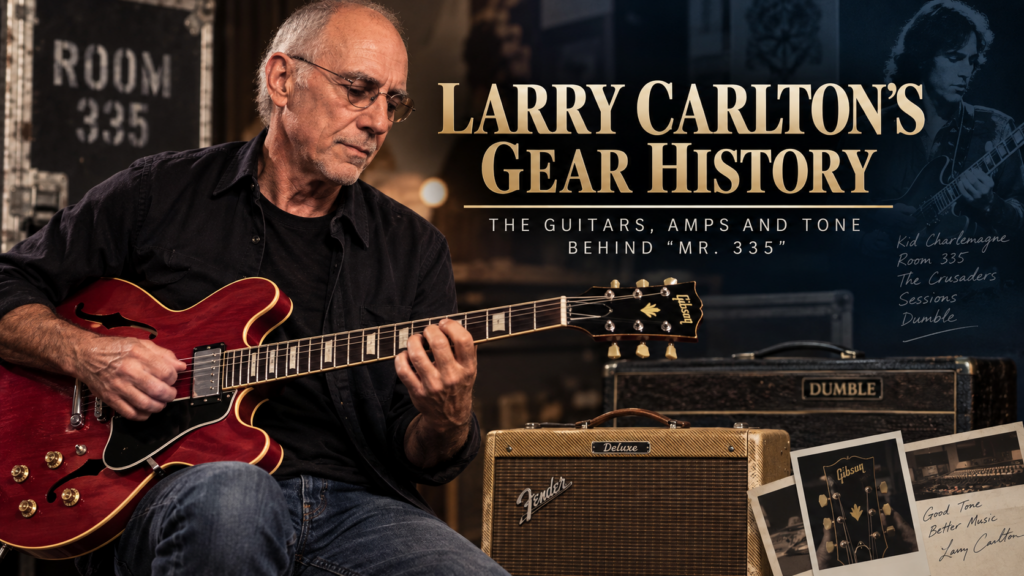
Few guitarists are as closely associated with a particular sound — or a particular guitar — as Larry Carlton. Nicknamed “Mr. 335”, Carlton helped define the sound of sophisticated studio guitar throughout the 1970s and ’80s, combining jazz phrasing, blues vocabulary and rock dynamics with an unmistakably smooth yet articulate electric guitar tone.
From his legendary Gibson ES-335 and Fender Tweed Deluxe to the Dumble amplifiers that became central to his later sound, Carlton’s equipment has evolved considerably over the decades. Yet his basic philosophy has remained remarkably consistent: a great guitar, a responsive amplifier and just enough additional equipment to serve the music.
Here we take a closer look at the gear history of one of the most influential session guitarists of all time.
The Early Years
Born in California in 1948, Larry Carlton began playing guitar as a child, initially absorbing the jazz guitar vocabulary of players such as Barney Kessel and Wes Montgomery.
By the late 1960s and early ’70s, Carlton was establishing himself as an exceptionally versatile session musician. His ability to move effortlessly between jazz, pop, rock, soul and funk made him ideally suited to the increasingly sophisticated Los Angeles studio scene.
Before the ES-335 became inseparable from his image, Carlton used a variety of instruments, including conventional solidbody and hollowbody guitars. As his session career accelerated, however, he found an instrument that seemed perfectly suited to the enormous range of sounds demanded of him.
The 1969 Gibson ES-335
The guitar most closely associated with Larry Carlton is his 1969 Gibson ES-335.
Carlton acquired the guitar in the early 1970s, and it would subsequently appear on countless recordings and live performances. Its combination of humbucking pickups, semi-hollow construction and relatively solid centre block provided exactly the balance Carlton needed.
An ES-335 could produce warm, rounded jazz tones without sacrificing the sustain and aggression required for rock and blues. For a studio musician expected to cover numerous styles during the same working day, that versatility was invaluable.
Carlton’s 335 became so central to his identity that his recording facility was eventually named Room 335.
The guitar can be heard throughout Carlton’s career and became particularly associated with the beautifully controlled overdriven tone heard on his late-1970s solo recordings.
Steely Dan and the Session Years
Carlton’s reputation as a session guitarist reached another level through his work with Steely Dan.
During the 1970s, Donald Fagen and Walter Becker became notorious for demanding extraordinary precision from their studio musicians. Carlton was one of the relatively small number of guitarists capable of satisfying both their technical requirements and their search for distinctive musical personalities.
His most famous contribution is undoubtedly the guitar work on “Kid Charlemagne” from Steely Dan’s 1976 album The Royal Scam.
The track contains one of the most celebrated guitar solos in popular music. Carlton combines blues bends, jazz-influenced harmony, chromatic movement and rhythmic sophistication without ever losing the melodic thread.
The ES-335 was central to his sound during this period, but an equally important part of the equation was the amplifier sitting behind it.
The Fender Tweed Deluxe
One of the most important amplifiers in Carlton’s recording history was a vintage Fender Tweed Deluxe.
The relatively low-powered Deluxe was ideal for studio work because it could be pushed into natural valve overdrive without producing the enormous volume associated with larger amplifiers.
Rather than relying heavily on distortion pedals, Carlton could simply drive the amplifier into its sweet spot.
The result was a tone that remained responsive to picking dynamics. Play gently and the sound cleaned up; dig into the strings and the amplifier compressed and overdriven naturally.
That touch-sensitive behaviour is a major part of the classic Carlton sound.
His famous Steely Dan recordings are frequently associated with the combination of his ES-335 and a small Fender amplifier, demonstrating just how effective a relatively simple recording setup can be.
The Crusaders
Carlton’s work with jazz-funk group The Crusaders provided another important showcase for his playing.
Joining the group during the 1970s, Carlton contributed to recordings including Chain Reaction, Those Southern Knights and Free as the Wind.
Here his sound often sat somewhere between jazz warmth and blues-rock bite. The ES-335 was particularly well suited to the Crusaders’ music, offering enough clarity for complex chords while retaining the thick midrange necessary for Carlton’s increasingly vocal lead style.
These recordings helped establish the musical identity that would define much of his solo career.
Larry Carlton and the Birth of the Classic “Mr. 335” Sound
Carlton’s self-titled 1978 album is arguably the definitive document of his classic tone.
Tracks such as “Room 335” demonstrated how far he had developed beyond the conventional boundaries of jazz guitar. His sound was smooth but never sterile, distorted but rarely aggressive and technically sophisticated without becoming detached from the blues.
The ES-335 remained at the centre of the setup.
Carlton frequently used the guitar’s volume and tone controls to shape his sound rather than simply leaving everything wide open. Combined with his remarkably controlled picking dynamics, this allowed him to move between clean and overdriven textures without dramatically changing equipment.
This approach is worth remembering when attempting to recreate his sound today: much of Larry Carlton’s tone happens before the signal ever reaches a pedalboard.
Enter the Dumble
If the ES-335 represents one half of the classic Larry Carlton rig, the Dumble Overdrive Special represents the other.
Alexander “Howard” Dumble built amplifiers individually for professional musicians, often tailoring them to the requirements of particular players. Production numbers were extremely small, and original examples have since become some of the most valuable guitar amplifiers in existence.
Carlton became one of the musicians most closely associated with the Dumble Overdrive Special.
The amplifier offered something particularly suited to his playing: a thick, sustaining overdrive sound that retained exceptional note definition.
For Carlton, whose solos frequently combine complex harmony with blues-style articulation, this was enormously important. Extended chords and sophisticated melodic lines remained clear even when the amplifier was producing significant overdrive.
The combination of ES-335 + Dumble Overdrive Special subsequently became one of the benchmark electric guitar sounds of the fusion era.
The Dumble Sound
It is tempting to think of Carlton’s Dumble simply as an expensive distortion machine, but that misses much of what made the amplifier useful.
A major characteristic of the Dumble sound is its dynamic response.
Carlton could alter the amount of perceived gain simply through his picking attack and guitar controls. Notes seemed to bloom after being struck, while the amplifier’s compression produced long sustain without completely flattening the player’s dynamics.
This suited Carlton perfectly.
His playing relies heavily on subtle differences in attack, vibrato and phrasing. A highly compressed or heavily saturated amplifier could easily obscure those details.
The Dumble instead amplified them.
Volume Pedals and Carlton’s Expressive Technique
Another important element of Carlton’s setup has been the volume pedal.
Carlton has frequently used volume swells to soften the initial pick attack of notes, creating horn-like or almost pedal-steel-style phrasing.
This is particularly effective when combined with delay and a sustaining amplifier.
Rather than using effects simply as decoration, Carlton integrates them into his technique. The volume pedal becomes part of the articulation of the instrument itself.
It’s another example of why copying a player’s equipment list rarely guarantees the same sound.
Delay and Ambience
Delay has also played an important role in Carlton’s lead tone.
During different periods he has used various delay units, with the effect generally applied relatively subtly. Instead of obvious repeating echoes, the delay creates additional depth around the guitar.
This contributes to the spacious, polished quality heard on many Carlton recordings.
Reverb is normally treated similarly. The fundamental guitar sound remains clearly defined, while ambience gives the notes somewhere to sit within the mix.
The philosophy is essentially the opposite of building a sound around effects.
The guitar and amplifier provide the tone; the effects provide context.
The Valley Arts Era
Like many leading Los Angeles session musicians, Carlton also became associated with Valley Arts guitars.
Valley Arts emerged from the Southern California studio scene and became known for highly refined, professional-grade instruments aimed at working players.
During the 1980s and ’90s, Carlton could be seen using Valley Arts instruments alongside his familiar Gibson.
These guitars offered the versatility expected by session players of the period, particularly when brighter single-coil and solidbody sounds were required.
They also demonstrate an important aspect of Carlton’s equipment history: although the ES-335 became his signature instrument, he has never been limited exclusively to semi-hollow guitars.
Gibson Larry Carlton Signature ES-335
Carlton’s relationship with the ES-335 eventually resulted in Gibson producing instruments bearing his name.
The Gibson Larry Carlton Signature ES-335 drew heavily from the characteristics of his famous vintage instrument, allowing players to obtain something closer to Carlton’s preferred version of the model.
It was a fitting collaboration.
Few musicians have done more to establish the ES-335 as a serious instrument for jazz, fusion and sophisticated studio work.
Before Carlton, the 335 was already a classic. After decades of his playing, it had acquired another identity entirely.
The Bludotone Era
With original Dumble amplifiers becoming extraordinarily valuable and increasingly difficult to tour with, Carlton later became closely associated with Bludotone amplifiers.
Bludotone’s amplifiers draw inspiration from the boutique, Dumble-style tradition while providing Carlton with equipment suitable for modern touring.
The fundamental characteristics remain familiar: smooth overdrive, strong midrange, exceptional touch sensitivity and enough clarity to preserve complex harmony.
For Carlton, the goal has never appeared to be changing his sound dramatically. Instead, newer equipment has allowed him to reproduce the qualities he values in a more practical form.
Sire and the H7
More recently, Carlton has developed an extensive relationship with Sire.
The partnership has resulted in the Larry Carlton range of guitars, covering Strat-style, Tele-style and semi-hollow instruments.
For Carlton fans, the Sire Larry Carlton H7 is particularly interesting.
The H7 follows the classic double-cutaway semi-hollow formula that Carlton has relied upon for decades, but at a significantly more accessible price than a vintage or Custom Shop Gibson ES-335.
His involvement with Sire represents an interesting shift in signature guitar philosophy.
Rather than creating an expensive collector-oriented instrument, the range is designed to make professionally capable guitars available to a much broader audience.
Other Sire Larry Carlton Models
The Sire collaboration has also demonstrated just how broad Carlton’s musical requirements actually are.
Models such as the S7, T7 and other instruments within the range provide variations on familiar solidbody designs.
This makes sense when considering Carlton’s background.
Although audiences associate him primarily with warm humbucker tones, a professional session guitarist needs access to considerably more than one sound. Clean rhythm parts, brighter single-coil textures and more contemporary tones have always formed part of Carlton’s musical vocabulary.
His signature range therefore reflects the working musician behind “Mr. 335,” rather than simply reproducing his most famous guitar.
Pedals: Less Important Than You Might Think
Compared with many modern guitarists, Larry Carlton’s pedalboard has rarely been the defining feature of his sound.
Over the years his rigs have included overdrive, delay, chorus and other effects, but the fundamental tone has generally remained centred around the relationship between the guitar and amplifier.
That distinction is important.
Carlton’s overdrive is not simply a distortion effect placed on top of a clean sound. Much of the character comes from the way the amplifier responds dynamically to the guitar.
This is why players attempting to recreate his tone using large amounts of pedal gain can sometimes end up with something far more compressed than Carlton’s actual sound.
How to Get the Larry Carlton Sound
Fortunately, recreating the broad character of Carlton’s sound doesn’t require an original 1969 ES-335 and a six-figure Dumble amplifier.
Start with a semi-hollow guitar fitted with moderate-output humbuckers.
Run it into a warm, valve-style amplifier with plenty of midrange and enough gain to produce smooth overdrive when you dig in.
Keep the bass controlled. Carlton’s sound is full but rarely muddy, while the treble is normally rounded enough to avoid harshness.
Add a small amount of delay and reverb.
Most importantly, don’t use too much gain.
The amplifier should still respond dramatically to your picking attack and guitar volume control.
Then comes the difficult part: the playing.
The Real Secret: Touch
Carlton’s equipment undoubtedly contributes to his sound, but his technique is ultimately more important.
His vibrato is controlled and vocal. His bends are remarkably accurate. He frequently varies his picking strength from note to note, while his phrasing leaves far more space than many technically accomplished guitarists.
He also has an exceptional understanding of harmony.
Carlton can move from straightforward blues vocabulary into sophisticated chord substitutions and altered harmony while making the transition sound completely natural.
That combination of blues feel and jazz knowledge is arguably the real foundation of the “Mr. 335” sound.
A Rig Built Around Responsiveness
Looking across Larry Carlton’s gear history, a clear theme emerges.
1969 Gibson ES-335. Fender Tweed Deluxe. Dumble Overdrive Special. Volume pedal. Delay. Bludotone. Sire.
The individual pieces of equipment have changed, but almost all share one characteristic: they allow the player to remain in control.
Carlton favours equipment that reacts to touch rather than disguising it.
That is why his tone can move from clean and delicate to thick and sustaining without losing its identity.
It’s also why his sound remains relevant decades after the recordings that first made it famous.
The Legacy of Mr. 335
Larry Carlton’s influence extends far beyond jazz fusion.
His session recordings helped establish a template for the sophisticated electric guitar tones heard throughout the late 1970s and 1980s, while his solo work demonstrated that technically advanced guitar music could still be rooted firmly in blues phrasing and melody.
His association with the ES-335 is now one of the most enduring artist-and-instrument relationships in guitar history.
But perhaps the most useful lesson from Carlton’s equipment history is also the simplest.
Great tone doesn’t necessarily require a complicated rig.
A responsive guitar, a great amplifier, a little ambience and an extraordinary pair of hands were enough to create some of the finest recorded guitar tones of the last half-century.
And more than fifty years into his career, Larry Carlton is still proving it.