Few bands have created a sound as instantly recognisable as Tool. Heavy, atmospheric, hypnotic and incredibly detailed, their music sits somewhere between progressive rock and metal, with guitar, bass and drums working together to create something far bigger than the sum of its parts.
But while Tool’s music is famously complex, the band’s core approach to gear is surprisingly focused.
At the centre of that sound are guitarist Adam Jones and bassist Justin Chancellor. Jones’ heavy, sustained guitar tone and Chancellor’s huge, highly melodic bass lines have become just as identifiable as the band’s riffs themselves.
So, what guitars and basses are responsible for that sound?
Let’s take a look at some of the most important gear behind Tool.
Adam Jones: The Silverburst Sound
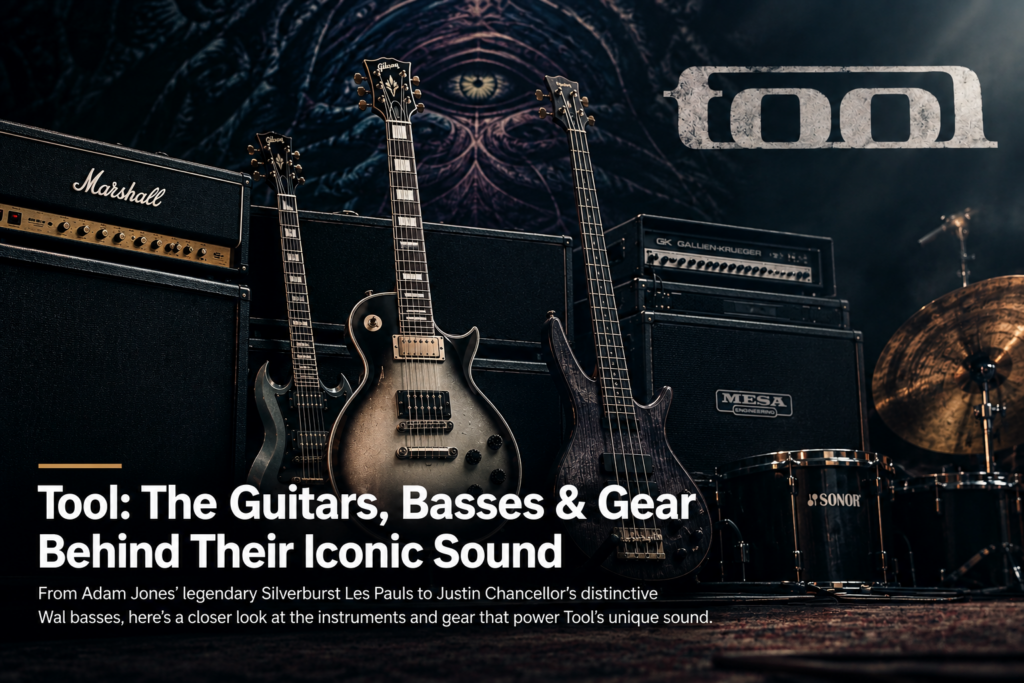
When you think of Adam Jones, there’s one guitar that immediately springs to mind: a Gibson Les Paul Custom in Silverburst.
Jones has used several Silverburst Les Paul Customs throughout Tool’s career, but his most famous instrument is his 1979 Gibson Les Paul Custom. The guitar has become almost inseparable from the Tool sound and has been used extensively both live and in the studio.
It’s a substantial, heavy guitar, with the classic Les Paul combination of a mahogany body, maple top and ebony fingerboard.
And then there’s that finish.
The Silverburst finish has become one of the defining visual characteristics of Jones’ setup. Rather than going for the brightly coloured or highly modified instruments often associated with metal guitarists, Jones’ guitars look relatively understated from a distance.
Get closer, however, and things become considerably more interesting.
His famous 1979 Les Paul was modified with a Seymour Duncan bridge pickup, giving the guitar the aggressive attack required for Tool’s riffs while retaining the sustain and thickness associated with a Les Paul.
Jones has also been known to use other Gibson guitars, including SGs, particularly when a different tonal character is required in the studio.
Why Does Adam Jones’ Guitar Sound So Huge?
The guitar itself is only part of the equation.
Jones has traditionally favoured running multiple amplifiers together rather than relying on one amp to do everything. His rigs have included a 1976 Marshall Super Bass, a Diezel VH4 and Mesa/Boogie equipment.
The idea is relatively simple: rather than asking one amplifier to provide every frequency and characteristic required, different amplifiers can contribute different parts of the overall sound.
Jones has described using multiple amps simultaneously, explaining that one provides characteristics another lacks. Combined, they create the enormous, layered sound heard in Tool.
His approach to effects is similarly practical.
Rather than covering his signal chain with dozens of effects, Jones uses a relatively focused collection of pedals, including delay, flanger, EQ, boost and wah. The Dunlop 535Q Cry Baby wah is particularly important, appearing as a textural effect rather than simply being used for traditional wah-wah solos.
That’s an important part of understanding Jones’ playing.
Tool isn’t really about showing off how much gear you have. It’s about using relatively familiar pieces of equipment in a very deliberate way.
The Adam Jones Signature Guitars
Adam Jones’ relationship with Gibson eventually led to one of the most interesting series of signature guitars in recent years.
And unlike many artist models, these guitars go much further than simply putting a famous player’s name on the headstock.
Gibson Custom Adam Jones 1979 Les Paul Custom
In 2020, Gibson released an extremely detailed recreation of Jones’ famous 1979 Silverburst Les Paul Custom.
The Custom Shop version was designed to replicate his original instrument as closely as possible, right down to the construction, finish and electronics.
The guitar features a mahogany body with a maple top, a three-piece maple neck and ebony fingerboard. It also uses a reverse-mounted neck pickup and a custom-wound Seymour Duncan DDJ bridge pickup.
Perhaps the most remarkable versions were the Murphy Lab aged examples, which recreated the wear and ageing of Jones’ original guitar.
Only 79 of the aged and signed guitars were produced, making them particularly rare collector’s pieces.
For anyone wanting to understand just how seriously Gibson approached the project, the specifications tell the story: this wasn’t simply a Silverburst Les Paul with a signature on it. It was an attempt to reproduce Jones’ actual number-one guitar.
Gibson USA Adam Jones Les Paul Standard
The Custom Shop guitar was followed by something considerably more accessible.
Gibson USA introduced the Adam Jones Les Paul Standard in Antique Silverburst, bringing many of the visual characteristics of Jones’ famous Custom to a regular production model.
It retains the mahogany body and maple top, along with an ebony fingerboard, but uses a different pickup combination.
The bridge features an uncovered DC High-Gain Humbucker, while the neck uses a chrome-covered BurstBucker 1.
It also features Adam Jones artwork on the back of the headstock and his signature on the truss rod cover.
For players who love the look of Jones’ famous Silverburst but don’t want to hunt down a vintage 1970s Les Paul Custom, this model brings the basic formula into a modern Gibson USA guitar.
Epiphone Adam Jones Les Paul Custom
The Adam Jones story doesn’t stop at Gibson.
Epiphone and Gibson Custom also produced an Adam Jones Les Paul Custom, bringing the Silverburst concept to a significantly wider audience.
The Epiphone version features a mahogany body with maple cap, three-piece maple neck and ebony fingerboard. It also uses a reverse-mounted neck humbucker and Seymour Duncan Distortion bridge pickup.
But this is where things get particularly interesting.
Rather than simply producing one Epiphone signature model, Adam Jones and Epiphone created an entire Art Collection.
The collection consists of seven different Silverburst Les Paul Customs, each featuring a different piece of artwork on the back.
The artwork was selected by Jones and includes pieces from artists including Frank Frazetta, Mark Ryden, Julie Heffernan, Korin Faught and Ernst Fuchs.
Each model was limited to 800 guitars.
It’s a fitting collaboration considering Jones’ career outside of music. Before Tool became his primary focus, Jones worked in Hollywood as a special effects artist, contributing to films including Jurassic Park and Terminator 2.
The signature guitars therefore combine two sides of Jones’ creative personality: guitar and visual art.
Gibson Custom Adam Jones Flying V
The Silverburst Les Paul isn’t the only signature Gibson associated with Jones.
In 2023, Gibson Custom introduced the Adam Jones Flying V Collector’s Edition.
It’s a very different shape from the Les Paul, but it retains several of Jones’ preferred characteristics, including a heavyweight, non-weight-relieved mahogany body and a Reverse Antique Silverburst finish.
Like the Les Paul, the Flying V is designed as much for collectors as it is for players, with extensive custom artwork and Murphy Lab ageing.
It’s another example of how Jones’ signature instruments have evolved beyond simply reproducing his famous Les Paul.
Justin Chancellor: The Bass Behind Tool
If Adam Jones provides the weight and texture of Tool’s guitar sound, Justin Chancellor provides much of its movement.
Chancellor joined Tool during the Ænima era and quickly established a bass style that is much more than simply doubling the guitar.
His bass lines can be melodic, heavily distorted, atmospheric and incredibly rhythmic. At times, the bass almost feels like a second lead instrument.
And the equipment he uses reflects that approach.
Wal Bass Guitars
The most important bass in Chancellor’s collection is arguably the Wal MkII.
Chancellor acquired his main Wal during the recording period around Ænima, and the instrument has remained closely associated with his sound ever since.
Wal basses are particularly interesting because of their highly individual construction and electronics. Rather than being a straightforward Fender-style bass, a Wal is a much more specialised instrument.
That suits Chancellor perfectly.
The bass has a distinctive midrange character that allows it to remain audible even when Jones’ guitars and Danny Carey’s drums are filling a huge amount of sonic space.
Chancellor has used several Wal basses over the years, with four-string models forming the core of his setup.
Music Man StingRay
The Wal may be the bass most closely associated with Chancellor, but it isn’t the only important instrument in his collection.
He’s also used a Music Man StingRay, including on several Tool songs.
The StingRay brings a noticeably different character to the equation. Its active electronics and powerful bridge pickup give it a punchy, aggressive sound that works particularly well for Chancellor’s percussive playing style.
It’s a good example of why having multiple basses can be useful in the studio.
Even if two instruments are tuned identically, their pickups, electronics and construction can completely change the way a bass sits in a mix.
Warwick Streamer
Chancellor has also been associated with Warwick, including a custom-shop Streamer Stage II.
Like the Wal, the Warwick offers a very different approach to the traditional Fender bass design.
The Streamer is capable of delivering plenty of low-end power while retaining the articulation needed for Chancellor’s more complicated parts.
And that’s an important part of the Tool sound.
The bass can’t simply be huge.
It needs to be huge and clear.
Justin Chancellor’s Bass Rig
Chancellor’s amplification has been every bit as substantial as his bass collection.
His setups have included Gallien-Krueger amplification and Mesa/Boogie cabinets, with separate approaches used for clean and dirty sounds.
Effects are also a major part of his sound.
Chancellor has used a wide range of pedals, including wah, distortion, delay, chorus, tremolo, octave and pitch-shifting effects.
This is one of the reasons his bass tone is so recognisable.
Listen closely to Tool and you’ll notice that the bass isn’t simply sitting underneath the guitars.
It moves.
It changes character.
It can suddenly become distorted, filtered or heavily effected before dropping back into a clean, powerful bass tone.
That approach is a huge part of what makes tracks such as Schism, The Pot and Forty Six & 2 so distinctive.
Danny Carey: The Rhythmic Engine
While this is very much a guitar and bass story, Tool wouldn’t sound like Tool without Danny Carey.
Carey’s drum setup is almost as distinctive as the instruments played by Jones and Chancellor.
He’s a long-time Sonor player and has used enormous custom kits featuring multiple toms, large bass drums and an extensive Paiste cymbal setup.
His more recent touring configurations have included Sonor SQ2 drums, Paiste cymbals, electronic percussion and his signature 22-inch “Monad” ride.
There have also been some truly unusual pieces of equipment over the years, including enormous gongs and custom bronze drums.
But the important thing from a guitar and bass perspective is what Carey does with all of it.
His playing provides the rhythmic framework that allows Jones and Chancellor to move away from conventional rock patterns.
The three instruments constantly interact.
What Can Guitarists and Bassists Learn From Tool’s Gear?
Perhaps the most interesting thing about Tool’s equipment isn’t how expensive or unusual it can be.
It’s how consistent the underlying philosophy is.
Adam Jones has built his sound around a relatively small number of core guitars and amplifiers, refining them over decades.
Justin Chancellor has done something similar, developing a collection of basses that each bring something different to his sound while maintaining the Wal as a major part of his identity.
Neither player relies on a single piece of equipment to create the Tool sound.
Instead, the sound comes from the combination of:
- A powerful, resonant guitar or bass
- Carefully chosen pickups
- Amplifiers with plenty of headroom and character
- Effects used for specific purposes
- Unusual tunings and playing techniques
- And, perhaps most importantly, the way the musicians interact with each other
That’s why buying an Adam Jones Les Paul doesn’t automatically make you sound like Tool.
The guitar is part of the recipe.
So is the amp.
So is the bass.
But the real magic happens when all of those elements are combined with the players’ individual approaches.
The Tool Sound: Built Around the Instrument
Tool’s gear is fascinating because so much of it has become iconic without ever feeling like it was chosen simply for show.
Adam Jones’ battered Silverburst Les Paul Custom is a perfect example.
It’s a relatively traditional guitar, a Les Paul Custom, yet in his hands it has become one of the most recognisable sounds in modern heavy music.
Justin Chancellor’s Wal basses tell a similar story.
They’re distinctive instruments with equally distinctive electronics, but they aren’t simply there to produce huge low frequencies. They’re used to create movement, melody and texture.
And that’s ultimately what makes Tool’s gear so interesting.
The band’s equipment isn’t just a collection of expensive instruments.
It’s a collection of tools that have been refined over decades to serve a very specific musical purpose.
For guitarists and bassists, that’s perhaps the biggest takeaway.
You don’t necessarily need a wall of gear.
You need the right gear, set up properly.