For most guitarists, standard tuning is where everything begins. E, A, D, G, B and E have been the familiar starting point for generations of players, providing a versatile foundation for everything from blues and rock to jazz and classical music.
However, some of the most recognisable guitar sounds in music history have come from musicians willing to move beyond these familiar six notes.
Alternate tunings have played an important role in shaping the sound of the guitar, allowing musicians to explore different chord voicings, create unusual textures and approach songwriting from entirely new perspectives.
From the open tunings of traditional blues musicians to the heavier sounds of modern rock and metal, changing the relationship between the strings can transform an instrument in surprisingly creative ways.
But where did these tunings originate, and how have they influenced the development of guitar music?
The Origins of Alternate Tunings
Alternate tunings are certainly nothing new. Long before the electric guitar became popular, musicians were experimenting with different string arrangements to achieve particular sounds and make certain styles of playing easier.
Traditional blues musicians were particularly influential in this area.
Early blues guitarists often used open tunings, where the strings are adjusted so that playing them without fretting produces a complete chord. This allowed musicians to create powerful rhythmic patterns and slide guitar melodies without having to form conventional chord shapes.
Open G and open D became especially popular, particularly among slide guitar players.
These tunings offered a natural advantage when using a slide, as moving the slide across the strings produced complete chords rather than individual notes. This helped create the distinctive sound associated with early country blues and Delta blues recordings.
Musicians such as Robert Johnson and Son House helped establish the expressive possibilities of these approaches, demonstrating that the guitar didn’t always need to be played in the conventional way.
The influence of these early experiments can still be heard throughout modern blues, rock and country music.
Open Tunings: A Different Approach to Chords
One of the most interesting aspects of alternate tuning is how dramatically it can change the way a guitarist approaches harmony.
In standard tuning, many familiar chords require relatively complex finger positions, particularly when playing across all six strings.
Open tunings simplify some of these shapes by allowing the open strings to produce a complete chord.
Take Open G tuning, for example. The strings are tuned to D, G, D, G, B and D, creating a G major chord when played without fretting.
This makes it particularly useful for slide guitar, as well as rhythm playing and alternative chord voicings.
Open D follows a similar principle, with the strings tuned to D, A, D, F sharp, A and D.
Both tunings have become closely associated with slide guitar, although their applications extend well beyond that particular style.
One musician who helped bring open tunings into mainstream rock was Keith Richards.
Richards became particularly well known for his use of open G tuning, famously removing the sixth string from his guitar to create a five-string arrangement.
The approach became a defining part of the Rolling Stones’ sound, contributing to the distinctive rhythmic guitar work heard on tracks such as ‘Brown Sugar’ and ‘Start Me Up’.
Rather than simply changing the tuning for convenience, Richards used it as an essential part of his musical identity.
DADGAD and the Influence of Folk Music
Another particularly influential alternate tuning is DADGAD.
As the name suggests, the strings are tuned to D, A, D, G, A and D, creating a sound that sits somewhere between major and minor tonality.
Unlike a conventional open major or minor tuning, DADGAD doesn’t immediately establish a complete major or minor chord when the strings are played openly.
This gives it a more ambiguous, spacious quality, making it particularly effective for fingerstyle playing and atmospheric arrangements.
The tuning became closely associated with British and Irish folk music, with guitarist Davey Graham helping popularise it during the 1960s.
Its influence soon extended beyond traditional folk.
Jimmy Page famously used DADGAD on Led Zeppelin’s ‘Kashmir’, one of the band’s most recognisable recordings. The unusual tuning helped create the track’s distinctive droning guitar parts and expansive atmosphere.
The result was something quite different from conventional rock guitar arrangements.
DADGAD remains popular among acoustic guitarists, particularly those interested in combining melody, bass lines and sustained open-string notes within a single arrangement.
Drop Tunings and the Evolution of Heavy Guitar Music
While open tunings helped shape blues and folk music, drop tunings became increasingly important in rock and metal.
The most familiar example is Drop D, where the sixth string is lowered by one whole tone from E to D.
This relatively small adjustment has a significant effect on the instrument.
It allows guitarists to play power chords across the lowest three strings using a single finger, making certain rhythmic passages easier to execute.
Drop D also provides access to a lower register without requiring a completely different instrument.
The tuning became particularly popular throughout the alternative rock and metal scenes of the 1990s, although its origins in rock music go back much further.
Bands such as Soundgarden, Tool and Rage Against the Machine used lower tunings to create heavier, more distinctive guitar arrangements.
As metal continued to evolve, guitarists began experimenting with increasingly low tunings.
Drop C, Drop B and even lower configurations became common in heavier styles, particularly metalcore and modern progressive metal.
These tunings allowed musicians to achieve a darker, more powerful sound while retaining familiar chord shapes and playing techniques.
However, playing in significantly lower tunings also introduced practical challenges.
Lower string tension can make an instrument feel less responsive, while poor setup can lead to unwanted buzzing and intonation problems.
As a result, heavier tunings often require thicker strings, appropriate neck adjustments and careful attention to bridge and nut setup.
Alternate Tunings and the Sound of the Electric Guitar
Although alternate tunings are often associated with acoustic and folk music, they have also played an important role in the development of electric guitar sounds.
For many musicians, changing the tuning isn’t simply about accessing lower notes or making particular chords easier to play. It can fundamentally influence the way they approach songwriting.
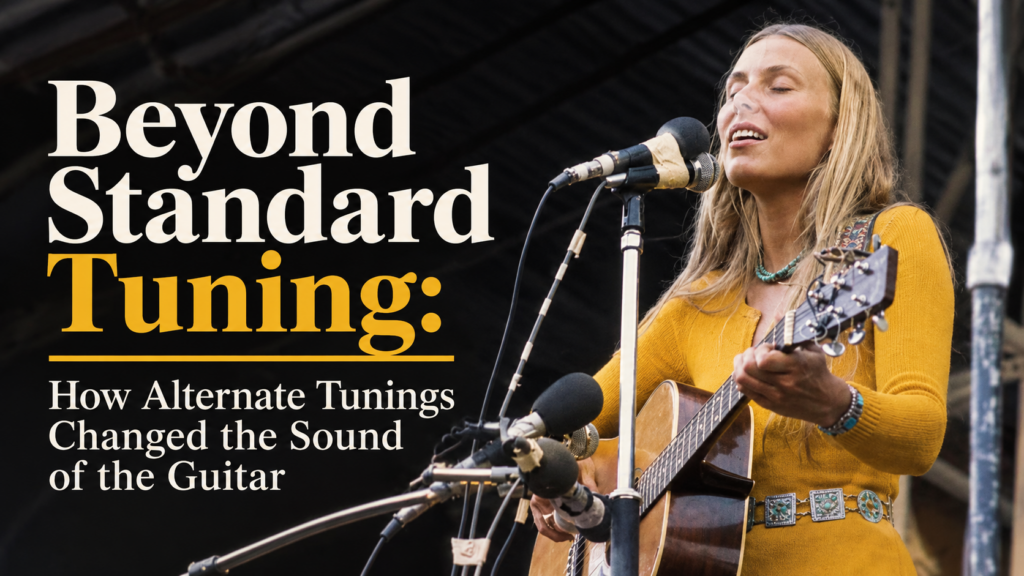
Joni Mitchell is a particularly interesting example.
Throughout her career, Mitchell used an extensive range of alternate tunings, allowing her to explore unusual chord voicings and melodic relationships that would have been difficult to achieve in standard tuning.
Her approach helped create a distinctive musical language, demonstrating that the guitar could be used in ways that went far beyond conventional chord shapes.
Similarly, Sonic Youth became well known for experimenting with unconventional guitar tunings, often using unusual string arrangements to produce dissonant textures and sounds that challenged traditional ideas about guitar music.
Their approach was particularly influential within alternative rock, demonstrating that the guitar didn’t always need to conform to familiar musical structures.
These examples highlight one of the most interesting aspects of alternate tuning: it encourages musicians to think differently about the instrument itself.
The Practical Side: What Happens When You Change Tuning?
While alternate tunings offer plenty of creative possibilities, they can also affect the physical characteristics of a guitar.
Changing string tension alters the way the neck responds, which can influence action, relief and intonation.
Occasionally changing between standard and alternate tunings is generally straightforward, particularly when moving between tunings with relatively small differences in string tension.
However, instruments permanently set up for significantly lower or higher tunings may benefit from adjustments to their setup.
String gauge is another important consideration.
A thicker set of strings can help maintain tension when tuning down, providing a firmer playing feel and improving tuning stability.
Nut slots may also need attention if a guitar is regularly used with heavier strings, as strings that don’t sit correctly can cause tuning problems.
For musicians who frequently switch between very different tunings, owning a dedicated guitar for each setup can be a practical solution.
This is particularly common among professional touring musicians, who may use several instruments throughout a performance.
Ultimately, the right approach depends on how frequently the tuning changes and how much the player values consistency.
Why Alternate Tunings Still Matter
Despite the availability of increasingly sophisticated guitar equipment, alternate tunings remain one of the simplest and most effective ways to explore new musical ideas.
They don’t require expensive equipment, complicated electronics or specialist effects. In many cases, all that’s needed is a tuner and a willingness to experiment.
For beginners, exploring an alternate tuning can be an excellent way to break away from familiar chord shapes and develop a different understanding of the fretboard.
For experienced players, it can provide a fresh approach to songwriting and composition.
Perhaps most importantly, alternate tunings have helped establish some of the most distinctive guitar sounds in music history.
From Keith Richards’ unmistakable open G riffs to the atmospheric textures of Led Zeppelin and the heavier sounds of modern metal, changing the tuning has allowed musicians to push the instrument in entirely new directions.
Final Thoughts
Standard tuning will always be the foundation for much of modern guitar playing, but it certainly isn’t the only way to approach the instrument.
The history of alternate tunings demonstrates just how versatile the guitar can be, with different string arrangements helping to shape everything from traditional blues and folk to progressive rock and modern metal.
Some musicians have used them to create entirely new playing techniques, while others have simply discovered different ways of expressing familiar musical ideas.
Either way, alternate tunings have played a significant role in expanding the possibilities of the guitar.
For anyone looking to explore a different side of their instrument, experimenting with a new tuning could be the perfect place to start. Sometimes, all it takes is a small adjustment to discover an entirely different sound.