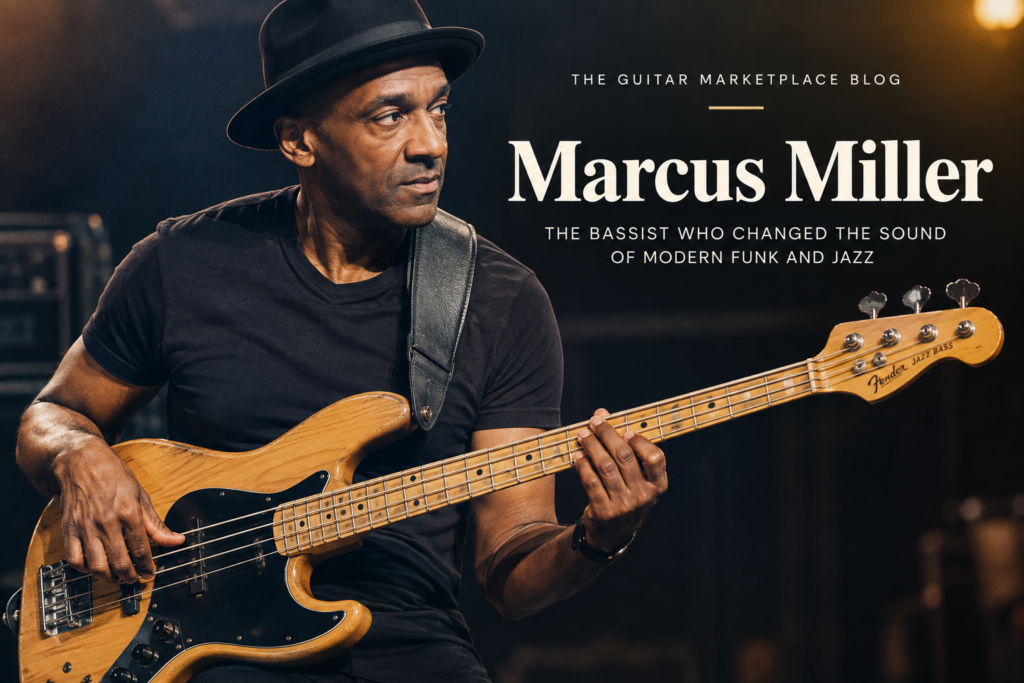
Few bass players have had quite the influence of Marcus Miller.
As a bassist, songwriter, producer, arranger, and composer, Miller has spent more than four decades working at the highest level of popular music. His playing has appeared alongside artists including Miles Davis, Luther Vandross, David Sanborn, Herbie Hancock, and a long list of major names from jazz, R&B, soul, and pop.
Yet for all of those collaborations, Miller’s sound remains remarkably easy to identify.
Much of that comes down to one particular instrument: a 1977 Fender Jazz Bass that Miller has used throughout his career. With its distinctive natural finish, modified electronics, Badass bridge, and unmistakable tone, the bass has become almost as closely associated with Miller as his thumb technique and instantly recognisable grooves.
But the story of Marcus Miller is about much more than one bass.
From Brooklyn to the New York Session Scene
William Henry Marcus Miller Jr. was born in Brooklyn, New York, in 1959 and grew up in Jamaica, Queens, surrounded by music.
His father was an organist and choir director, while his wider family also had strong musical connections. Miller was exposed to classical music, gospel, jazz, and soul from an early age, developing an interest in several instruments before eventually making the bass his main focus.
By his teenage years, Miller was already working as a professional musician in New York.
This was an important period in the development of his playing. Rather than concentrating exclusively on one style, Miller became a highly versatile session musician. He worked across jazz, R&B, soul, and pop, learning how to adapt his playing to whatever the music required.
That experience would become one of the defining characteristics of his career.
Miller was not simply interested in playing impressive bass lines. He developed an understanding of arrangement, songwriting, production, and the role that every instrument plays within a recording.
That versatility eventually made him one of the most in demand session musicians in New York.
The 1977 Fender Jazz Bass
For many musicians, the story of Marcus Miller begins with his Fender Jazz Bass.
Miller’s relationship with the Jazz Bass began when he was a teenager. After losing an earlier Fender, he acquired a natural finish 1977 Jazz Bass that would eventually become his main instrument.
At first glance, it was hardly an exotic instrument.
It was a Fender Jazz Bass.
But Miller’s modifications helped transform it into something much more distinctive.
The bass was originally fitted with Fender’s standard electronics, but Miller eventually took it to New York luthier Roger Sadowsky. Sadowsky installed an active preamp, and the instrument was later fitted with a Bartolini TCT preamp. The bridge was also replaced with a Badass bridge, while the large pickguard became one of the bass’s most recognisable visual features.
The result was a Jazz Bass capable of producing a huge range of sounds while retaining the fundamental character of the instrument.
For Miller, that versatility was crucial.
He has spoken about choosing the Jazz Bass partly because of its two pickups and slimmer neck compared with the Precision Bass. More importantly, he learned to make one instrument work across a huge range of musical situations rather than constantly changing basses.
That philosophy became central to his approach.
Finding His Voice
Miller’s early influences included some of the most important bass players in the history of modern music.
James Jamerson, Larry Graham, and Jaco Pastorius were among the players who influenced him, while the Fender Precision and Jazz Bass became important parts of the vocabulary from which he developed his own sound.
But Miller did not simply copy those players.
One of the most interesting parts of his development came when he began working with Miles Davis.
Miller joined Davis’s touring band in the early 1980s, an opportunity that forced him to reconsider how he approached the instrument. Davis had his own very particular ideas about space, rhythm, arrangement, and musical communication.
Miller has explained that playing like his heroes was not necessarily going to work within Davis’s music. He had to find his own voice.
That experience became hugely important.
Rather than treating the bass as an instrument that simply provided the foundation, Miller increasingly used it as an expressive voice within the arrangement.
He could lock into a deep pocket, add melodic movement, provide harmonic information, or step forward with a solo without losing the groove underneath it.
That combination became one of his trademarks.
Miles Davis and Tutu
Miller’s relationship with Miles Davis remains one of the defining chapters of his career.
Although he was not simply Davis’s bass player, Miller became an important collaborator in the studio, contributing as a songwriter, producer, and arranger as well as a musician.
One of the most famous results was Tutu, Davis’s 1986 album.
Miller was heavily involved in the writing and production of the record, helping create the contemporary jazz sound that defined the album. He also contributed to Davis projects including Music from Siesta and Amandla.
Tutu demonstrated just how much Miller had developed beyond the role of a traditional session bassist.
His bass playing was obviously important, but so was his understanding of production and technology. The album incorporated synthesised sounds, programmed elements, electronic textures, and contemporary R&B influences alongside Davis’s trumpet.
Miller was helping to bridge the gap between traditional jazz and the increasingly electronic sound of the 1980s.
Luther Vandross and the Art of the Session
Another hugely important part of Miller’s career came through his work with Luther Vandross.
Miller and Vandross developed a long-running creative partnership, with Miller contributing as a bassist, songwriter, arranger, and producer. Their collaboration produced numerous songs and recordings and helped establish Miller as one of the most accomplished musicians working behind the scenes in R&B.
This side of Miller’s career is particularly interesting because it demonstrates that his reputation was never based solely on his ability to play bass.
A great session musician needs to understand the song.
They need to know when to play, when not to play, how to support a vocalist, and how to create a part that serves the arrangement rather than competing with it.
Miller’s career is full of examples of that philosophy.
His bass lines can be technically spectacular, but they are almost always rooted in the groove.
The Marcus Miller Sound
So, what actually makes Marcus Miller’s tone so recognisable?
Part of it is the instrument.
The modified 1977 Fender Jazz Bass gives Miller a powerful combination of clarity, low end, midrange presence, and attack. The active preamp provides additional control over the frequency spectrum, while the Jazz Bass pickup configuration gives him plenty of tonal flexibility.
But the equipment is only part of the equation.
Miller’s right hand is arguably just as important.
His thumb technique produces a powerful, percussive attack that can make individual notes sound almost like they have been played with a pick. He combines this with ghost notes, slides, hammer-ons, pull-offs, harmonics, and extremely precise rhythmic placement.
The result is a sound that can be both aggressive and incredibly controlled.
It is a tone that works particularly well in funk because every note can carry rhythmic information.
Listen closely to Miller and the bass is rarely just sitting underneath the drums.
It is interacting with them.
More Than a Bass Player
Miller’s career eventually developed into something much broader than session work.
He began releasing music under his own name, establishing himself as a bandleader and composer as well as a bassist.
His solo catalogue includes albums such as The Sun Don’t Lie, M², Marcus, Renaissance, Afrodeezia, and Laid Black.
These records gave Miller the opportunity to put the bass at the centre of the music.
Rather than simply supporting another artist, he could build entire compositions around his own ideas about rhythm, harmony, melody, and production.
His 2001 album M² went on to win the Grammy Award for Best Contemporary Jazz Album, further establishing his position as one of the leading figures in modern jazz.
Miller has also worked as a composer for film and television, demonstrating once again how broad his musical interests have become.
The Birth of the Signature Bass
Given how closely Marcus Miller had become associated with his 1977 Jazz Bass, it was perhaps inevitable that the instrument would eventually become a signature model.
Fender introduced a Marcus Miller Signature Jazz Bass in 1998, based heavily on the specifications and modifications of his own instrument.
The concept was relatively straightforward.
Take a classic Fender design, then incorporate the features that Miller had spent years refining.
The result included an active EQ system, Badass-style bridge, and styling inspired by Miller’s own bass.
It was an interesting example of something that happens regularly in the guitar and bass world.
A player modifies an instrument to solve their own problems.
Other musicians hear the result.
Eventually, the modifications become part of the instrument’s identity.
From Fender to Sire
Miller’s signature bass journey later took another interesting turn.
In 2015, he began working with Sire Guitars, helping develop a range of Marcus Miller instruments intended to bring his preferred specifications and approach to a wider audience.
The Sire Marcus Miller range became particularly notable because it brought many of the features associated with Miller’s sound into instruments available at considerably different price points from traditional American-made signature models.
Miller has continued to use Fender instruments, including his original Jazz Bass, while also incorporating Sire basses into his setup.
It is another reflection of his approach to equipment.
The brand matters, but the ability of the instrument to perform a particular musical job matters more.
Why Marcus Miller Still Matters
Marcus Miller’s influence can be heard throughout modern bass playing.
His combination of funk, jazz, R&B, slap, fingerstyle technique, melodic playing, and studio production has influenced generations of musicians.
But perhaps the most important part of his legacy is that he demonstrated how much more the bass could do.
The bass can provide the foundation.
It can also provide melody.
It can drive the rhythm, communicate with the drums, shape the harmony, and become a lead instrument without losing its place within the song.
Miller has spent his career moving between those roles.
And through all of it, that 1977 Fender Jazz Bass has remained a constant.
There are plenty of technically accomplished bass players.
There are plenty of great session musicians.
There are plenty of successful producers.
Marcus Miller has managed to become all three.
His career is therefore about much more than a famous Fender Jazz Bass or a distinctive thumb technique. It is the story of a musician who understood that great playing is ultimately about serving the music, whether that meant locking into a groove behind Luther Vandross, creating something completely new with Miles Davis, producing a record, or stepping forward as a bandleader.
That is why the Marcus Miller sound remains so recognisable.