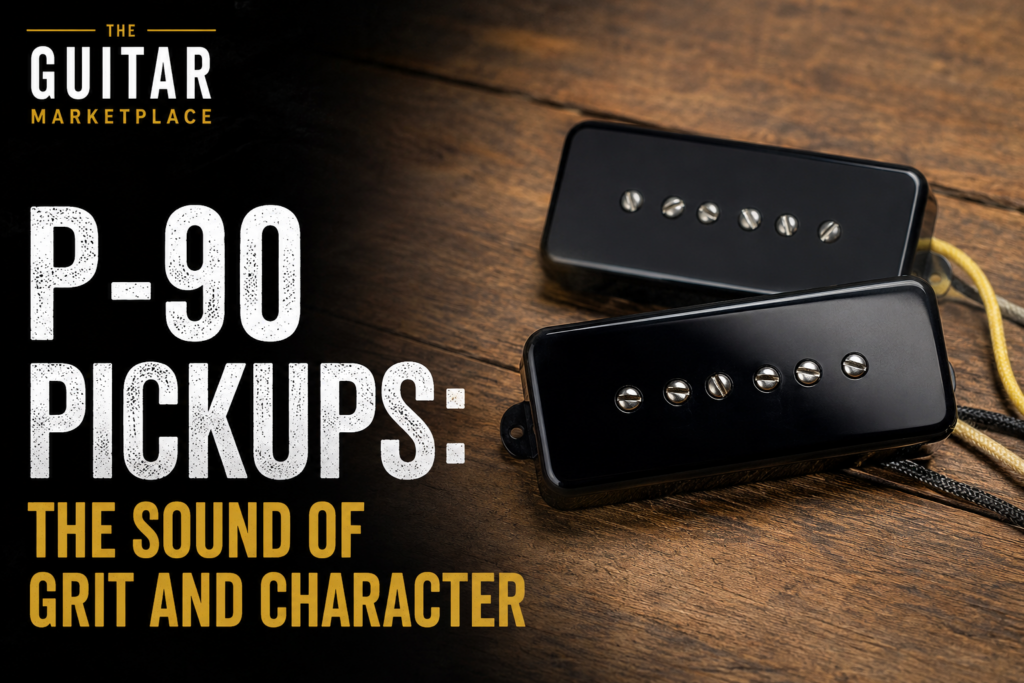
There’s something about a P-90.
They’ve been around for decades, found their way onto countless great guitars, and yet they still have a sound that feels completely their own. Raw, punchy and full of character, P-90s have become a firm favourite for guitarists who want a little more attitude from their instrument.
A Brief History of the P-90
Gibson introduced the P-90 in the 1940s, and it soon became a big part of the company’s sound.
You’ll find them on some seriously iconic guitars, including the Les Paul Goldtop, Les Paul Junior, Les Paul Special and ES-330. They’ve also appeared on plenty of guitars from other manufacturers over the years, proving that the P-90 is far from being a one-trick pony.
The basic design has remained remarkably consistent, too. A wide single-coil with bar magnets underneath gives the P-90 its distinctive combination of power, warmth and bite.
What Does a P-90 Sound Like?
The easiest way to describe a P-90 is probably gritty.
Clean, they have plenty of clarity and a lovely warmth to them. Start pushing your amp, though, and they really come alive. There’s a growl and bite to the sound that works brilliantly for blues, rock, punk, garage and pretty much anything that benefits from a bit of edge.
They’re also very responsive to the way you play. Dig into the strings and you’ll get more aggression; back off your picking and volume control and they’ll clean up nicely.
That dynamic response is a big part of what makes them so much fun to play.
What Guitars Use P-90s?
The P-90 is particularly associated with Gibson, and for good reason.
Some of the best-known P-90-equipped guitars include:
- Gibson Les Paul Goldtop
- Gibson Les Paul Junior
- Gibson Les Paul Special
- Gibson ES-330
- Gibson SG Special
- Epiphone Casino
Of course, plenty of modern manufacturers have put their own spin on the P-90, so there’s no shortage of options if you like the sound but want something a little different.
Do P-90s Hum?
Yes — and that’s worth knowing before you buy one.
As a single-coil pickup, a P-90 can pick up electromagnetic interference, resulting in some background hum. How noticeable it is depends on your guitar, amp and surroundings.
For many players, it’s simply part of the deal. There are also plenty of modern P-90 designs that aim to reduce the noise while keeping the character of the original.
Why Are P-90s Still So Popular?
It’s simple really: they sound great.
The P-90 has managed to stay relevant for decades because it offers a combination of warmth, bite, dynamics and grit that’s hard to replicate.
They’re not trying to be the quietest or most technically advanced pickup out there. They just have a sound and feel that works.
And sometimes, that’s all you really need from a guitar.
If you like your tone with a bit of grit, a bit of growl and plenty of personality, it’s well worth giving P-90s a try.