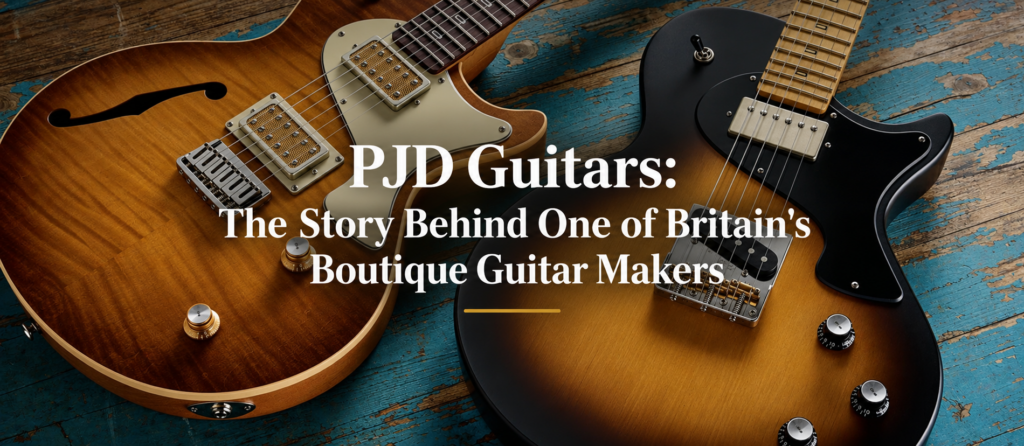
There is something special about a guitar that has been built with the player in mind from the very beginning. While the biggest names in the guitar world have become household names through decades of history, a growing number of British builders are proving that there is still plenty of room for smaller makers to do things their own way.
One of those makers is PJD Guitars.
Based in Yorkshire, PJD has developed a reputation for producing distinctive, carefully considered electric guitars that combine traditional craftsmanship with modern playability. From the striking St John to the Carey, York, Woodford, Romulus, and Valhalla models, PJD has built a range that feels familiar enough to be immediately accessible, while still having a character of its own.
And although the company has grown considerably since its beginnings, the story of PJD Guitars starts in a much smaller workshop.
From the Royal Opera House to Guitar Building
PJD Guitars was founded in 2010 by Leigh Dovey. The name PJD is a tribute to Leigh’s late father, who worked as a prop maker at the Royal Opera House in London’s Covent Garden.
That connection to traditional craftsmanship would prove important.
Leigh inherited his father’s woodworking knowledge, tools, and a small home workshop. During the day, he worked as a sound and video engineer at the Royal Opera House, while his evenings were spent developing his skills as a guitar builder.
It was a combination of technical knowledge, woodworking, and a passion for guitars that eventually led to PJD becoming a fully fledged guitar company.
Early opportunities to work with professional musicians helped Leigh refine his approach and develop confidence in his own instruments. Rather than attempting to simply reproduce established designs, PJD gradually developed its own ideas about what a modern British guitar could be.
In 2017, the company moved to a larger workshop in York, providing the space to expand production and continue developing the range.
Today, PJD describes its instruments as being focused on craftsmanship, playability, and a distinctive voice. Those three ideas run through the company’s range.
The PJD Approach
Look through the PJD catalogue and there is an obvious appreciation for classic electric guitar design.
There are single cut guitars, offset designs, more contemporary shapes, and plenty of familiar ingredients. But PJD’s instruments aren’t simply exercises in nostalgia.
The company’s Custom Shop gives players the opportunity to work directly with PJD to create highly individual instruments. Finishes, inlays, neck profiles, pickup configurations, hardware, and even more unusual construction options can be specified as part of the process.
This is where the boutique nature of PJD becomes particularly apparent.
Rather than taking an established formula and producing one specification for everyone, the Custom Shop is built around the idea that the guitar should suit the person playing it. PJD says that the process runs from the initial concept through to the final setup, with the aim of creating an instrument that reflects the player’s requirements.
For guitarists who spend a lot of time thinking about neck shape, pickup combinations, finishes, woods, and hardware, that level of involvement can be a big part of the appeal.
The St John
One of the most recognisable guitars in the PJD range is the St John.
Its offset body gives it an immediately distinctive appearance, while its specifications are aimed firmly at the working guitarist. The model has appeared in several different configurations, from the higher specification Custom Shop instruments to the more accessible Origin models.
The St John is a good example of what PJD does particularly well. It takes some of the visual language associated with classic offset guitars, but approaches it from the perspective of a modern British builder.
The result is a guitar that doesn’t need to rely on a famous logo or vintage pedigree to stand out.
The Guitar Marketplace has already featured the St John on several occasions, including a St John Standard in Firemist Gold and an Origin Series St John Pro in Sea Blue. The current PJD St John Elite featured by The Guitar Marketplace combines an alder body and quilted maple top with a roasted maple neck, rosewood fingerboard, a PJD P90 in the neck, and a PJD humbucker in the bridge.
The Carey
If the St John represents PJD’s take on the offset guitar, the Carey takes things in a more familiar single cut direction.
The Carey has been developed around the idea of a classic single cut guitar, but with the refinements and construction choices that have become part of PJD’s identity.
The current Carey Classic, for example, uses a chambered swamp ash body, roasted maple neck, and a choice of rosewood or maple fingerboard. Its pickup combination pairs a PJD Scam 59 humbucker with a Fat Nacho P90.
It is a combination that gives the Carey plenty of tonal territory to explore, while retaining the straightforward controls and familiar feel that make this style of guitar so popular.
The Carey is also available in the Origin range, bringing the basic concept to a considerably more accessible price point.
Building a More Accessible PJD
Boutique guitars are, by their nature, not always accessible to every guitarist.
PJD has addressed that with the Origin Series.
The idea behind Origin is not simply to make cheaper versions of the Custom Shop guitars. PJD describes the range as an opportunity to bring the feel, balance, and character of its instruments to a wider audience, using carefully selected manufacturing partners while retaining PJD’s designs and specifications.
The range currently includes models such as the Carey Origin, St John Origin, York Origin, and Woodford Origin, with bass versions of the St John also available.
Prices vary across the range, with current Origin models including the £499 Apprentice, £599 Standard, and £799 Pro versions.
The St John Origin Pro, for example, uses a mahogany body, a bound flame maple veneer neck, Indian rosewood fingerboard, and a pair of Alnico V humbuckers. PJD describes the pickups as being voiced around vintage PAF characteristics, while the guitar itself uses a 10 inch radius, hardtail bridge, and PJD Standard neck profile.
That means the Origin Series isn’t simply about getting the PJD aesthetic for less money. It is an attempt to translate the company’s design philosophy into a format that can be enjoyed by a much broader range of players.
More Than One Style of Guitar
Although the St John and Carey may be among the most recognisable PJD models, the company’s catalogue extends considerably further.
The York provides another take on the classic electric guitar, while the Woodford offers a more modern double cut design. The Romulus and Valhalla take PJD into other territory again.
That variety is important because it demonstrates that PJD isn’t tied to one particular interpretation of the electric guitar.
The common thread is the approach to construction and playability rather than a single body shape.
PJD also produces its own range of pickups, including humbuckers, P90s, Strat style sets, and other designs. This allows the company to control another important part of the instrument’s character rather than relying entirely on third party electronics.
British Made, With a Modern Outlook
There is an interesting story developing in British guitar building.
For decades, the conversation around British guitar manufacturing has inevitably included names such as Burns, Watkins, Vox, and the many smaller builders that emerged throughout the twentieth century. Today, companies such as PJD are part of a new generation of British makers continuing that tradition.
What makes PJD particularly interesting is that the company doesn’t appear interested in simply recreating the past.
There is obvious respect for the guitars that came before, but the instruments are designed around contemporary players. Modern neck profiles, carefully selected hardware, alternative pickup combinations, chambering, custom finishes, and more individualised specifications all have a place within the PJD approach.
It is less about recreating a particular year of guitar history and more about asking what a great guitar should feel like today.
Why PJD Matters
The guitar industry has never been short of choice.
Walk into any major guitar shop and you will find instruments from some of the biggest manufacturers in the world, alongside increasingly impressive affordable alternatives. So why choose a smaller British builder?
For PJD, the answer appears to be individuality.
A PJD guitar has a recognisable identity. The company’s designs aren’t simply trying to disappear into a crowded market of familiar shapes. There is a deliberate attempt to create instruments that feel established without feeling predictable.
The Custom Shop takes that idea even further, allowing the player to become part of the design process.
At the other end of the range, Origin makes the same philosophy considerably more accessible.
That combination is perhaps what makes PJD so interesting. The company can build highly individual instruments for players who want something genuinely bespoke, while also producing more accessible guitars for players who simply want to experience what PJD is about.
A New Chapter in British Guitar Making
PJD Guitars may not have the century of history associated with some of the world’s most famous guitar manufacturers, but that is part of the appeal.
The company is still writing its story.
From a small home workshop and a background at the Royal Opera House, through the move to York and the development of an increasingly diverse range of guitars, PJD has established itself as an interesting name within the British guitar industry.
And perhaps most importantly, the guitars themselves don’t need an elaborate explanation.
Pick one up, plug it in, and the reason for the company’s growing reputation becomes much easier to understand.
For players looking beyond the usual names, PJD offers something increasingly valuable: a guitar with its own identity, built by people who clearly care about how it feels in the hands of the person playing it.
That is a tradition worth continuing.
And it is one that makes PJD Guitars a British guitar maker worth keeping an eye on.